


Quick Answer: Why Does the Lotus Sutra Matter in China?
The Lotus Sutra (法华经, Fǎhuá Jīng) is a Mahāyāna Buddhist scripture whose Chinese translations helped shape Buddhist teaching, devotion and art. The version linked to Kumarajiva is traditionally dated to 406.[1][3]
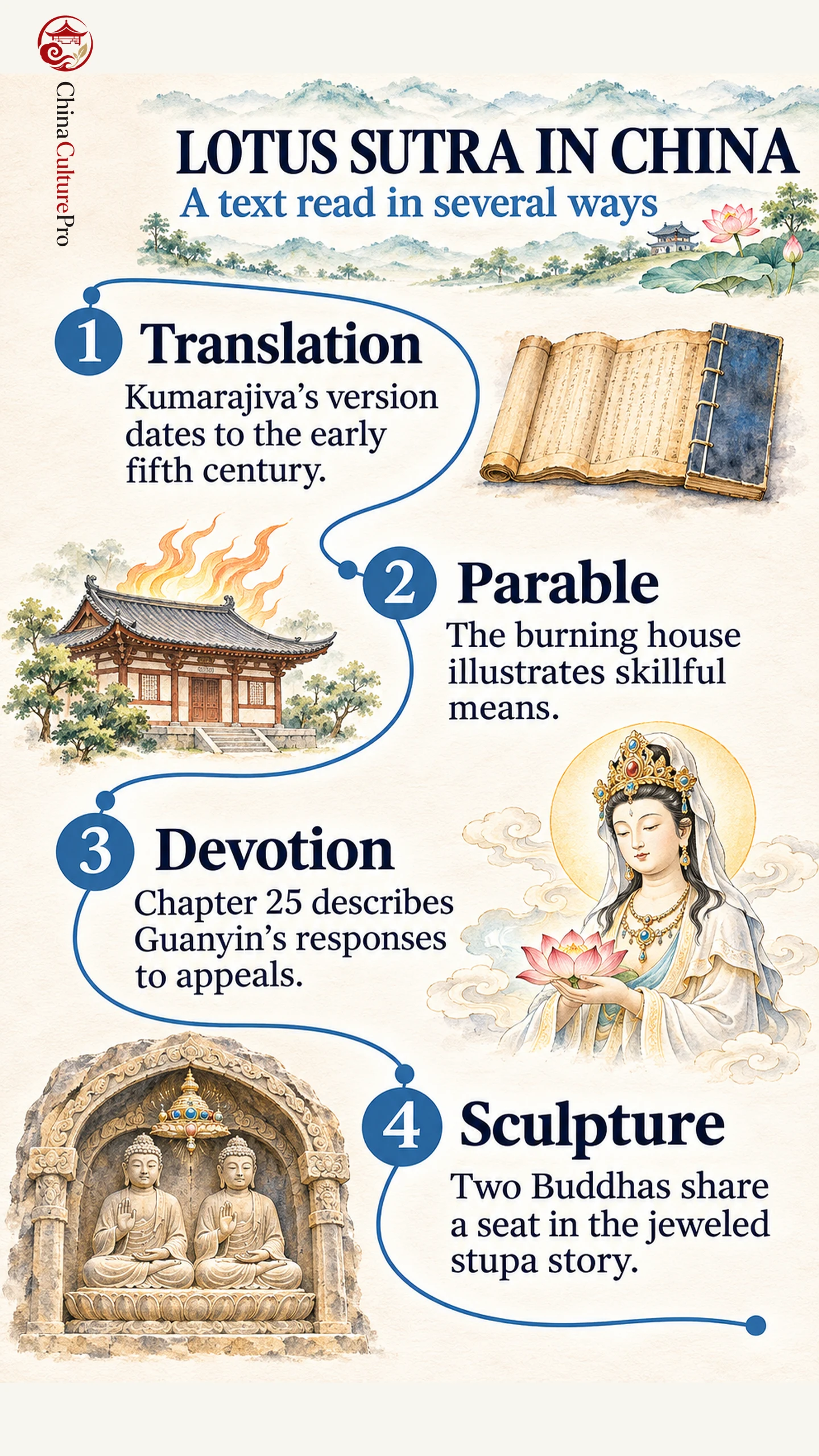
- Teaching: A burning house parable illustrates skillful means (方便, fāngbiàn).[1]
- Devotion: A chapter about Guanyin (观音, Guānyīn) circulated separately in China.[2]
- Art: Two seated Buddhas can represent the episode of the jeweled stupa.[4][5]
The three examples show how different parts of the same book reached readers and worshippers.
The Lotus Sutra (法华经, Fǎhuá Jīng) contains parables, promises of awakening and accounts of sacred figures responding to people in need. A reader might encounter the whole scripture, a single chapter or a carved scene. Each offers a different way into the text.
How the Lotus Sutra Circulated in China
Several Chinese translations survive. The version associated with Kumarajiva took shape in the early fifth century. Its account of multiple teachings leading toward one Buddha vehicle became especially important to Chinese interpreters, including those associated with Tiantai Buddhism.[1][3]
What the Burning House Parable Teaches
Skillful means (方便, fāngbiàn) refers to teaching in a way adapted to the people receiving it. In one parable, a father promises different carts to persuade his children to leave a burning house. Once outside, they receive fine carts of a single kind. The story connects different ways of drawing people toward Buddhist practice with a shared goal of buddhahood.[1]
Why Guanyin’s Chapter Circulated Separately
Chapter 25 presents Guanyin (观音, Guānyīn) responding to appeals in different circumstances and taking forms suited to those who need help. The chapter’s circulation on its own made that teaching accessible as a text in its own right. The promises in it also help explain later forms of child-giving Guanyin imagery in China.[1][2]
Why Two Buddhas Sit Together
In the scripture, a jeweled stupa appears while Shakyamuni teaches. Prabhutaratna, or Many Treasures Buddha (多宝佛, Duōbǎo Fó), is inside and shares his seat with Shakyamuni. An Asian Art Museum marble stele dated 595 shows the pair side by side. The shared seat and details around them point to the scripture’s episode of a shared seat.[4][5]
FAQs About the Lotus Sutra in China
Who translated the best-known Chinese version?
The most widely used Chinese version is associated with Kumarajiva and is traditionally dated to 406. Other Chinese translations also survive.
What is the one vehicle?
It is the Buddha vehicle, the shared way toward buddhahood into which the scripture brings different paths of teaching.
Why is Guanyin important in the Lotus Sutra?
Chapter 25 depicts the bodhisattva responding to appeals and taking forms suited to those who need help. Readers in China also circulated the chapter separately.
Sources
[1] Bukkyō Dendō Kyōkai. The Lotus Sutra, translated by Tsugunari Kubo and Akira Yuyama
[2] University of British Columbia Press. The Lotus Sutra
[3] Journal of Chinese Religions. The Elevation of the Status of the Lotus Sūtra in the Panjiao Systems of China
[4] Asian Art Museum. Stele with the Buddha Shakyamuni and Prabhutaratna
[5] Asian Art Museum, Khan Academy. Stele with the Buddha Shakyamuni and Prabhutaratna