


Quick Answer: What Is the Water and Land Ritual?
The Water and Land Ritual (水陆法会, Shuǐlù Fǎhuì) is an elaborate Chinese Buddhist assembly. It uses recitation, offerings and the dedication of merit to address many kinds of beings, including the deceased. Paintings help make the different groups visible.[1][3]
- Scope: Water and land expresses the breadth of the beings addressed.[1]
- Space: Upper and lower assemblies organize different groups within the ceremony.[1][6]
- Art: Song paintings and Ming ensembles preserve examples of how the rite was pictured.[2][4]
A hanging scroll may be one part of a larger group of paintings used together.
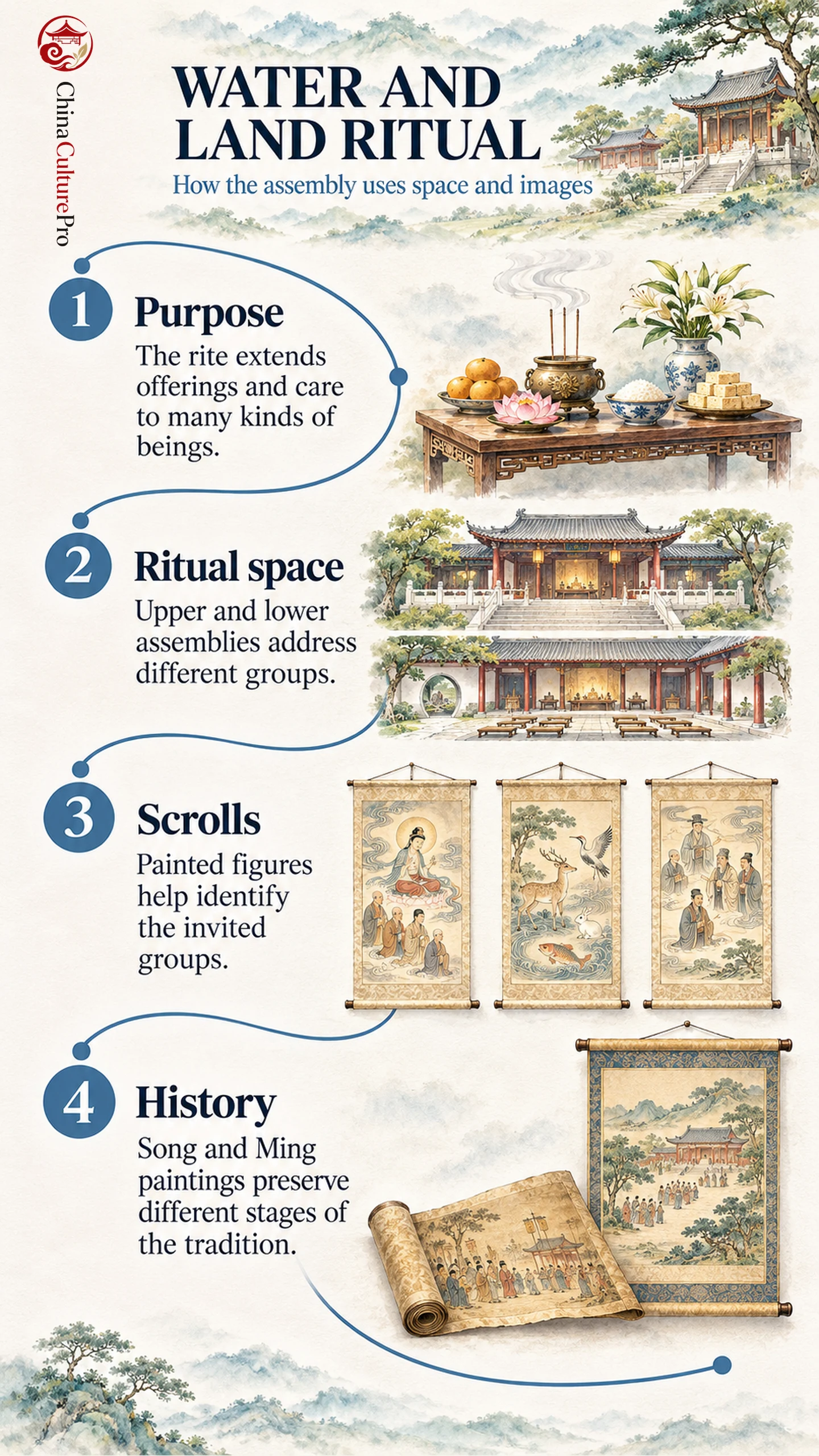
The Water and Land Ritual (水陆法会, Shuǐlù Fǎhuì) brings texts, participants, offerings and paintings into a single ceremony. A museum can display one scroll by itself. Its original ritual setting helps explain why the picture contains so many figures.
Who the Ritual Addresses
The ceremony developed over centuries, with important forms documented in the Song period. Its aim is often described as universal deliverance. Offerings and recitation extend care to a broad range of beings, including those understood to be suffering after death. The scope differs from the story and calendar focus of Ullambana, which connects offerings with a seventh-month observance.[1][2]
The dedication of merit also appears in Chinese Buddhist funeral rites, where the recitation may be directed toward a person who has died.
How Space and Paintings Organize the Assembly
An upper assembly (上堂, shàngtáng) honors figures such as buddhas and bodhisattvas. A lower assembly (下堂, xiàtáng) addresses other groups, including beings for whom aid is sought. The ritual can use different spaces within Buddhist temples. Paintings help distinguish the groups, and the arrangement can vary with the liturgy used.[1][4][6]
What Song and Ming Paintings Preserve
The Met’s early thirteenth-century Descent of Deities to Earth shows a procession led by five buddhas. Clouds carry them across the painting. The order of the figures lets a viewer follow the figures as one moving assembly.[2]
Ming paintings from Baoning Temple in Shanxi include the Four Heavenly Kings. Their attributes identify them within the set. Later museum displays bring works from several collections together and offer another view of how groups were organized.[3][4][5]
FAQs About the Water and Land Ritual
Does the name refer only to people who died in water?
The phrase expresses an inclusive scope. The ceremony addresses many kinds of beings across water and land.
Why are so many paintings involved?
Different paintings represent different groups addressed or invited in the ritual. Together they make the assembly visible.
Is it the same as the Buddhist seventh-month observance?
Both can involve offerings and care for the deceased. They have distinct texts, organization and ritual contexts.
Sources
[1] Hualin International Journal of Buddhist Studies. Liu Jingyu, Negotiating Boundaries: Shuilu Ritual Reforms in Late Imperial China
[2] The Metropolitan Museum of Art. Descent of Deities to Earth
[3] Guangdong Museum. Solemn and Inclusive: Chinese Shuilu Painting Art Exhibition
[4] Fo Guang Shan Buddha Museum. Meeting in the Dharma: Ming and Qing Dynasties Water and Land Dharma Service Paintings
[5] Religions. Lute, Sword, Snake, and Parasol
[6] University of Macau Library. Research on Shuilu paintings and the assembly of deities