


Quick Answer: What Is Huayan Buddhism?
Huayan Buddhism (华严宗, Huáyán Zōng) is a Chinese Buddhist tradition that takes its name from the Flower Garland Sutra (华严经, Huáyán Jīng). Its teachers used commentaries and analogies to explain a world in which phenomena arise in relation to one another.[1][2]
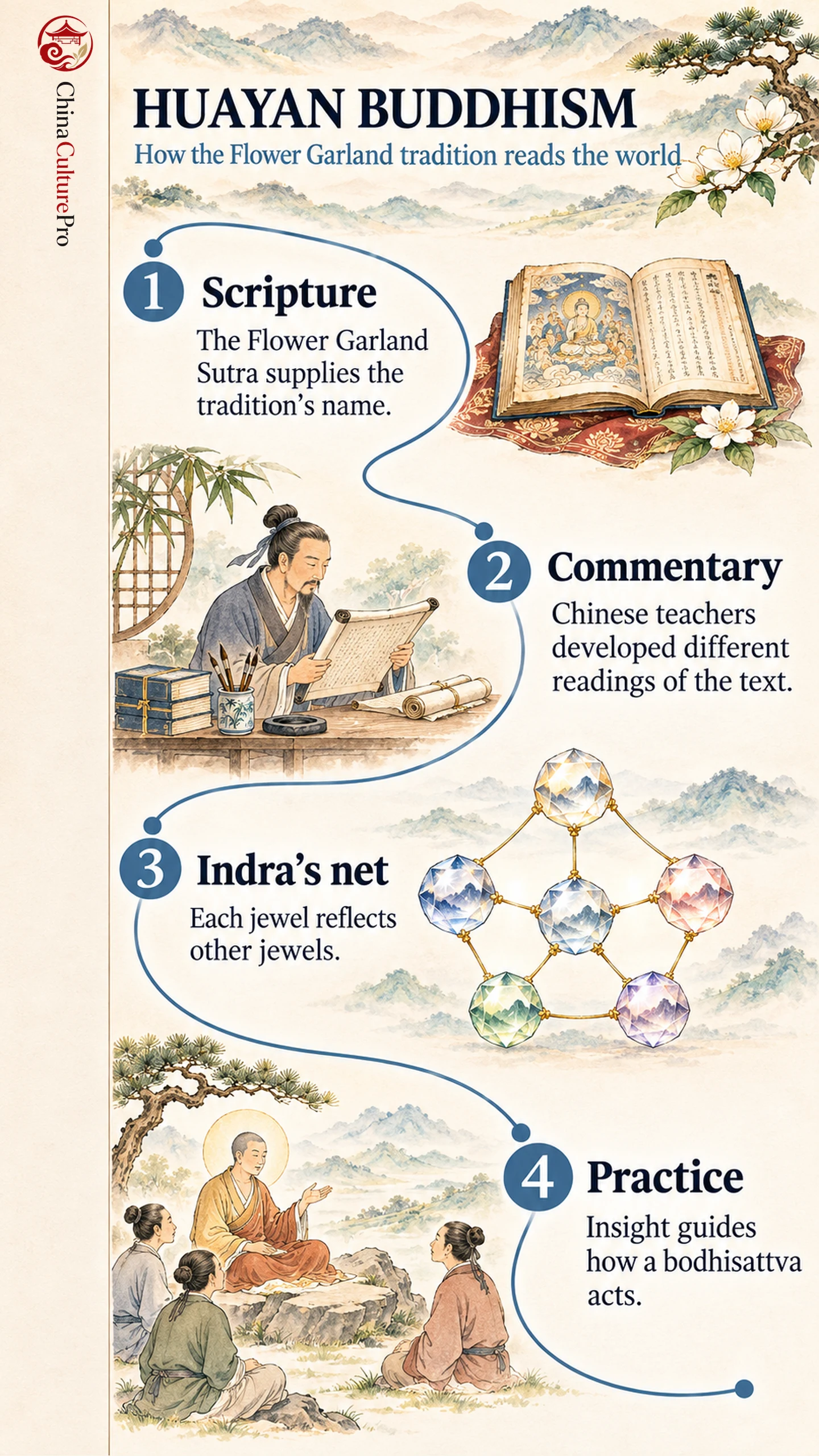
- Scripture: The Flower Garland Sutra presents a vast world of buddhas, bodhisattvas and Buddhist practice.[1]
- Commentary: Chinese teachers including Zhiyan, Fazang and Chengguan developed different explanations of the text.[3]
- Analogy: Indra’s net (因陀罗网, Yīntuóluó Wǎng) pictures jewels reflecting one another.[2]
The net helps a reader imagine what it means to understand one thing through its relations to many others.
Huayan Buddhism (华严宗, Huáyán Zōng) developed from the study of a translated scripture. Its Chinese teachers asked how a single event or object could express relations extending far beyond it. Their answers became part of a tradition of reading, teaching and practice.
How a Scripture Became a Chinese Tradition
The Flower Garland Sutra (华严经, Huáyán Jīng) supplied images, narratives and a name. Later lineage accounts list Dushun, Zhiyan, Fazang, Chengguan and Zongmi as five Chinese patriarchs. They did different kinds of work. Fazang developed arguments for mutual dependence and wrote major commentaries. Chengguan produced a later commentary that became influential in its own right.[1][3]
Teachers carried related approaches to Korea and Japan, where the traditions became known as Hwaeom and Kegon. Local teachers and institutions developed those traditions in their own settings.[1]
What Indra’s Net Helps Explain
Imagine a net with a jewel at each junction. In Indra’s net (因陀罗网, Yīntuóluó Wǎng), one jewel reflects the others, each of which contains reflections in turn. The individual jewel remains visible, yet what it shows depends on the larger arrangement. The image helps explain interpenetration, the idea that each phenomenon can be understood through the many others present in its relations.[2]
That perspective has an ethical purpose. To see oneself as dependent on others gives a basis for taking their suffering seriously. In Huayan writings, insight into how phenomena are related belongs with the compassion of a bodhisattva.[1]
How to Read Related Images
Vairocana (毗卢遮那佛, Pílúzhēnà Fó), a cosmic Buddha associated with the sutra, can occupy the center of a religious assembly. A Ming silk painting at the Spencer Museum probably served as the central image of a larger set. Other works place Manjushri and Samantabhadra next to a different Buddha. A late Tang scroll in Cleveland identifies its central Buddha as Shakyamuni. To identify a particular group, check the central figure’s label, attributes and accompanying figures.[4][5]
FAQs About Huayan Buddhism
Is Huayan the same as the Flower Garland Sutra?
The Flower Garland Sutra is a scripture. Huayan is the Chinese Buddhist tradition whose teachers interpreted it alongside other works.
What does Indra’s net represent?
It represents mutual interpenetration. Each jewel reflects others, making the relationships of the whole visible in one part.
Was Huayan limited to China?
Huayan took shape in China and influenced related traditions in Korea and Japan. Its ideas also reached other Chinese traditions, including Chan.
Sources
[1] Stanford Encyclopedia of Philosophy. Huayan Buddhism
[2] Internet Encyclopedia of Philosophy. Fazang (Fa-tsang)
[3] Minnesota Zen Meditation Center. Huayan Buddhism
[4] Spencer Museum of Art. Vairocana, 1454
[5] Cleveland Museum of Art. Shakyamuni Triad: Buddha Attended by Manjushri and Samantabhadra