


Quick Answer: Who Was Huineng?
Huineng (慧能, Huìnéng), who died in 713, was a Chinese Buddhist teacher remembered as the Sixth Patriarch (六祖, Liùzǔ) of Chan. His reputation grew after his death through the work of Shenhui (神会, Shénhuì) and texts such as the Platform Sutra (坛经, Tánjīng).[1][3]
- Historical teacher: He studied with Hongren and taught in southern China.[1]
- Textual figure: The Platform Sutra presents him as a southerner who challenges assumptions about access to awakening.[2]
- Painted figure: A Southern Song scroll by Liang Kai shows him cutting bamboo.[4][5]
The early historical evidence and the later stories illuminate different parts of his reputation.
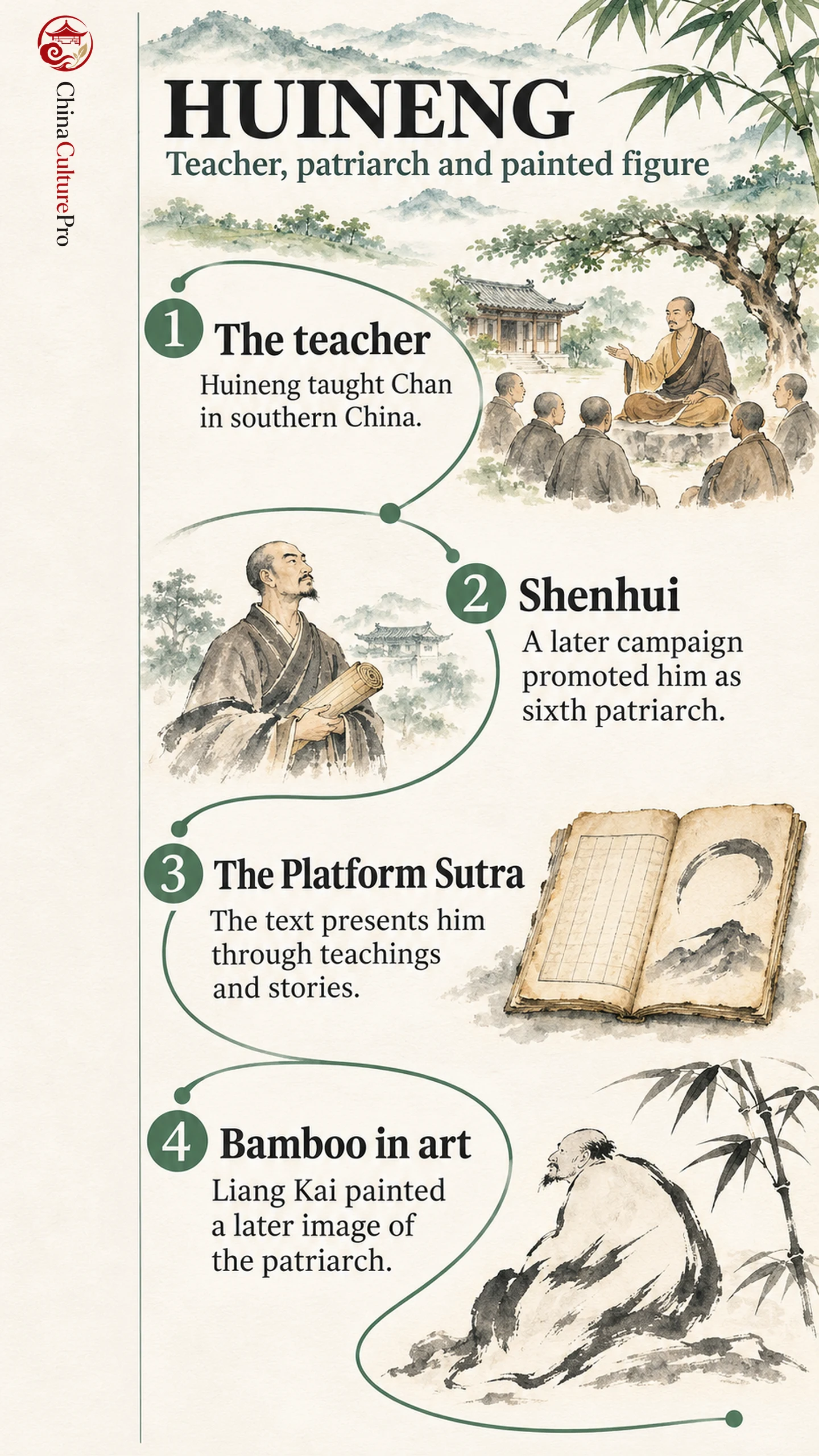
Huineng (慧能, Huìnéng) appears in Chinese Buddhist tradition as a southerner who rose to become the Sixth Patriarch (六祖, Liùzǔ). In later ink paintings he can be recognized by a small scene of ordinary work. The different images of the teacher belong to different moments in the growth of Chan tradition.
What Is Known About Huineng
The historical outlines are limited. Huineng studied with Hongren and taught in southern China. Decades later, Shenhui (神会, Shénhuì) promoted him as the legitimate sixth patriarch of Chan Buddhism. His campaign helped turn the remembered teacher into a central figure in disputes about who could represent the lineage.[1][3]
How the Platform Sutra Presents Him
The Platform Sutra (坛经, Tánjīng) tells of Huineng traveling from Lingnan to seek Hongren’s teaching. In the story, he answers a challenge based on his southern origin by saying that Buddha-nature has no regional boundary. A later scene puts his verses beside one attributed to Shenxiu. One image invokes the work of polishing a mirror, while Huineng’s response questions how dust could stain its original purity.[2]
The dialogue and verses make Huineng a figure who unsettles assumptions about social position and religious understanding. They reveal the text’s priorities even where the historical details of the episode are uncertain.[2][3]
Why Huineng Appears With Bamboo
Liang Kai’s Southern Song hanging scroll in the Tokyo National Museum shows Huineng cutting bamboo. Spare brushwork gives the everyday task a prominent place. A later Japanese painting by Kano Tan’yū reworks the scene as a parable of awakening in the midst of an ordinary action. The paintings show the same motif in Chinese and Japanese works made centuries apart.[4][5][6]
FAQs About Huineng
Why is Huineng called the sixth patriarch?
A later Chan lineage identified him as the sixth Chinese patriarch. Shenhui’s campaign helped establish that account.
Did Huineng write the Platform Sutra?
The text presents teachings attributed to Huineng. Its composition and transmission are separate questions from the historical teacher’s own words.
Why is there bamboo in pictures of Huineng?
The bamboo belongs to a later story of awakening during an everyday task. Liang Kai’s painting is a well-known example of the subject.
Sources
[1] Oxford Research Encyclopedia of Religion. John Jorgensen, Huineng
[2] Columbia University, Asia for Educators. Excerpts from the Platform Sutra of the Sixth Patriarch
[3] Stanford Encyclopedia of Philosophy. Chan Buddhism
[4] Tokyo National Museum. The Sixth Patriarch Cutting Bamboo
[5] Japan National Institutes for Cultural Heritage, e-Museum. The Sixth Patriarch Cutting the Bamboo
[6] The Metropolitan Museum of Art. The Sixth Patriarch of Zen at the Moment of Enlightenment