

Quick Answer: Who Is the Medicine Buddha?
The Medicine Buddha (药师佛, Yàoshī Fó), called Bhaisajyaguru in Sanskrit, is a Mahayana Buddha associated with vows to relieve suffering. His scripture places his realm in the east. One common rendering of its name is Pure Lapis Lazuli (净琉璃世界, Jìng Liúlí Shìjiè).[1][2]
- Scripture: One widely read Chinese translation is the 650 version by Xuanzang (玄奘, Xuánzàng), catalogued as T0450.[2]
- Vows: The twelve vows connect Buddhist awakening with needs such as relief from illness, food and clothing.[1]
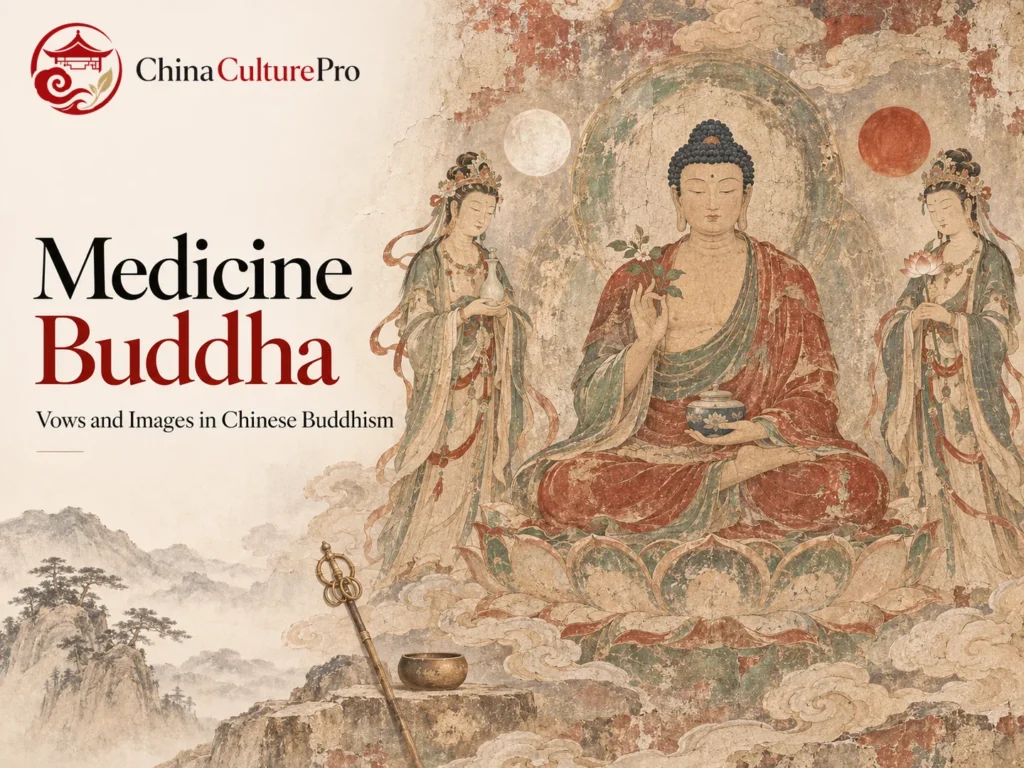
- Images: A medicine bowl, a monk’s staff and attendants marked by the sun and moon can help identify him.[4]
The texts express Buddhist aspirations. The details that identify the Buddha vary from one mural to another.

In one Yuan temple painting, the Medicine Buddha’s bowl is easy to miss because he is not holding it himself. Looking at the figures around him opens up the scene. At Dunhuang, lamps and dancers give another view of how a Chinese painter could picture a Medicine Buddha assembly.
What the Medicine Buddha’s Vows Address
The sutra presents the vows as promises made by Bhaisajyaguru when he was still a bodhisattva on the path to becoming a Buddha. The seventh focuses on people afflicted by illness who lack care and resources. The eleventh concerns hunger and the twelfth addresses a lack of clothing. By describing these needs alongside awakening, the scripture connects material hardship with a larger Buddhist account of suffering.[1]
The text describes an eastern Buddha land. The west is associated with Amitabha in another tradition, expressed in the Amitabha Sutra. In Cave 220 at Mogao, the two assemblies share a chamber and occupy different walls.[2][3]
Two Chinese Murals and Their Identifying Details
Lamps and Music at Dunhuang
In an early example of Chinese cave temple art, the Dunhuang Academy identifies seven Medicine Buddha images on the north wall of the main chamber of Mogao Cave 220. Nearby are guardian figures, musicians, dancers and a tiered lamp stand. The opposite wall presents Amitabha’s Western Pure Land. In these Dunhuang murals, the scenes occupy separate sides of the chamber.[3]
The Bowl and Staff at Guangsheng Temple
In a mural from the Lower Guangsheng Temple, now at the Met and dated around 1319, the central Buddha sits on a lotus throne. Look just below and to either side for the secondary figures carrying his bowl and staff. The sun and moon beside two attendants help identify the bodhisattvas Sunlight (日光菩萨, Rìguāng Púsà) and Moonlight (月光菩萨, Yuèguāng Púsà). The bowl, staff, sun and moon work together as clues in this painting.[4]
FAQs About the Medicine Buddha
What does Yaoshi Fo mean?
It means Medicine Buddha. The longer title refers to the light of a blue gemstone. English translations use lapis lazuli or blue beryl.
Is the Medicine Buddha always shown in blue?
Chinese paintings use different colors. The Guangsheng Temple figure wears red and green, while the bowl and staff appear with smaller figures nearby.
Are the twelve vows and the twelve generals the same thing?
The vows are aspirations attributed to the Buddha. The generals are guardian figures who appear in the scripture and at the sides of some painted assemblies.
Sources
[1] Dharma Drum Institute of Liberal Arts. Sutra of the Original Vows of the Medicine Buddha, parallel texts
[2] 84000. The Detailed Account of the Previous Aspirations of the Blessed Bhaisajyaguruvaiduryaprabha
[3] Dunhuang Academy. Digital Dunhuang, Mogao Grottoes Cave 220
[4] The Metropolitan Museum of Art. Buddha of Medicine Bhaishajyaguru (Yaoshi fo)