


Quick Answer: What Is Chinese Poetry?
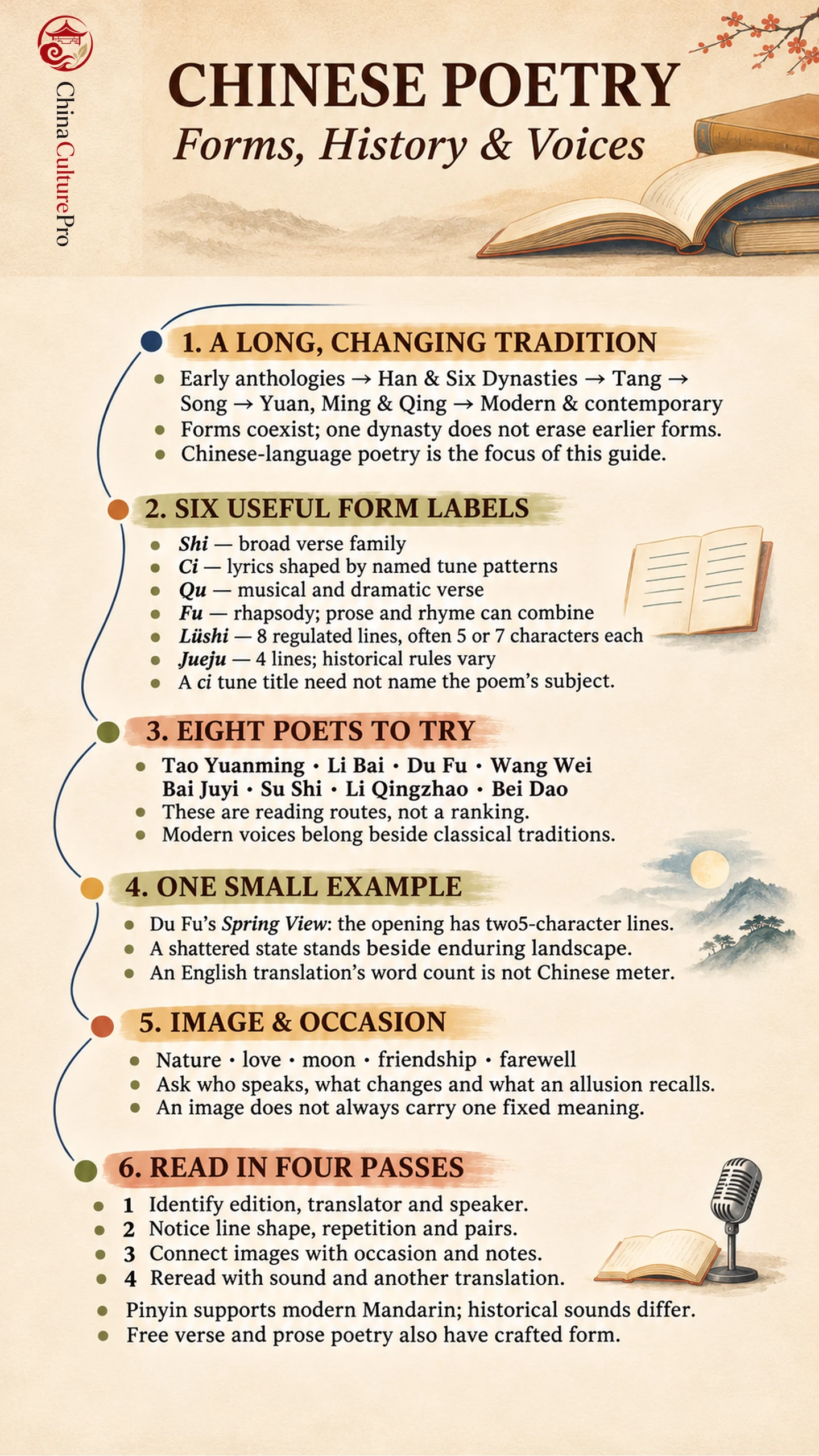
Chinese poetry is a long, changing field of written and performed literature, from early anthologies to classical verse, modern vernacular writing and contemporary experiments. Different periods use different forms; no single line length, subject or author represents the whole tradition.
- Shi (诗, shī): A broad word for poetry and a more specific family of verse forms.
- Ci (词, cí): Lyrics structured by named musical patterns.
- Qu (曲, qǔ): Verse connected with musical and dramatic traditions.
- Fu (赋, fù): Rhapsody, often combining descriptive prose and rhymed passages.[1]
This guide concerns Chinese-language poetry. It does not claim to represent every poetic tradition in every language spoken in China, or to make classical and modern writing follow identical rules.
A short poem can hold a landscape, an encounter and a change of feeling in very little space. Yet brevity is only one route into Chinese poetry. Longer narratives, intricate lyrics, expansive rhapsodies, public recitations and prose poems belong to the field too.
Start by asking three questions: when was the poem written, what form does it use, and what does its speaker seem to be doing? Those questions connect a first reading with the wider Chinese literary tradition, without requiring a complete literary history before opening a poem.
Periods: A Tradition That Keeps Expanding
The periods below are a reading map. A form can become prominent in one period and continue to be written much later; the history is not a relay in which each dynasty discards its predecessor’s poetry.
| Period or setting | Useful orientation | Where to explore next |
|---|---|---|
| Early anthologies | The Book of Songs (诗经, Shījīng) gathers poems with roots in the early first millennium BCE. The Songs of Chu (楚辞, Chǔcí) offers another early poetic tradition. | Begin with the Book of Songs or the Songs of Chu. |
| Han (汉, Hàn) and Six Dynasties (六朝, Liù Cháo) | Rhapsody, Music Bureau writing or yuefu (乐府, yuèfǔ), five-character verse, landscape and personal voices develop in different settings. | Notice how music, description and the literary speaker shape different kinds of poem. |
| Tang (唐, Táng), 618–907 | Ancient-style and regulated verse coexist, with major achievements in short and longer poems. | Explore Tang poetry. |
| Song (宋, Sòng), 960–1279 | Ci flourishes alongside continued shi writing; the dynasty is not represented by lyrics alone. | Compare the forms through Song ci poetry. |
| Yuan (元, Yuán), Ming (明, Míng) and Qing (清, Qīng) | Qu, drama and continuing shi and ci traditions offer later routes through poetic history. | Look for continuity and variation rather than assuming poetry ends after its best-known medieval authors. |
| Modern and contemporary writing | New poetry (新诗, xīnshī) includes experiments with vernacular language, free verse, modernism, performance and prose poetry. | Place it within modern Chinese literature. |
The early anthologies are not the work of one poet. The Book of Songs contains 305 surviving poem texts, together with six additional titles whose texts are absent. Its repertoire includes social and ritual settings as well as intimate voices.[3]
Modern poetry also has its own history. Baihua (白话, báihuà), or vernacular writing, became central to early twentieth-century literary reform. Hu Shi (胡适, Hú Shì) argued for substantive contemporary writing and against automatic imitation of the ancients. Later developments include experiments in the 1930s and 1940s, modernist writing in Taiwan and Hong Kong, and the varied mainland poetry that followed the 1970s.[4][5]
These changes concern audiences and circulation as well as lines on a page. Recitation has mattered in modern public culture, and prose poetry continues to complicate the boundary between a poem and an ordinary prose paragraph.[12][13]
Major Forms and What Their Names Mean
A form gives a reader expectations to test. It does not supply a poem’s meaning by itself. These six labels are useful first distinctions:
| Label | Working definition |
|---|---|
| Shi | Poetry in a broad sense, or a particular verse family with ancient-style and regulated forms. |
| Ci | Lyrics composed to named tune patterns that prescribe a poem’s structure. |
| Qu | Song verse connected with musical patterns, including independent songs and dramatic traditions. |
| Fu | Rhapsody that can combine descriptive prose and rhymed passages. |
| Lüshi (律诗, lǜshī) | An eight-line regulated poem, commonly with five or seven characters per line, with tonal and parallel structures. |
| Jueju (绝句, juéjù) | A four-line poem, commonly with five or seven characters per line; not every historical quatrain follows the same strict rules. |
The labels operate at different levels: lüshi and jueju belong within the wider history of shi, rather than standing beside it as unrelated traditions. The comparison of shi, ci and qu develops the larger distinctions; the regulated verse guide explains the more specific structures.[1][14][15]
A ci tune title usually identifies a pattern, not necessarily the subject of the poem. A lyric under a familiar title can address a different occasion or emotion from another lyric using that same pattern. The original musical history and the surviving literary pattern are related questions, not proof that every old melody can now be reconstructed.[7][16]
Historical rhyme and tonal categories also require care. Modern Mandarin pronunciation and its four tones do not provide a complete reconstruction of medieval poetic sound. Recordings can help a reader hear a present-day reading while annotations explain historical features that pronunciation alone may conceal.[11]
Famous Poets: Eight Useful Starting Points
Choose by reading interest rather than treating these writers as a ranked list. Each has a broader range than the brief suggestion beside the name.
| Poet | One useful starting interest |
|---|---|
| Tao Yuanming (陶渊明, Táo Yuānmíng) | Rural life, cultivation and the choices involved in retreat from official life. |
| Li Bai (李白, Lǐ Bái) | Travel, friendship, striking imaginative scale and shifting poetic voices. |
| Du Fu (杜甫, Dù Fǔ) | Family, public disorder and the relationship between personal experience and historical crisis. |
| Wang Wei (王维, Wáng Wéi) | Landscape, perception and the interplay of movement, sound and stillness. |
| Bai Juyi (白居易, Bái Jūyì) | Narrative, social observation and the communication of feeling to a reader. |
| Su Shi (苏轼, Sū Shì) | Reflection, friendship and changing perspectives across several poetic forms. |
| Li Qingzhao (李清照, Lǐ Qīngzhào) | Ci lyrics in which objects, memory and intimate feeling can meet historical change. |
| Bei Dao (北岛, Běi Dǎo) | Modern poetic language, individual voice and questions of freedom and estrangement. |
Li Bai may appear as Li Po and Du Fu as Tu Fu in older English editions. Those spellings do not identify different poets. Modern work such as Bei Dao’s also shows why reading Chinese poetry cannot stop at a medieval dynasty.[8][9][10]
For women’s poetry, Li Qingzhao offers an important beginning rather than the whole subject. Her surviving work has a particular historical setting and a crafted literary voice; a lyric speaker should not automatically be equated with a complete diary of the poet’s life.[7]
How a Short Poem Makes Meaning
The opening of Du Fu’s Spring View (春望, Chūn Wàng) makes a useful small example. The following are its first two lines, not the complete poem. The English wording is a literal gloss written for this guide.[6]
| Chinese line | Modern Mandarin pinyin | Literal English gloss |
|---|---|---|
| 國破山河在 | Guó pò shān hé zài | The state is shattered; mountains and rivers remain. |
| 城春草木深 | Chéng chūn cǎo mù shēn | In the city in spring, grasses and trees grow thick. |
Each Chinese line has five characters. The English gloss needs more words because it makes grammatical relationships explicit. Counting English words would therefore not identify the Chinese meter.
The contrast also does interpretive work. The continued presence of the landscape stands beside political destruction; spring growth is not simply cheerful decoration. A familiar image changes meaning through its situation within the poem. The two lines do not require a claim that a mountain or season always carries one fixed symbolic message.
Other reading paths reveal similarly varied relationships between image and occasion:
- Intimate feeling: Love poems can use a speaker, setting or remembered encounter rather than a direct confession.
- Recurring images: Moon poetry can connect shared sight with separation, time or longing.
- Landscape and season: Nature poetry can concern labor, retreat, perception or public events as well as beauty.
- Social occasions: Friendship and farewell poems often emerge from a particular visit, departure or exchange.
A note may also reveal a literary allusion: a phrase can recall an earlier text without explaining that history inside the poem. Context can expand a reading, but it should be tested against the actual wording.[2]
Reading Chinese Poetry in English
Use four passes to give a short poem room to develop:
- Identify the edition and speaker: Note the poet, translator and date if supplied, then read the translation once without solving every reference.
- Notice the poem’s shape: Count the Chinese characters in each line when available, look for repetitions and paired structures, and note any stated form.
- Connect image with occasion: Ask what changes between the opening and ending, and use notes to test historical references or allusions.
- Reread with sound and comparison: Listen to a reliable reading if available and compare a second translation, observing where wording and emphasis differ.
A bilingual edition with commentary makes these passes easier even for a reader who does not know Chinese. A character-by-character gloss can illuminate compressed syntax, while a literary translation shows how one translator recreates rhythm, voice and movement in English. Neither should be mistaken for the only possible English version.[11]
Pinyin can support a Mandarin reading, but it is a romanization system rather than a translation or a recording of every historical pronunciation. Use audio and historical notes for different purposes.
Finally, short traditional wording is not automatically a poem. The distinction between idioms and proverbs helps separate lexical expressions from a verse text with its own form, speaker and occasion.
FAQs About Chinese Poetry
Are all Chinese poems written in five- or seven-character lines?
No. Those lengths are important in several classical forms, but early verse, ci, qu, rhapsody and modern writing follow other patterns too. Identify the form before assuming a line-length rule.[4][14][15][16]
Does Chinese poetry rhyme?
Much classical poetry uses rhyme, often with other formal constraints. The rhyme may depend on historical sound categories that modern Mandarin does not preserve completely. Modern poems can make different choices about rhyme and rhythm.[11]
Can I read Chinese poetry without knowing Chinese?
Yes. A translation with useful notes offers an entry point. Chinese text, pinyin and recordings add further ways to notice form and sound; you do not need to master them all before enjoying a poem.[11]
Is Chinese poetry mainly from the Tang dynasty?
The dynasty produced many famous works, but it is one part of a much longer history. Earlier anthologies, later lyrics and verse, and modern and contemporary writing all deserve their own reading paths.[3][4][7]
Sources
[1] Columbia University Press. How to Read Chinese Poetry: A Guided Anthology
[2] Columbia University Press. How to Read Chinese Poetry in Context
[3] Reed College, Hyong Rhew. Shijing
[4] Michelle Yeh, Wiley. Modern Poetry in Chinese: Challenges and Contingencies
[5] Hu Shi, Asia for Educators, Columbia University. A Preliminary Discussion of Literary Reform
[6] Du Fu, Chinese primary text via Wikisource. Spring View
[7] Li Qingzhao, Asia for Educators, Columbia University. Poem to the tune of Southern Song
[8] The Poetry Foundation. Du Fu
[9] The Poetry Foundation. Li Bai
[10] The Poetry Foundation. Bei Dao
[11] Columbia University Press. How to Read Chinese Poetry Workbook
[12] University of Hawai‘i Press, John A. Crespi. Voices in Revolution
[13] University of Hawai‘i Press, Nick Admussen. Recite and Refuse: Contemporary Chinese Prose Poetry
[14] Key Concepts in Chinese Thought and Culture. Lüshi: regulated verse
[15] Key Concepts in Chinese Thought and Culture. Jueju: quatrain
[16] Key Concepts in Chinese Thought and Culture. Ci: lyric