

Quick Answer: What Are Hungry Ghost Festival Offerings?
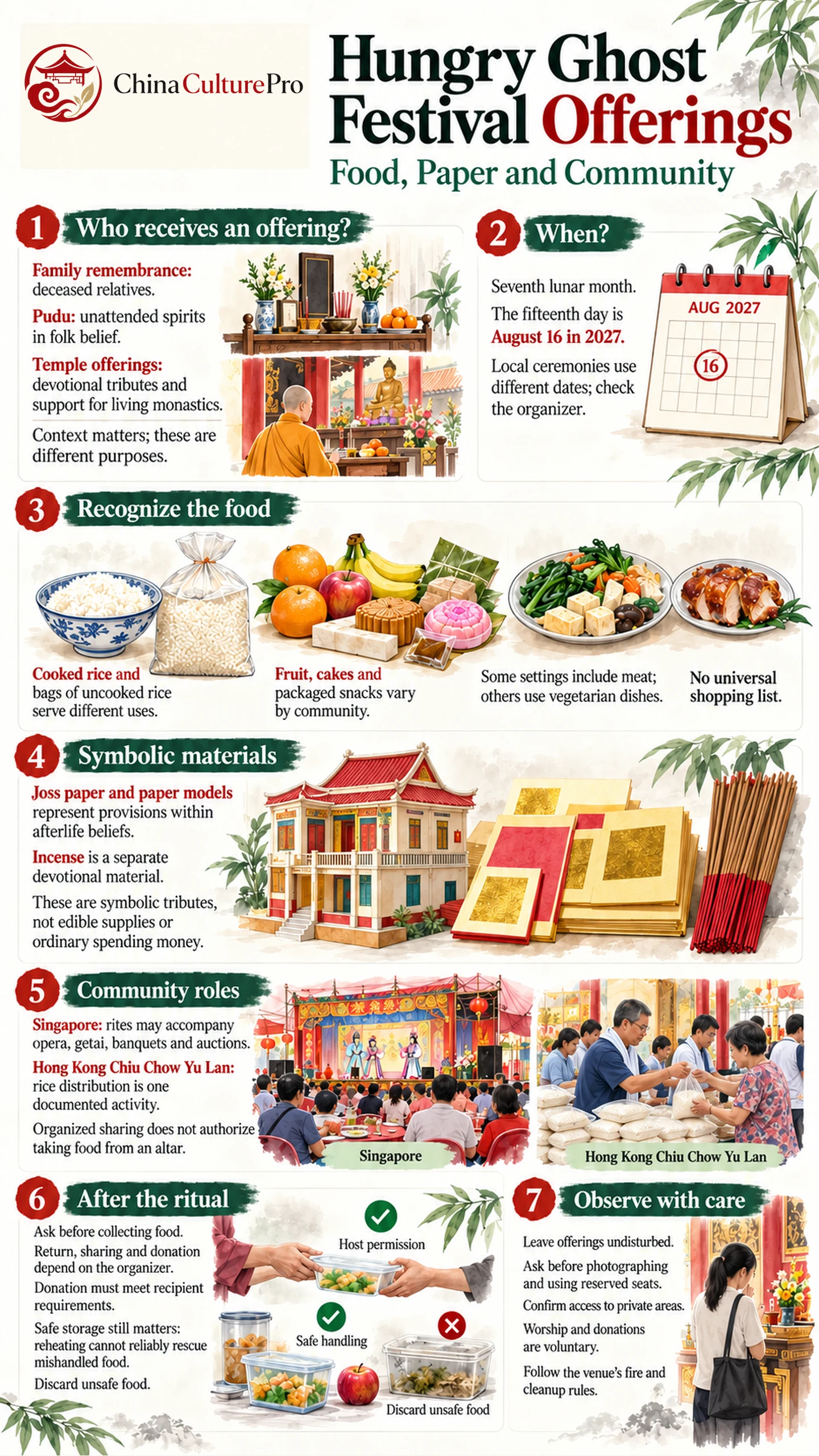
Hungry Ghost Festival (中元节, Zhōngyuán Jié) offerings (供品, gòngpǐn) include food and symbolic objects presented in family, community or temple observances.
- Food: Rice, fruit, prepared dishes and packaged foods appear in different local settings.
- Ritual paper: Joss paper (纸钱, zhǐqián) and paper models represent provisions within traditional beliefs about the afterlife.
- Recipients: Ancestral worship (祭祖, jìzǔ), pudu (普渡, pǔdù) for unattended spirits, and temple offerings have different purposes.
There is no universal shopping list or required ritual. Choices depend on the community, religious setting and household; these traditions do not guarantee protection or good fortune.
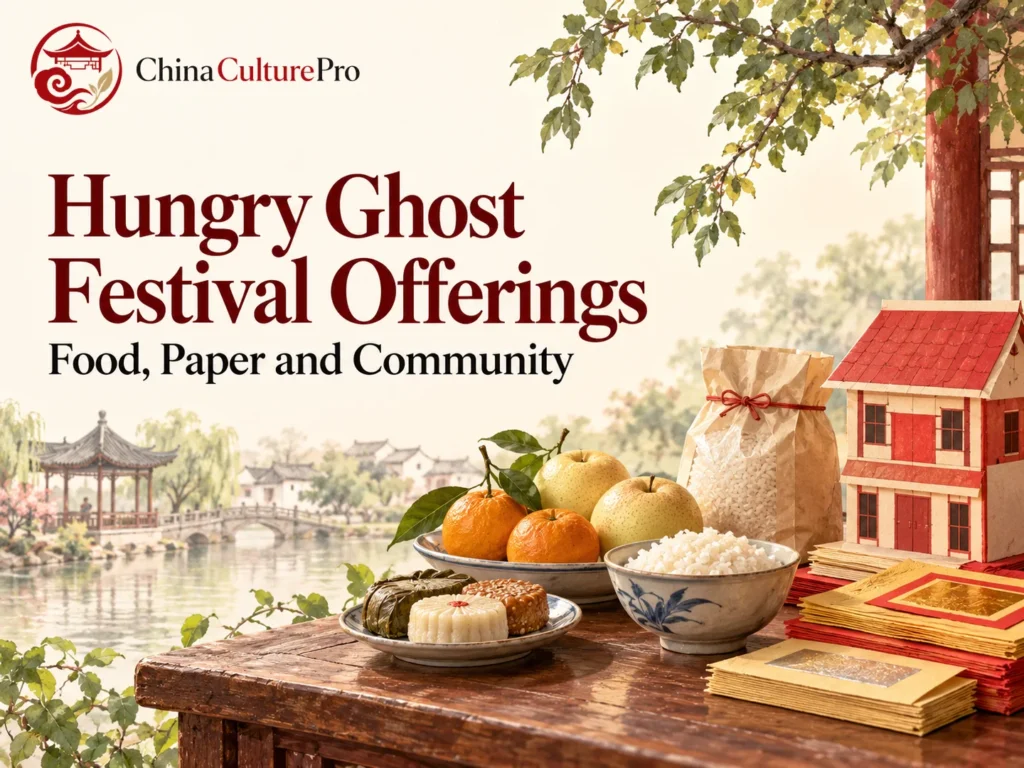
Fruit, prepared dishes and paper goods can appear together on a temporary altar, yet they serve different purposes. Understanding who is being honoured helps explain what you see. This guide focuses on these objects; the festival overview covers the wider festival background.
Who Are the Offerings For?
Family ancestral worship remembers deceased relatives. Food can express continuing affection, gratitude and family connection. These ancestors should not automatically be called “hungry ghosts”: remembering a known relative is different from making communal offerings for spirits believed to lack descendants or regular care.[2]
Pudu extends ritual attention beyond one’s own family. In folk belief, unattended or wandering spirits may receive food and other provisions through these observances. A roadside table may belong to such an event, but its location alone does not establish its purpose. Ask the organizer rather than assuming every outdoor offering is for wandering spirits or every indoor altar is exclusively ancestral.
Buddhist Ullambana (盂兰盆会, Yúlánpén Huì) has a further distinction: offerings can support living monastics. Within this religious tradition, providing for the sangha is connected with filial gratitude and dedicating merit to parents and ancestors. Merit and spiritual liberation are religious teachings, while supplying food and necessities to monastics is a tangible act of support.[2]
These contexts can overlap in community life. They help explain an offering’s meaning without reducing every ceremony to “feeding ghosts.”
When Are Offerings Made?
Observances take place during the seventh lunar month, with the fifteenth day a major festival date. In 2027, that day falls on August 16.[3] The lunar month has either 29 or 30 days, depending on the year; it is not the same as Gregorian July.
Community ceremonies may use different dates across the month. In Singapore, household observances commonly fall on the fifteenth or sixteenth, while associations arrange their own programs.[1] Check the actual invitation or organizer’s notice. A calendar date does not establish a universal prayer hour, public opening time or sequence of offerings.
What Food Is Offered During the Hungry Ghost Festival?
Food can range from a small household spread to substantial supplies assembled by a temple or community group. The following categories help identify what is present; they are not instructions to prepare every item. Taiwanese festival-food inspections document fruit, bean products, meat products, sweets, biscuits and cakes among foods used for ancestral worship and pudu.[4]
| Food category | Examples | What to distinguish |
|---|---|---|
| Rice and rice supplies | Bowls of cooked rice; bags of uncooked rice | A prepared dish differs from a supply that may later be distributed or donated. |
| Fruit | Fresh fruit selected by the household or organizer | There is no single fruit selection that defines every community’s observance. |
| Cakes and snacks | Festival cakes, sweets, biscuits and packaged foods | These remain food products with ingredients, expiry dates and storage requirements. |
| Savoury dishes | Meat, seafood or bean-based dishes in particular settings | Their presence does not make meat compulsory for other households or temples. |
| Vegetarian offerings | Vegetable dishes and vegetarian prepared foods | A temple’s dietary practice should be confirmed before contributing food. |
Vegetarian temple offerings can also be elaborate: a documented Banqiao Buddhist observance included mushroom and yam dishes alongside vegetarian dim sum.[5] That example illustrates one devotional setting, rather than a menu for all Buddhist ceremonies.
Do not infer a compulsory number of dishes from a photograph. Nor should an unfamiliar fruit, modern snack or brand be assigned an ancient meaning without local evidence. If invited to contribute, ask what the host actually needs.
Joss Paper, Paper Models and Incense
Joss paper is a ritual material, distinct from edible provisions and ordinary spending money. Paper replicas may represent houses, vehicles or other everyday goods. In the associated folk belief, presenting and burning these representations provides for the deceased in an afterlife. The intended transfer is a religious or cultural interpretation, not a verifiable delivery of possessions.[6]
A familiar household object can become a paper model with a devotional purpose. Its appearance does not tell a visitor exactly whom it is intended for. Paper types, recipients and uses should be understood within the particular ceremony, rather than inferred from a universal colour chart.
Incense is another material used in some observances; it is neither food nor paper currency. Seeing it beside a dish does not make every object on the table interchangeable. Some participants use several kinds of tribute, while others make simpler choices. Visitors can ask the host which objects belong to which part of the ceremony.
Any use of flame is subject to the venue’s current rules. Cultural explanation is not permission to burn offerings wherever they are displayed.
Family Altars and Community Rituals
A family observance may take place around a small home altar, whereas a collective event can occupy a temporary pavilion or shared neighbourhood space. Size alone does not determine the recipient: the host’s ritual arrangements matter. A household may remember its own relatives and also take part in a wider communal observance.
In Singapore, associations, shops and neighbourhood groups hold events in settings including housing estates and hawker centres. Religious rites may be accompanied by opera or getai (歌台; Mandarin gētái), live stage entertainment. Some events include a banquet, distribution of auspicious objects or an auction. The combination varies by organizer.[1] At larger Singapore events, auctions can help fund later festivities and charity.[11]
Performances can themselves be understood as offerings, rather than simply background entertainment. A banquet serves living guests, while goods displayed for auction have another role. Knowing which part of the event you are watching helps prevent confusing every table of food with an unrestricted public meal.
Hong Kong’s Chiu Chow Yu Lan gatherings offer a distinct example. Their documented activities include ancestral and wandering-spirit rites, opera for deities, rice distribution and auctions.[7] Organized distribution is different from a passerby taking rice or fruit off a table. Access to ceremonies, meals and distributions should be confirmed separately with the host.
What Happens to the Food After the Ritual?
There is no blanket rule that offered food must be discarded or eaten. Permission and food safety are separate questions. A completed ceremony does not establish either one.
- Return or sharing: Follow the household’s or organizer’s arrangements before collecting any food. An unattended table is not an invitation to take it.
- Donation: In New Taipei’s 2026 pudu season, temples and other groups supplied rice and gift boxes to a welfare distribution platform. Some offerings were reclaimed; others were donated.[8] A recipient food bank’s requirements can include unopened packaging, clear labels, sufficient remaining shelf life and an appropriate delivery temperature.[9]
- Disposal: Food that has been unsafely stored or contaminated should not be passed on simply to avoid waste.
Cooked dishes and sealed dry supplies need different handling. Follow product labels, protect food from contamination and avoid leaving perishable offerings in warm conditions for extended periods. Refrigeration and appropriate storage should follow promptly when food is being retained.[4]
Reheating cannot reliably rescue mishandled food: some bacterial toxins may remain after heating.[10] Assess storage history rather than relying only on appearance, smell or an unexpired date. For donated goods, contact the receiving organization first; a local collection’s acceptance rules are not a worldwide standard. Neither donation nor eating the offerings is a compulsory religious conclusion.
How to Observe Offerings Respectfully
Keep your visit considerate and follow the host’s directions:
- Leave offerings undisturbed: Do not step over, move, taste or remove food and paper goods. Keep paths and access to the altar clear.
- Ask before photographing: Seek permission for close views of ceremonies, participants and private altars. Follow any restrictions even when the activity is outdoors.
- Check seating: Front-row seats have traditionally been reserved for spirits at some performances.[11] Follow staff directions rather than assuming every event keeps the same arrangement.
- Confirm access: A public performance does not automatically open a family’s rite, members’ banquet or distribution area to everyone.
- Follow venue rules: Respect current fire controls, designated areas and cleanup arrangements; do not treat a custom as an exemption.
Observation, making a donation and joining worship are separate choices. You can accept an invitation without taking on a religious role. If uncertain, ask where you may stand and what help would be welcome.
FAQs About Hungry Ghost Festival Offerings
Do offerings have to include meat?
No. Food choices depend on the household, community and religious setting. Vegetarian offerings are used in some Buddhist observances. If you are bringing something, confirm the organizer’s dietary requirements rather than assuming a meat dish is expected.
Is burning joss paper required?
No universal requirement applies to every household or visitor. Paper offerings and venue restrictions vary. You may observe without burning anything; ask the host about their arrangements and respect any fire restrictions.
Can you eat food after it has been offered?
Sometimes, with the host’s permission and safe handling. Food intended for collection or sharing may be available afterward, but prolonged warm storage or contamination can make it unsafe. Having been offered neither proves safety nor automatically prevents eating it.
Can visitors attend without making an offering?
Yes, where an activity is open to visitors or you have been invited. You need not supply food, donate or join worship simply to watch. Private rites and restricted event areas still require permission, even beside a public performance.
Sources
[1] Singapore Chinese Cultural Centre, Culturepaedia. Zhong Yuan Festival
[2] Dharma Drum Mountain. Ullambana, filial remembrance and offerings to monastics
[3] Hong Kong Observatory. Gregorian–Lunar Calendar Conversion Table of 2027
[4] New Taipei City Department of Health. 2026 Zhongyuan festival foods and storage guidance
[5] Fo Guang Shan Banqiao branch. Vegetarian devotional foods at a 2022 observance
[6] National Heritage Board, Roots. Zhong Yuan Jie, Hungry Ghost Festival
[7] Hong Kong Intangible Cultural Heritage Office. Yu Lan Festival of the Hong Kong Chiu Chow Community
[8] New Taipei City Social Welfare Department. 2026 post-pudu supplies redistributed through a welfare platform
[9] Taiwan People’s Food Bank. 2026 donation acceptance conditions
[10] Singapore Food Agency. Temperature Control in Cooked Food
[11] Teochew Federation Singapore. Teochew Traditions