

Quick Answer: What Are the Main Qixi Traditions?
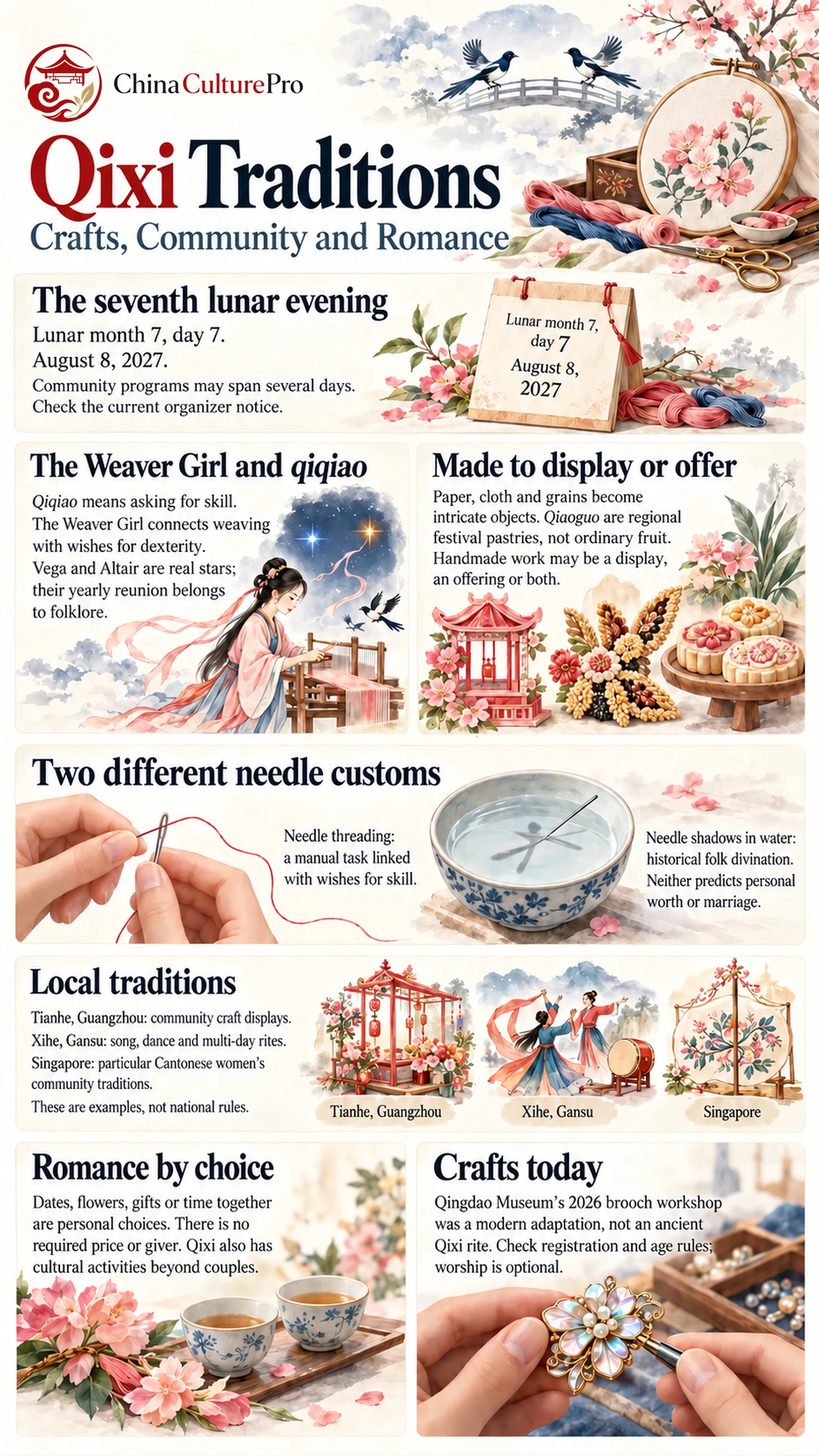
Qiqiao (乞巧, qǐqiǎo) means asking for skill or dexterity. Traditionally, women directed these wishes to the Weaver Girl (织女, Zhīnǚ), a figure associated with weaving. Qixi (七夕, Qīxī) customs include three overlapping groups:
- Craft and skill: needle-threading challenges, handmade objects and displays of workmanship.
- Community observance: local offerings, gatherings and performances, sometimes with devotional rites.
- Modern celebration: dates, flowers, gifts or time spent together, alongside cultural activities.
There is no national checklist everyone follows. The Seven Sisters observances of particular Cantonese communities, for example, cannot stand for every family’s Qixi. Taking part in a craft activity need not involve worship.
A threaded needle or tiny handmade object can tell you as much about Qixi (七夕, Qīxī) as a bouquet. These customs connect skilled hands with stories and community life. Our Qixi overview covers the wider festival; here, the focus is on what its traditions involve.
When Are Qixi Customs Observed?
Qixi falls on the seventh day of the seventh lunar month. In 2027, that is August 8. It is not fixed on July 7 of the Gregorian calendar.[1]
The festival’s main date and a community’s program are separate matters. Preparations, displays and gatherings may extend across several days. Some devotional observances take place at night, but museum activities and public craft sessions can run during the day. An evening ritual is not a rule for every Qixi activity.
For a particular event, check the organizer’s notice for the correct year, location, time and booking conditions. A traditional community calendar does not guarantee daily public access, and an activity held in 2026 should not be assumed to return on the same schedule in 2027.
Why the Weaver Girl Matters to Qiqiao
In a familiar telling, the Weaver Girl and the Cowherd (牛郎, Niúláng) love one another but are separated by the Milky Way. Once a year, magpies form the Magpie Bridge (鹊桥, quèqiáo), allowing them to meet. Versions differ over the heavenly authorities, family relationships and events leading to their separation. This is folklore, rather than a record of historical people.[2]
The figures are associated with real stars: Vega represents the Weaver Girl and Altair the Cowherd. Their annual reunion belongs to the story; the stars do not physically come together on Qixi. Looking at them can connect a modern observer with the festival’s imagery without turning the legend into astronomy.[2]
The Weaver Girl’s occupation also explains the appeal of qiqiao. Worshippers sought nimble hands and a quick mind from a figure imagined as an accomplished weaver. Needlework, weaving and intricate displays gave these wishes a visible form. Women’s gatherings offered opportunities to share work and aspirations, including hopes for marriage in some settings.[3]
This historical emphasis on women’s skills is context for understanding the customs, not a standard for judging women today. Qixi’s craft traditions also carry meanings beyond finding a partner: making, learning and gathering with others.
Traditional Qixi Crafts and Skill Customs
Threading Needles and Testing Skill
Qiqiao includes both manual tasks and the interpretation of signs. The activities below have different purposes, even when they share a wish for skill.
| Custom | What participants did | How to understand it |
|---|---|---|
| Chuanzhen qiqiao (穿针乞巧, chuānzhēn qǐqiǎo) | Threaded needles, sometimes in a challenge associated with the evening | A manual task connected with wishes for dexterity; equipment and rules varied. |
| Touzhen yanqiao (投针验巧, tóuzhēn yànqiǎo) | Observed a needle’s shadow in water and interpreted its shape | A historical form of folk divination, rather than a reliable assessment of ability. |
| Handwork displays | Presented carefully made objects for others to admire | Showcased workmanship; a display could also have a devotional purpose. |
Historical accounts distinguish needle-threading from needle-shadow interpretation, with the latter described in Ming and Qing customs.[4] The familiar image of threading by moonlight should not be turned into one rule about needle holes, lighting or who must win. A present-day organizer may adapt the activity for its participants.
Successful threading demonstrates performance at that task. It does not determine someone’s overall intelligence, personal worth or future marriage. Reading shapes as signs of “obtaining skill” expresses a traditional belief, not evidence that the ritual grants a new ability.
Handcrafted Displays, Qiaoguo and Offerings
Qixi craft can extend well beyond sewing. Paper, cloth and individual grains can become flowers, figures, miniature buildings or other elaborate objects. These displays make fine workmanship visible, while some also serve as tributes in a community’s observance.[3][5]
Qiaoguo (巧果, qiǎoguǒ) are festival pastries associated with qiqiao in some regions. Despite the name’s final character meaning “fruit,” the term here refers to prepared pastries rather than ordinary fresh fruit. Their shapes and methods vary; there is no single version that every household makes or offers.[4] Shaping a decorative food can be part of the craft theme without making it a universal ritual requirement.
Fruit, flowers or other objects may appear beside handmade pieces. Ask what a particular display represents: an object can be an offering, a demonstration of skill, or both. Neither a photograph of one table nor a regional list supplies a compulsory shopping list for everyone. Singapore’s Seven Sisters pastries, for example, should not automatically be treated as another name for every region’s qiaoguo.[3]
Regional Traditions: Guangzhou, Xihe and Singapore
Regional examples show how different the same festival can look. The Seven Sisters Festival (七姐诞, qījiědàn) is one Cantonese expression of Qixi. Majie (妈姐, mājiě), Cantonese domestic workers, were among the groups who sustained such celebrations in Singapore.[3]
| Place or community | Distinctive practices | Limits of the example |
|---|---|---|
| Tianhe, Guangzhou, including Zhucun | Community women display intricate figures, flowers and other objects, with skill challenges and Seven Sisters observances | The national heritage project concerns Tianhe customs; related practices also occur beyond Zhucun. It is not a nationwide ceremony.[5] |
| Xihe, Gansu | A multi-day tradition combining qiqiao songs, dance, craft and rites welcoming and seeing off the honored figure | The recorded cycle spans seven days and eight nights, from the previous lunar month’s final evening through the seventh day. It is not a visitor-event timetable.[6] |
| Particular Cantonese communities in Singapore | Women’s associations displayed handmade tributes, including Seven Sisters basins, paper goods and clothing; majie played an important role | These are documented community traditions, not a description of all Singaporeans or all Cantonese households.[3] |
Xihe’s qiqiao tradition and Tianhe’s customs have separate national intangible cultural heritage listings, recorded in 2008 and 2011 respectively.[5][6] Those designations apply to the named projects, not every activity advertised under Qixi.
In Singapore, surviving observances and revival programs connect older women’s community traditions with today’s audiences.[3]
How Qixi Is Celebrated Today
Dates, Gifts and Personal Choices
Some couples mark Qixi with dinner, flowers, small gifts or a personal message. Others prefer time together without a purchase. Such choices can coexist with the older craft traditions; celebrating romance does not require reproducing a historical rite.
There is no festival-wide rule about a gift’s price, which gender should give it or how publicly affection should be expressed. Partners can agree on what feels appropriate. Spending is not a measure of devotion, and being single does not exclude someone from learning about the festival, making something by hand or joining a suitable cultural activity.
Craft Workshops and Community Events
On August 19, 2026, Qingdao Municipal Museum held a Qixi workshop in which participants made mother-of-pearl inlay brooches. The program connected a traditional decorative craft with a contemporary festival experience.[7] It did not establish brooch-making as an ancient, universal Qixi ritual.
This distinction matters when museums introduce embroidery, paper work or other creative activities. A craft may have a long history while its use in that particular Qixi program is new. A workshop can teach through adaptation, provided the connection is explained honestly.
Before joining, check registration, age requirements and instructions for tools or materials. Ask before photographing participants or private devotional displays. A public workshop may welcome families and individual visitors, subject to its rules; a private observance needs an invitation. Taking a class or viewing an exhibition does not oblige anyone to worship.
FAQs About Qixi Traditions
Why do people thread needles during Qixi?
Threading connects practical dexterity with wishes directed to the skilled Weaver Girl. It can test performance at a small manual task. Neither the result nor a traditional reading of needle shadows predicts someone’s intelligence, worth or marriage prospects.
Is Qixi only for couples?
No. Historical customs included women’s craft gatherings and community observances. Modern exhibitions and suitable workshops offer other ways to engage with the festival. Check the organizer’s conditions rather than assuming an activity is restricted to couples or open to everyone.
Do you have to worship the Weaver Girl to take part?
No. Craft learning, viewing displays and devotional rites can be separate activities. You may join a suitable public cultural program without worship. For a private observance, seek an invitation and ask what participation the host would welcome.
Is Qixi on July 7 every year?
No. Its date is the seventh day of the seventh lunar month, not Gregorian July 7. In 2027 it falls on August 8. Local programs may take place on other dates around the festival.
Sources
[1] Hong Kong Observatory. 2027 Gregorian–Lunar Calendar Conversion Table
[2] Hong Kong Space Museum. Chinese Valentine’s Day, When Altair and Vega Meet
[3] Singapore Chinese Cultural Centre, Culturepaedia. Qixi Festival
[4] China News Service. The Many Forms of Qiqiao: What Is Needle-Shadow Divination?
[5] China Intangible Cultural Heritage Network. Qixi Festival: Tianhe Qiqiao Customs
[6] China Intangible Cultural Heritage Network. Qixi Festival: Xihe Qiqiao Festival
[7] Qingdao Municipal Museum. Qixi Mother-of-Pearl Brooch Workshop, 2026