
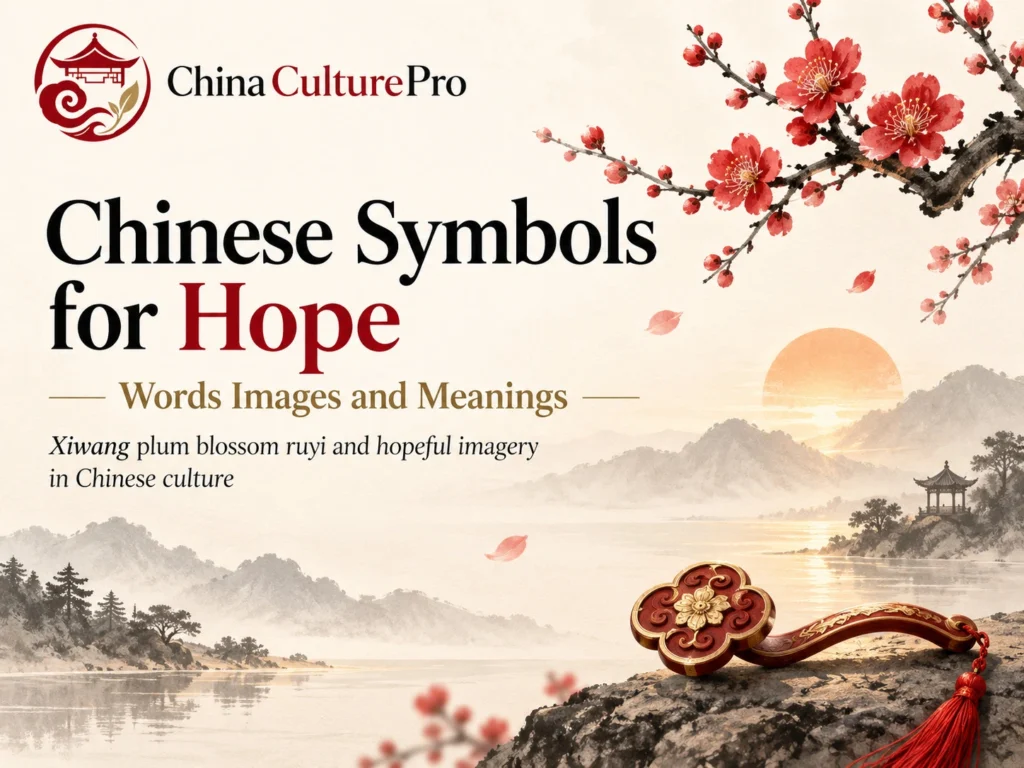

Quick Answer: What Are the Chinese Symbols for Hope?
Chinese symbols for hope include words, traditional associations, and modern visual metaphors. Four useful choices express different intentions:
- Direct wording: Xiwang (希望, xīwàng) is the common Chinese word for hope or to hope.
- Plum blossom: The plum blossom (梅花, méihuā) can express renewed hope through its flowering as winter gives way to a new season.
- Ruyi: Ruyi (如意, rúyì) conveys “as you wish” and wishes for things to go well, rather than translating hope directly.
- Modern imagery: Contemporary designs may use seasonal renewal or a rising sun, with meaning supplied by their wording and creator.
This is a practical selection, not an ancient fixed set. These expressions do not guarantee success, change fate, or have verified therapeutic effects.
An encouragement gift, Chinese character design, or decorated object can express hope in different ways. Written language states the wish directly; traditional motifs suggest it through cultural associations; contemporary artwork may create a new metaphor. Start by deciding which kind of message you need.
How Is Hope Written in Chinese?
The direct everyday answer is 希望. It can name hope or describe hoping for something to happen. Related words emphasize eager waiting, anticipation, or a particular wish. Choose by the sentence or message you intend, rather than treating all four as interchangeable decorative symbols.[1]
| Term and pronunciation | Main meaning | Natural use | Important distinction |
|---|---|---|---|
| Xiwang 希望 (xīwàng) | Hope; to hope | Hopes for someone’s future, an event, or an outcome | Works as a noun or verb, depending on the sentence. |
| Panwang 盼望 (pànwàng) | To look forward eagerly; to long for | Eagerly awaiting a person, reunion, or welcome development | Highlights longing and waiting more strongly.[2] |
| Qidai 期待 (qídài) | To anticipate; to look forward to | Anticipating a future event or someone’s performance | Emphasizes expectation; the full sentence determines its tone and register.[3] |
| Yuanwang 愿望/願望 (yuànwàng) | A wish or desire | Naming something a person wants to realize | Usually names the wish itself; it cannot replace every use of “to hope.”[4] |
In Mandarin, 希 (xī) has a high, level first tone and 望 (wàng) has a falling fourth tone. The unaccented spelling “xi wang” loses that pronunciation information. Two examples show the noun–verb distinction:
- Verb: 我们希望项目能顺利推进。 Wǒmen xīwàng xiàngmù néng shùnlì tuījìn. “We hope the project can move forward smoothly.”
- Noun: 他对未来充满了希望。 Tā duì wèilái chōngmǎn le xīwàng. “He is full of hope for the future.”
For a standalone word design, the complete 希望 communicates the concept without requiring an omitted sentence. For a greeting, writing what you hope for can make the message warmer and more specific than displaying the abstract word alone.
希望, 盼望, and 期待 have the same standard forms in simplified and traditional Chinese. 愿望 becomes 願望. Script choice changes the written form where applicable; it does not turn the message into a different kind of blessing. The broader Chinese character symbols guide explains how readable words also function as decorative emblems.
Can Xi or Wang Mean Hope on Their Own?
Yes. Xi (希, xī) and Wang (望, wàng) both have dictionary senses related to hoping or expectation. Calling either character meaningless or automatically wrong would erase those senses. The difficulty is that each also means other things.[5][6]
Xi can refer to rarity or scarcity, as well as hoping or aspiring. Wang can mean looking into the distance, expecting, reputation, or the full-moon phase and the fifteenth day of a lunar month. A lone character leaves more of that meaning for its context to establish. A seal, a poem, and a personal motto may deliberately use a single character differently; the surrounding language and occasion help explain the choice.
For an English-speaking reader choosing a neutral word design, 希望 is therefore clearer. An artist may deliberately select one character, but should be able to explain that choice. Removing half the word simply to fit a small space is not the same as making an informed calligraphic decision.
The classical dictionary Shuowen Jiezi (说文解字, Shuōwén Jiězì) explains Wang through hoping for the return of someone away from home. That is a historical lexicographic explanation, not proof that the modern character’s visible components form a simple picture of “hope.” A modern-looking moon component alone cannot establish such a story.[7]
Check the form as well as the interpretation. 希 has seven standard strokes and 望 has eleven.[5][6] The different character 忘 (wàng) means “to forget.” Also, hope’s 希 (xī, first tone) differs from the joy character 喜 (xǐ, third tone). Similar romanizations can conceal different characters and meanings.
Which Chinese Images Can Express Hope and Renewal?
Plum Blossoms: Hope After Winter
The plum blossom’s association with hope grows from a seasonal observation: flowers appear on bare branches while conditions are still cold. They suggest that a difficult season is passing and new life is possible. Flowering time varies with location, climate, and cultivar; there is no single date for every tree.[8]
This makes plum imagery suitable for a message about endurance and a hoped-for change. The meaning emerges through the relationship between blossom, branch, season, and accompanying words. Identify the plant and composition before assigning that reading.
A concrete example is Birds, Plum Blossoms, and Bamboo in Winter, accession F1916.478 at the Smithsonian’s National Museum of Asian Art. The painting places a flowering tree among snow-dusted bamboo (竹, zhú) stems. Its interpretation includes courage in adversity and renewed hope. The current attribution is Ming dynasty, sixteenth century, ink and color on silk; it was formerly attributed to Ma Lin, rather than accepted as his work.[9]
The same flower can also evoke integrity, beauty’s brevity, or celebration. Look at the whole composition before narrowing the reading. The plum blossom meaning guide explores those other associations and how to recognize the plant.
Ruyi: A Wish for Things to Go Well
Ruyi offers a different message: may things happen as you wish. Its use as a gift conveys favorable intentions toward the recipient, making it relevant to hopeful wishes without turning it into a literal sign for hope.[10]
An eighteenth- to nineteenth-century Qing Ruyi Scepter, accession 29.110.45 at the Metropolitan Museum of Art, combines cloisonné enamel with gilt-bronze medallions.[10] The handle and cloud-shaped head are useful recognition clues.[11]
For a general goodwill gift, this broad wish may fit. If your intended message is specifically “keep hoping,” written wording will communicate it more directly. The Ruyi symbolism guide explains its forms and wider uses.
Spring and Sunrise in Modern Hope Designs
Spring (春, chūn) and sunrise (日出, rìchū) can provide visual metaphors for a new beginning. A contemporary designer might pair 希望 with a rising sun, or combine a flowering branch with a short encouragement message. These are possible creative choices, not reconstructions of a fixed ancient emblem.
The distinction matters when describing the finished artwork. “A modern design expressing hope through a new day” makes a different claim from “the ancient Chinese symbol for hope.” The latter needs specific historical evidence.
For an existing image, use its title, inscription, date, and stated purpose. For a new design, decide what you want the image to say and use wording to make that intention clear.
What Should Not Be Mistaken for a Universal Hope Symbol?
Related positive meanings can support a hopeful design without becoming direct equivalents of hope:
- Fu: Fu (福, fú) expresses blessings and favorable circumstances. A Fu decoration can convey goodwill, but it does not specifically name the feeling or act of hoping.[12]
- Bamboo and lotus: Bamboo (竹, zhú) can represent integrity and endurance; lotus (莲/蓮, lián) often represents purity, with further meanings in particular combinations. Neither turns every image of the plant into a hope emblem.[8]
- Chinese phoenix: Fenghuang (凤凰, fènghuáng), often called the Chinese phoenix, has associations including peace and prosperity. Do not automatically read a historical phoenix motif as rising from ashes. Rebirth imagery in later creative works needs its own context.[13]
- Green: A designer may choose green to suggest growth. That choice does not make every green object a hope symbol. Interpret green in Chinese culture through the object, period, occasion, and any inscription rather than color alone.
How to Choose a Hope Symbol for a Gift, Tattoo or Design
Use the intended message to guide the artwork, then check the actual result. The same design may read differently as encouragement, a general blessing, or a personal reminder.
- Define the intention: Write your meaning in plain language first. Do you want “hope,” eager anticipation, resilience through difficulty, or “may your wishes come true”? Choose the word or image that carries that meaning rather than selecting an attractive mark and assigning it a translation afterward.
- Match the recipient and occasion: For a friend’s graduation, a plum design with a clear message can express encouragement. For an elder, Ruyi may suit a broader goodwill wish. A personal tattoo can carry a more individual interpretation, provided you understand how other readers may interpret it. Religious expressions need attention to their particular tradition.
- Check the complete composition: Read the text, plants, colors, and other motifs together. Ask whether the intended message survives if the inscription is removed. If it does not, keep the wording rather than presenting the picture as a universally understood symbol. Avoid combining signs simply because each seems positive in isolation.
- Verify the final artwork: Check simplified or traditional forms, character order, orientation, and every stylized stroke. Have a fluent reader or qualified calligrapher inspect the exact engraving or tattoo design, not just a typed translation. Check any mirrored version, cropped lettering, or altered layout again before approving it.
For a different intention, compare Chinese symbols by meaning before borrowing an image from another occasion.
FAQs About Chinese Symbols for Hope
What Is the Chinese Symbol for Hope?
The common direct wording is 希望 (xīwàng), meaning hope or to hope. Pictorial choices such as plum blossoms express related ideas through context; there is no single image that fits every hopeful message.
Does Wang Mean Hope on Its Own?
Yes. 望 (wàng) has senses of hoping and expecting, alongside looking into the distance, reputation, and lunar meanings. A standalone design needs context; the complete word 希望 is clearer for a general message.
Which Flower Symbolizes Hope in Chinese Culture?
Plum blossoms have a documented association with renewed hope because their early flowering suggests a new season. They can also express courage, integrity, or fleeting beauty, so the specific artwork still matters.
Is Hope Written Differently in Traditional Chinese?
No. 希望 has the same standard form in simplified and traditional Chinese. Some related terms do change: simplified 愿望 is traditional 願望. Confirm the actual word rather than assuming every character has two forms.
Can Chinese Symbols for Hope Be Used in Tattoos?
Yes, as personal expression. Verify the complete meaning, characters, orientation, and final artwork with a fluent reader. An individual interpretation can be meaningful, but the tattoo cannot guarantee hope, success, or changes in fortune.
Sources
[1] Ministry of Education, Taiwan. 希望
[2] Ministry of Education, Taiwan. 盼望
[3] Ministry of Education, Taiwan. 期待
[4] Ministry of Education, Taiwan. 願望
[5] Ministry of Education, Taiwan. 希
[6] Ministry of Education, Taiwan. 望
[7] Ministry of Education, Taiwan. 望
[8] Smithsonian National Museum of Asian Art. A Selected Illustrated Guide to Common Chinese Symbols
[9] Smithsonian National Museum of Asian Art. Birds, Plum Blossoms, and Bamboo in Winter
[10] Metropolitan Museum of Art. Ruyi Scepter
[11] Metropolitan Museum of Art. Ruyi scepter
[12] Ministry of Education, Taiwan. 福
[13] Smithsonian National Museum of Asian Art. Lacquer tray