
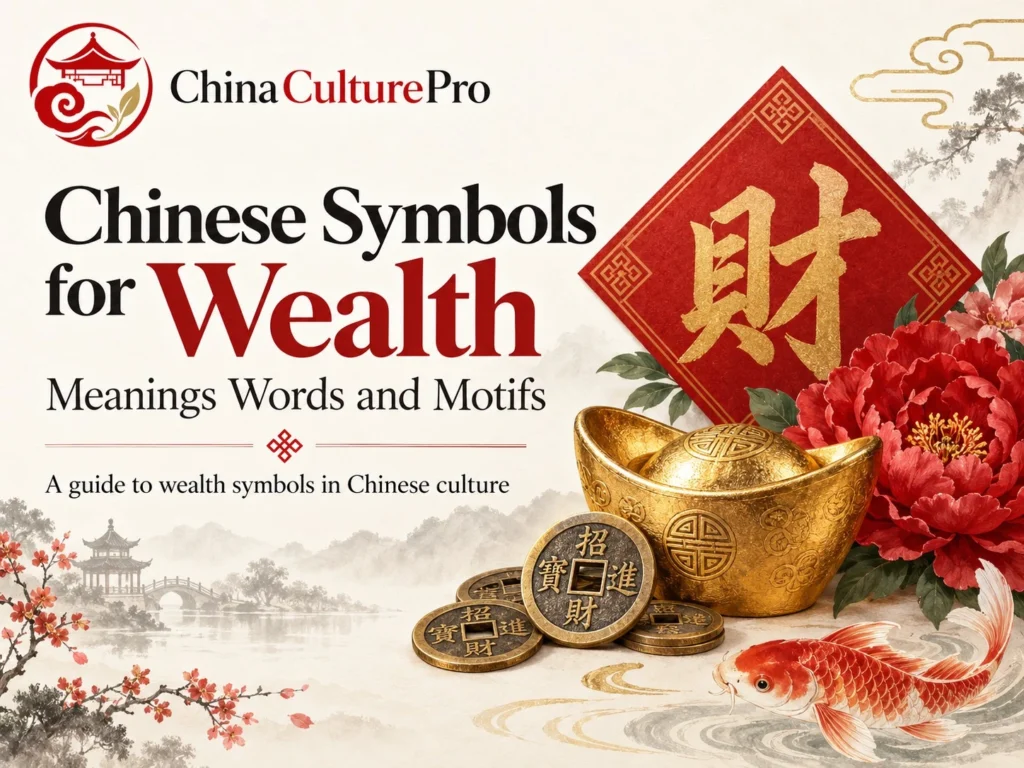

Quick Answer: What Are the Chinese Symbols for Wealth?
Cai (财/財, cái) is the most direct Chinese character for money and material wealth; Caifu (财富/財富, cáifù) is the fuller word for wealth. Traditional images express related wishes through several different routes.
- Written meanings: Characters distinguish money, abundance, general blessings, and prosperity associated with official rank.
- Currency images: Ingots and square-holed coins turn recognizable forms of money into decorative wishes for prosperity.
- Deities and mythical figures: Wealth deities and auspicious beasts belong to particular religious, folk, or later decorative traditions.
- Natural motifs: Fish suggest surplus through wordplay; peonies evoke wealth, honor, and a flourishing life.
These symbols communicate cultural wishes and beliefs. They do not guarantee income, business success, or financial returns.
Choose the meaning before choosing the image: money, a comfortable life, social distinction, and general good fortune are different wishes. This guide connects those choices with written expressions and recognizable motifs within the wider system of Chinese symbols by meaning.
Chinese Wealth Symbols at a Glance
Use this shortlist to identify a candidate. The detailed sections explain how its meaning depends on the complete object and setting.
| Symbol | Type | Recognition | Meaning and limit |
|---|---|---|---|
| Cai (财/財, cái) | Character | 贝/貝 component | Money and material assets; a direct lexical meaning. |
| Wealth Fu (富, fù) | Character | Different from 福 | Wealthy or abundant; describes a condition. |
| Blessing Fu (福, fú) | Blessing character | 礻 component | Broad good fortune; more than money. |
| Lu (禄/祿, lù) | Rank-related character | 礻 component | Official salary and status in prosperity imagery. |
| Yuanbao (元宝/元寶, yuánbǎo) | Monetary image | Ingot, often boat-shaped | Material wealth; decorative gold color does not identify the metal. |
| Cash coins (方孔钱, fāngkǒng qián) | Monetary image | Round outline, square hole | Currency or a money-shaped charm; distinguish their purposes. |
| Caishen (财神/財神, Cáishén) | Wealth deity | Ingot, tiger, or official robes | Different identities; an ingot alone is insufficient. |
| Jin Chan (金蟾, jīnchán) | Legendary toad | Three legs and money imagery | Wealth folklore; not every frog image. |
| Pixiu (貔貅, píxiū) | Mythical beast | Often winged, lionlike | Wealth-retention folklore; forms and names vary. |
| Dragon (龙/龍, lóng) | Mythical creature | Scaled body and claws | Authority and auspiciousness; no exclusively financial meaning. |
| Fish (鱼/魚, yú) | Visual pun | Fish with contextual companions | Surplus; not automatically one complete blessing. |
| Peony (牡丹, mǔdān) | Floral motif | Large, layered blossom | Wealth and honor; also spring and beauty. |
How Is Wealth Written in Chinese?
English “prosperity” can blur several Chinese concepts. Start with the word’s meaning, then decide whether it suits an inscription, greeting, or decorative design.
Cai and Caifu: Money, Assets and Wealth
Cai refers to valuable possessions and resources, including money and goods. It is the clearest single-character choice when material wealth is the intended subject. Caifu makes that idea an explicit noun: wealth or material assets. A lone Cai can function as a compact inscription.
The traditional character 財 combines 貝, a component associated with valuables, with 才 as its sound component. The sound component does not mean that talent inevitably produces riches.[1]
The simplified 财 and traditional 財 have the same meaning and pronunciation, with a rising second tone. Choose the writing system appropriate to the rest of the design. The guide to Chinese character symbols explains the wider distinction between ordinary vocabulary and decorative emblems.
Fu and Fugui: Wealth and Honor
富 is pronounced fù, with a falling fourth tone. It describes being wealthy, plentiful, or well supplied. Expressions such as 富有 (fùyǒu, wealthy) and 富足 (fùzú, comfortably supplied) make the intended sense clearer than an isolated character.[2]
Fugui (富贵/富貴, fùguì) joins material wealth with elevated social standing: “wealth and honor” or “wealth and distinction.” The second part matters when interpreting luxurious decoration. A wish for fugui concerns both comfortable resources and prestige, rather than a specified amount of cash.[3]
富 has the same standard form in simplified and traditional Chinese. It is a separate character from 福, despite both often being written “Fu” without tone marks in English.
Blessings and Official Prosperity: Fu and Lu
福, pronounced fú with a rising second tone, expresses blessing or favorable fortune. Its scope can include prosperity, long life, and other desirable circumstances.[4] The dedicated Fu symbol guide explains that broader blessing tradition.
Lu includes dictionary senses of blessing and official pay. In prosperity imagery, its distinctive emphasis is the salary, position, and benefits of government office; it should not simply be translated as cash.[5] Read more about Lu and career prosperity when status is the central wish.
Fu Lu Shou (福禄寿/福祿壽, Fú Lù Shòu) brings blessing, official prosperity, and longevity together. Its three wishes remain distinct; calling the whole group “wealth symbols” loses much of its meaning.[6]
Why Do Ingots and Coins Represent Wealth?
Monetary imagery has a straightforward basis: actual valuables became recognizable pictures of prosperity. That history also helps distinguish a monetary object from a later decorative version.
Yuanbao and Sycee: Historical Money and Decorative Forms
Yuanbao evokes an ingot, commonly represented today with raised ends and a rounded center. Historical silver currency ingots are often called sycee in English. Silver ingots were used for substantial transactions, tax payments, and wealth storage; the monetary meaning preceded their use as decorative prosperity imagery.[7]
Actual ingots were not all gold, nor did they share one universal size or profile. A gold-colored modern ornament may simplify a familiar ingot shape without reproducing a particular historical monetary form.
For interpretation, separate the physical object from the image: a silver ingot has a monetary history, while an ingot painted on a greeting card contributes a wish for material plenty. Color alone cannot establish the object’s metal or date.
Cash Coins: Currency, Charms and Replicas
Round cash coins with square central holes are another recognizable monetary form. Their inscriptions can identify an issuing reign, value, or mint, depending on the coin type.
A brass ten-cash coin of the Xianfeng reign, dated 1851–1861, offers a precise example. The Horniman Museum’s coin nn16637.10 bears Xianfeng Zhongbao on one side, with denomination and mint information on the other.[8]
Keep currency, coin-shaped charms, and modern replicas conceptually separate. A charm may resemble money while serving a decorative or auspicious purpose. A red cord or a group of five coins does not, by itself, establish an ancient nationwide ritual rule. Interpret the assembly as well as the individual pieces.
Which Deities and Mythical Figures Are Associated with Wealth?
Human figures, toads, and winged beasts draw on different traditions. Identify their attributes and stories before assigning a general “money symbol” label.
Caishen: A Wealth-Deity Role with Different Identities
Caishen means a deity of wealth, but the name does not identify one universally standardized figure. Different traditions recognize different wealth deities, including civil and martial forms. Wealth-deity worship can overlap folk religion, Daoism, and some Buddhist traditions.[9]
Zhao Gongming (赵公明, Zhào Gōngmíng) is a prominent martial wealth deity. A black tiger and martial attributes can help identify him, whereas official robes or an ingot alone leave several possibilities.
A wooden figure in the National Museum of Finland, VK6494:613, was identified as Zhao Gongming through its distinctive face and black tiger. Its owner worked in China from the late nineteenth century, but that biographical fact does not establish a precise carving date.[9]
This example shows why an inscription, provenance, and companion animal can be more useful than a general resemblance to an official.
Liu Hai and Jin Chan: The Three-Legged Toad
Liu Hai (刘海, Liú Hǎi) appears in a familiar wealth story with a three-legged toad and a string of coins. Jin Chan, commonly called the money frog in modern English, belongs to this legendary association. The toad’s connection with treasure is part of folklore.
An early-twentieth-century woodblock print in Harvard Art Museums, 1935.37.34, depicts Liu Hai enticing the three-legged toad with gold coins. Its catalogue associates it with Xi’an, Shaanxi, while noting uncertainty about the production place. The accession year, 1935, is separate from its making.[10]
The combination of person, toad, and coins establishes the story more securely than an isolated amphibian. The Jin Chan money frog guide explores that identification further. A coin held in the mouth is not a required feature of every historical depiction.
Pixiu and Dragons: Different Mythical Associations
Pixiu is frequently presented as a wealth-gathering and wealth-retaining beast. A later story says it consumes treasure but cannot excrete it, explaining the idea of riches entering without leaving. Treat that as a symbolic legend, not anatomy or a documented description of every ancient beast.[11]
Historical naming can overlap: horned, winged guardian beasts have received different labels, and the familiar modern money-beast explanation cannot simply be projected onto all earlier sculptures. The Pixiu meaning guide separates those historical and later associations.
The dragon has a wider range, including imperial authority, water, protection, and auspicious wishes.[12] A prosperity-themed design can use it, but “wealth” does not exhaust its meaning. Consult the Chinese dragon guide when its period or courtly context matters. Pixiu and dragons should not be treated as interchangeable financial emblems.
How Do Fish and Peonies Express Abundance?
Natural motifs can suggest prosperity without depicting money. Fish use visual wordplay; peonies rely on a familiar cultural association with splendor and distinction.
Fish: Surplus Through Wordplay
Fish, yú, sounds exactly like 余/餘 (yú), meaning surplus or something left over. The wish concerns having enough and something to spare, which can include food, resources, and a comfortable life.[6]
Lotus can extend the rebus: 莲/蓮 (lián) sounds like 连/連 (lián), “continuous.” It is not a strict homophone of 年 (nián), “year.”
The Smithsonian’s seventeenth- to eighteenth-century jade Dish with overlapping petals and fish, S1987.780, combines lotuslike petals with fish carved on the exterior. The complete composition supports a reading of continuous abundance.[13]
A fish does not always need a lotus to suggest surplus, but neither does any fish automatically state an entire blessing. Check the surrounding images and words; the fish symbolism guide covers other readings.
Peonies: Wealth, Honor and Status
The peony’s wealth association includes honor and social distinction. Its large, elaborate blossoms suit images of splendor, making it a recognizable floral counterpart to the idea of fugui.[14]
Yet peonies also belong to spring imagery and the enjoyment of flowers. A naturalistic flower painting may emphasize seasonal beauty, while a richly decorated household object may invite an auspicious reading. Both possibilities belong to the motif’s cultural range.[14]
For a gift, a peony can offer a less explicitly monetary wish than a coin or ingot. It suits an intended message of flourishing, elegance, and distinction when that meaning fits the recipient. This is a contextual design choice, not a compulsory gift custom. The peony meaning guide explores the flower’s broader associations.
Which Wishes Combine Chinese Wealth Symbols and Words?
Complete phrases tell the reader more than an isolated character or ornament. Three useful expressions differ in emphasis and presentation:
- Zhaocai jinbao (招财进宝/招財進寶, zhāocái jìnbǎo): A wish for money and treasure to come in. It suits an explicitly prosperity-focused inscription. Decorative versions may combine the four characters into one square composition; that arrangement remains a compound design, not the traditional form of a single character.[15]
- Gongxi facai (恭喜发财/恭喜發財, gōngxǐ fācái): A familiar New Year greeting wishing someone prosperity. It is often translated loosely as “Happy New Year,” but its actual wording concerns becoming prosperous.[16]
- Niannian youyu (年年有余/年年有餘, niánnián yǒuyú): “May you have surplus year after year.” Liannian youyu (连年有余/連年有餘, liánnián yǒuyú) stresses continuing abundance. Lotus-and-fish imagery can visualize this continuing-surplus wish; a written inscription makes the intended phrase clearer.[6][13]
For a compact design, choose between a legible phrase and a recognizable image combination. Combining both can clarify meaning, provided the lettering remains complete.
How Are Wealth Symbols Used in Homes and Businesses?
At New Year, prosperity wishes can appear in greetings, prints, and household decoration. Caishen images may belong to worship as well as festive display; an ornamental ingot may simply contribute a familiar visual wish. A festive decoration and a devotional image therefore call for different readings, even when both depict wealth.[9][16]
In a business setting, a wealth phrase makes the intended message explicit. A fish or peony design can express broader abundance or distinction. When giving such an object, consider whether an openly monetary message suits the occasion and whether religious imagery is welcome to the recipient.
There is no single placement rule that governs all these traditions. A household, temple, or particular school may have its own conventions, but those conventions should be identified in their own context. A retail label prescribing one compass direction does not establish the meaning of every historical object.
Modern decorations can also combine several traditions. Read the wording, figure, and motif individually before treating the whole arrangement as one inherited symbolic formula.
How to Choose a Chinese Wealth Symbol for a Gift or Design
- Define the wish: Decide whether you mean material wealth, a life with plenty, social distinction, or general blessing. For example, a direct wealth inscription and a broad household blessing communicate different intentions. Consider the occasion and recipient together.
- Choose words or imagery: Use Cai or Caifu for direct wording, or select an ingot, fish, or peony for an illustrated message. A deity or mythical figure adds a more specific traditional association, so choose it deliberately.
- Check the complete meaning: Verify simplified or traditional characters, tone, and any compound phrase. For pictures, inspect companion motifs and attributes: lotus changes a fish rebus, while a three-legged toad with Liu Hai identifies a particular story. Keep personal reinterpretation separate from inherited meaning.
- Review the final design: Have a competent Chinese reader check stylized lettering, especially for a tattoo or engraving. Examine the actual finished artwork for missing strokes, mirrored characters, or incomplete compound forms. Confirm that its monetary, religious, or status-related message is appropriate for the audience.
FAQs About Chinese Symbols for Wealth
What Is the Chinese Character for Wealth?
财/財 (cái) is the most direct single character for material wealth. 财富/財富 (cáifù) is the fuller noun, while 富 describes being wealthy or having abundant resources in a particular context.
Are 富 and 福 the Same Symbol?
No. 富 (fù) concerns wealth or abundance; 福 (fú) expresses broader blessing and good fortune. Their characters and tones differ. They are not simplified and traditional versions of the same word.
Why Do Fish Symbolize Wealth in Chinese Culture?
The Mandarin word for fish, yú, sounds like the word for surplus. This creates a wish for plenty, rather than literal money. Companion motifs and inscriptions can make the intended blessing more specific.
Is Pixiu the Same as the Money Frog?
No. Pixiu is a different mythical beast. The money frog usually refers to Jin Chan, the three-legged toad associated with coins and Liu Hai. Their stories and identifying forms should be read separately.
Do Chinese Wealth Symbols Have Fixed Placement Rules?
No rule covers every symbol and tradition. Specific religious, household, or feng shui practices may prescribe arrangements, but those are contextual conventions. Placement does not guarantee any financial outcome for the owner.
Sources
[1] Ministry of Education, Taiwan. 財: Dictionary of Chinese Character Variants
[2] Ministry of Education, Taiwan. 富: Concised Mandarin Chinese Dictionary
[3] Ministry of Education, Taiwan. 富貴: Concised Mandarin Chinese Dictionary
[4] Ministry of Education, Taiwan. 福: Concised Mandarin Chinese Dictionary
[5] Ministry of Education, Taiwan. 祿: Concised Mandarin Chinese Dictionary
[6] Asian Art Museum. Hidden Meanings in Chinese Decorative Motifs
[7] Hong Kong Monetary Authority. Money Past and Present
[8] Horniman Museum and Gardens. Coin: nn16637.10
[9] National Museum of Finland. Caishen, god of wealth
[10] Harvard Art Museums. Door God: Immortal Liu Hai, Folk Deity of Wealth, Enticing the Three-Legged Toad with Gold Coins
[11] National Palace Museum, Southern Branch. 神獸
[12] The Metropolitan Museum of Art. Vase with Dragon amid Clouds
[13] Smithsonian National Museum of Asian Art. Dish with overlapping petals and fish
[14] The Metropolitan Museum of Art. Extravagant Display
[15] Ministry of Education, Taiwan. 招財進寶: Concised Mandarin Chinese Dictionary
[16] Ministry of Education, Taiwan. 恭喜發財: Revised Mandarin Chinese Dictionary