
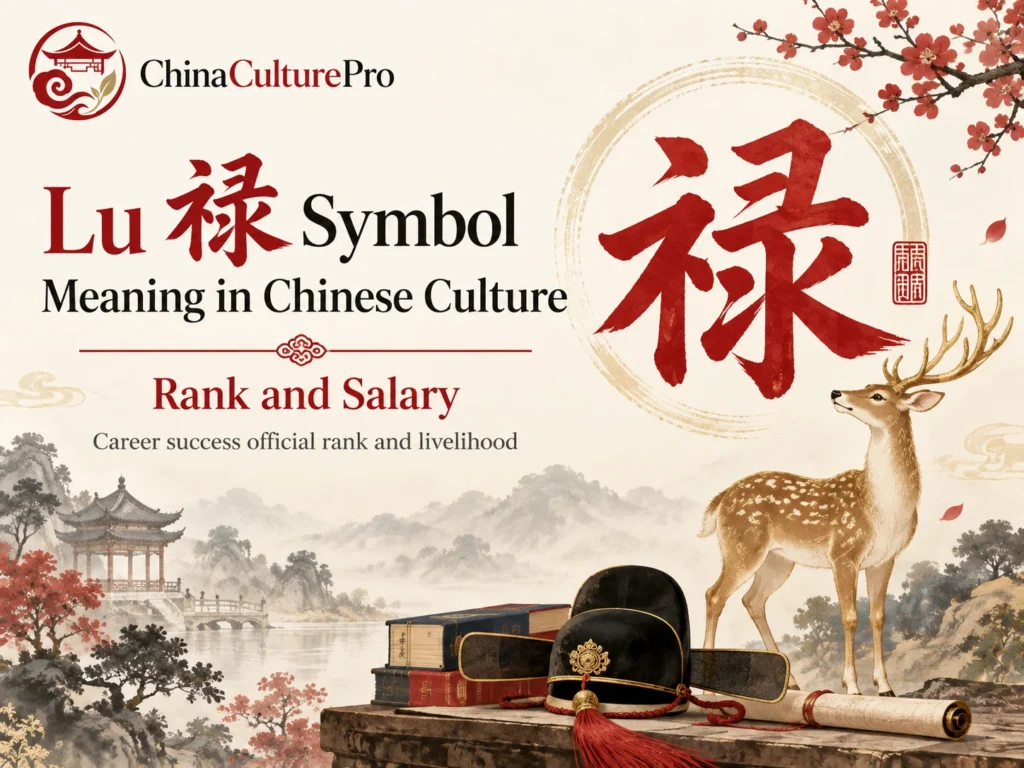

Quick Answer: What Does the Lu Symbol Mean?
Lu (禄/祿, lù) is a Chinese auspicious character associated with official rank, salary, career achievement, and the security that a respected position could provide. In modern settings, it can express a broader wish for career success or professional prosperity, but it is more specific than general luck or money.
- Historical meaning: Lu includes the idea of official emolument (俸禄/俸祿, fènglù)—the salary and benefits attached to government office.
- Modern meaning: It can convey career progress, professional stability, and success at work.
- Written forms: 禄 is simplified Chinese; 祿 is traditional Chinese. They have the same pronunciation and meaning.
- Visual rebus: Deer (鹿, lù) is pronounced exactly like Lu and can represent it in Chinese art.
- Related system: In Fu Lu Shou (福禄寿/福祿壽, Fú Lù Shòu), Fu (福, fú) represents blessing, Lu represents rank and livelihood, and Shou (寿/壽, shòu) represents longevity.
Lu is a cultural expression of good wishes. It does not guarantee wealth, promotion, or a change in fortune, and the character itself is not a feng-shui device.
Lu is often translated simply as “prosperity,” but its historical connection with office, rank, and income is more specific. That distinction helps readers identify official figures, deer, and related imagery within the broader system of Chinese symbols and meanings. It is especially useful when interpreting gifts, artworks, and museum objects.
What Does Lu Mean in Chinese?
The traditional character 祿 has two related dictionary senses: blessing or goodness, and the pay or salary attached to office.[1] In auspicious art, the second sense became especially important because an official post in imperial China brought rank, income, prestige, and greater security for the official’s family.[2]
English therefore needs more than one translation. “Official salary” or “emolument” fits a historical context; “rank and career prosperity” suits decorative art; and “career success” may fit a modern gift. Lu is not a direct synonym for cash.
| Character | Main meaning | Useful English gloss | Key distinction |
|---|---|---|---|
| Fu (福, fú) | Broad blessing and good fortune | blessing; good fortune | Covers life generally, not only work or office |
| Lu (禄/祿, lù) | Rank, official salary, and career reward | emolument; rank; career prosperity | Focuses on position, livelihood, and professional benefit |
| Cai (财/財, cái) | Money and material assets | wealth; money | Refers more directly to material wealth |
| Shou (寿/壽, shòu) | Long life and longevity | longevity; long life | Concerns lifespan rather than status or income |
What Is the Difference Between 禄 and 祿?
禄 and 祿 are the simplified and traditional forms of the same character. Both are pronounced lù and carry the same lexical and symbolic meanings. 禄 is standard in mainland China, while 祿 is used in traditional-character regions and is common in historical objects, calligraphy, and designs intended to look traditional.
Neither form is more auspicious. Calligraphic and ornamental styles change the character’s appearance, not its meaning or symbolic power. For a tattoo, logo, engraving, or jewelry, choose the form for the intended audience and have every stroke checked by a competent reader or calligrapher.
Why Does a Deer Represent Lu in Chinese Art?
The connection is phonetic: deer and Lu are both pronounced lù in Mandarin. Chinese decorative art uses such homophones as visual rebuses, allowing an image to stand for an auspicious word.
A Qing-dynasty “One Hundred Deer” vase demonstrates the mechanism: its deer represent the many social and economic benefits a man could accumulate during an official career.[3]
Yet a deer does not always mean official emolument. Deer also appear in longevity imagery and may accompany pine trees, cranes, lingzhi fungus, or a longevity deity.[4] Context should control the reading:
- A Lu reading is more likely: Deer appear with official dress, court tablets, rank imagery, the written character 禄, or an explicit Fu Lu Shou composition.
- A longevity reading is more likely: Deer form part of an immortal landscape with pine, crane, lingzhi, peaches, or a longevity figure.
- A literal reading remains possible: Hunting scenes, naturalistic landscapes, and objects where the surrounding imagery does not establish an auspicious rebus.
Companion motifs guide interpretation, but the date, object type, inscription, and full composition still matter.
How Does Lu Relate to Luxing and Fu Lu Shou?
The Written Character and Luxing
Lu is the written character and abstract idea. Luxing (禄星/祿星, Lùxīng) is its personified Star God of Rank and Official Salary. Traditional images commonly present Luxing as a court official wearing formal robes and a decorated belt while carrying a court tablet.[2]
Luxing should not simply be renamed the Chinese God of Wealth. His focus is office, rank, and income attached to public status. Gods of Wealth, coins, ingots, fish, and peonies have a more directly commercial or material emphasis.[2]
Lu in Fu Lu Shou
Fu Lu Shou brings together three distinct wishes rather than three words for luck:
| Component | Main wish | Symbolic domain |
|---|---|---|
| Fu | Blessing and favorable circumstances | Life and family wellbeing in a broad sense |
| Lu | Rank, livelihood, and career reward | Office, status, income, and professional advancement |
| Shou | Longevity | Long life and aging well |
The trio may appear as three deities, three written characters, or a composition of associated motifs.[4] It is also separate from the Three Abundances, a different blessing system concerned with many blessings, long life, and many descendants.
Where and How Is the Lu Symbol Used?
Traditional Art and Decoration
Lu can be communicated through writing, a personified figure, or a homophonous image. A calligraphic 禄 states the wish directly; Luxing embodies it as an official; deer convey it through sound. These forms appear on paintings, prints, porcelain, textiles, furniture, and other decorative objects.
Interpret the complete object. A deer in a naturalistic painting may not function like one beside official attributes or among a hundred deer on an auspicious vase. A figure in official dress is not automatically Luxing unless its attributes and composition support that identification.
Modern Career and Gift Contexts
Today, Lu can suit a graduation, new job, promotion, professional milestone, or office decoration. “Career success,” “professional prosperity,” or “a secure livelihood” is then more natural than “official salary.” These are modern extensions, not mandatory Chinese gift customs.
- Choose the script for the audience: Use 禄 for a simplified-Chinese context and 祿 for a traditional or historical visual style.
- Keep the writing system consistent: Do not mix simplified and traditional forms accidentally in a multi-character design.
- Verify stylized lettering: Seal script and ornamental forms can be difficult to distinguish from malformed or AI-generated characters.
- Match the intended meaning: Use Cai rather than Lu when the message is specifically about money or material wealth.
Common Misreadings of the Lu Symbol
| Common claim | More accurate interpretation |
|---|---|
| Lu simply means wealth or money | Its distinctive historical focus is rank, official salary, and the benefits of office; Cai is more direct for material wealth. |
| Lu means random luck | Lu describes a more specific form of blessing connected with position, livelihood, and career reward. |
| The character Lu and Luxing are identical | The character names the concept; Luxing personifies it as a deity. |
| Every deer promises promotion | Deer can evoke Lu through a homophone, but they can also belong to longevity, hunting, or natural scenes. |
| Traditional 祿 is more powerful than simplified 禄 | The forms differ in writing convention, not meaning or auspicious strength. |
| Lu is a feng-shui tool that produces career success | It is an auspicious cultural and decorative expression, not a mechanism that controls real-world outcomes. |
FAQs About the Lu Symbol
Does Lu Mean Wealth, Prosperity or Official Salary?
All three may appear in translation, but they are not equally precise. Official salary or emolument best reflects the historical institutional meaning. Rank and career prosperity fit auspicious art, while career success works in modern contexts. Lu does not simply mean cash wealth.
Is 禄 the Same as 祿?
Yes. 禄 is simplified Chinese and 祿 is traditional Chinese. Both are pronounced lù and have the same meaning and symbolic function; the choice depends on region, period, and design style.
Does Every Deer Symbolize Lu?
No. The deer can represent Lu because 鹿 and 禄 are homophones, especially in official or career-related compositions. In longevity imagery, hunting scenes, or natural landscapes, the animal may perform a different role or remain literal.
Is Lu the Same as the Chinese God of Prosperity?
No. Lu is a character and cultural concept. Luxing is the personified deity associated with rank and official salary, while Chinese Gods of Wealth focus more directly on commercial and material prosperity.
Sources
[1] Ministry of Education, Taiwan. Revised Mandarin Chinese Dictionary: 祿
[2] Asian Art Museum. Hidden Meanings in Chinese Art
[3] The Metropolitan Museum of Art. Vase with the “One Hundred Deer” motif
[4] The Palace Museum. Eternal Abundance from Heaven: Auspicious Deer Artifacts at the Palace Museum