

Quick Answer: What Does the Shou Symbol Mean?
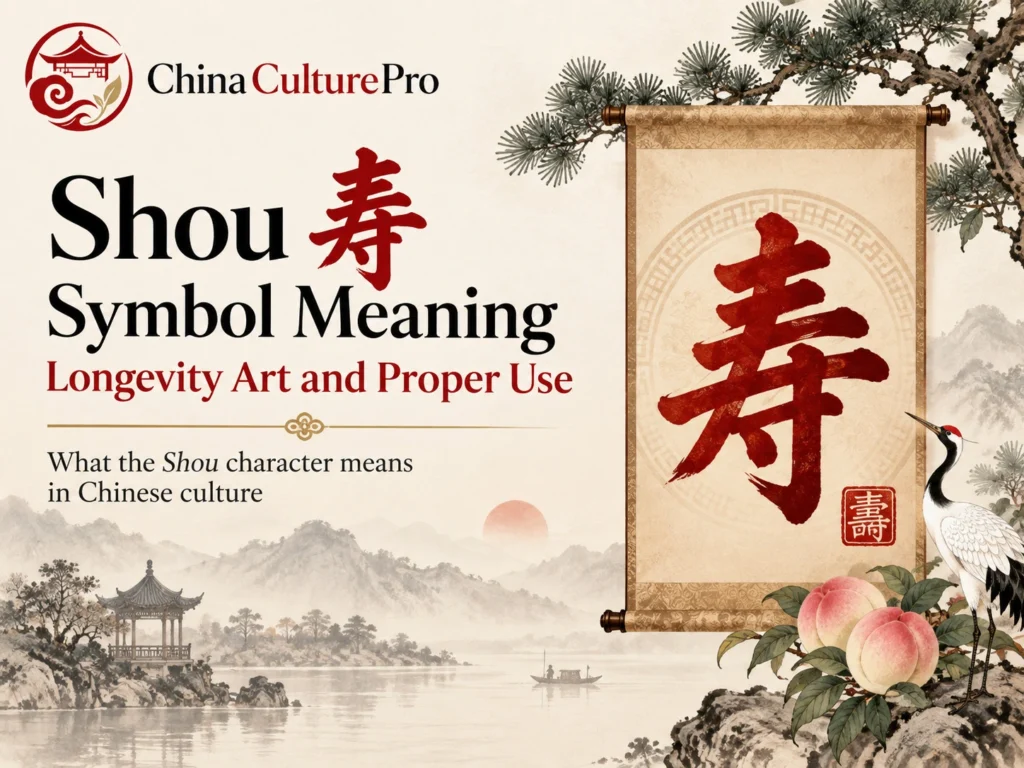
Shou (寿/壽, shòu) is the Chinese character for longevity and a wish for long life (长寿/長壽, chángshòu). When displayed by itself, it functions as both readable writing and an auspicious decorative emblem.
- Forms: 寿 is simplified Chinese; 壽 is traditional Chinese. They have the same pronunciation and meaning.
- Main settings: The character appears on birthday gifts, calligraphy, textiles, ceramics, furniture, and jewelry.
- Interpretive limit: Shou does not literally mean health, life in general, or immortality.
- Related imagery: It may appear with peaches, cranes, pine trees, bats, or the personified Longevity Star.
- Cultural force: It expresses a wish for long life; it does not medically or supernaturally extend one.
The safest English translations are “longevity” and “long life,” chosen according to the sentence.
A Shou character may be plain enough to read instantly or transformed into a circular, symmetrical, or highly calligraphic design. This guide explains how to read those forms without confusing the written character with a deity, an animal motif, or a generalized “Asian good-luck symbol.” For a wider framework, see our guide to Chinese symbols and meanings.
What Does Shou Mean in Chinese?
The meanings of 寿 stay centered on duration of life. It can refer to longevity, lifespan or age, a birthday, and the act of honoring someone on a birthday. In decorative contexts, however, its dominant message is a positive wish for long life.[1]
| Chinese term | Pinyin | Best English sense | Important limit |
|---|---|---|---|
| 寿/壽 | shòu | longevity, lifespan, birthday-related honor | As a decorative emblem, it normally conveys longevity |
| 长寿/長壽 | chángshòu | long life, longevity | The clearest everyday expression of living a long time |
| 生命 | shēngmìng | life, living existence | Broader than Shou; it does not specifically imply duration |
| 健康 | jiànkāng | health | Related to long life, but not the literal meaning of Shou |
| 长生不老/長生不老 | chángshēng bùlǎo | agelessness or mythical immortality | A stronger religious or mythic idea, not a default translation of Shou |
Some compounds beginning with 寿 are euphemisms for burial clothing or coffins. They do not change the positive meaning of Shou on a birthday gift or decorative object.
What Is the Difference Between 寿 and 壽?
寿 and 壽 are two standard written forms of the same character. 寿 is the simplified form used in mainland Chinese publishing and everyday writing. 壽 is the traditional form used in Hong Kong, Macao, Taiwan, historical objects, and many calligraphic or heritage-style designs. Neither form is more auspicious.[2]
Calligraphy can alter the character dramatically. Seal, clerical, regular, running, cursive, circular, and symmetrical versions may look unlike one another while preserving the same meaning. The tradition of Hundred Shou Pictures (百寿图/百壽圖, bǎishòutú) arranges the character in many historical or stylized forms. A surviving museum panel shows ten forms and may once have belonged to a set of one hundred; these are artistic variations, not different blessings.[4]
How Is the Shou Symbol Used in Birthdays and Decorative Art?
Birthday Wishes and Gifts
Shou is especially appropriate for birthday celebrations, traditionally including milestone birthdays and events honoring older relatives. It appears in calligraphy, hanging panels, greeting cards, gift packaging, cakes, peach-shaped birthday buns, and bowls of longevity noodles. The message is respectful: “May you enjoy a long life.” It does not imply that the recipient is weak or unwell.
An eighteenth-century gold-thread tapestry panel centers the Shou character as a birthday wish and was probably made as a celebration display or gift. This kind of object shows that the character’s birthday role is not a recent marketing invention.[5]
Calligraphy, Textiles, Ceramics and Furnishings
A written character becomes a decorative emblem when enlarged, repeated, placed in a central medallion, or reshaped through calligraphy. Examples occur on hangings, garments, porcelain, lacquer, furniture, and personal accessories. By the Ming and Qing dynasties, Shou and other longevity motifs were established themes for birthday and retirement objects.[3]
The design may use one large character, a circularized form, or a field of repeated characters. Repetition can form an all-over pattern, while a single medallion makes longevity the visual center. The layout changes emphasis, not the blessing itself. Stylization does not create a new mystical meaning, and not every round or symmetrical Chinese motif is Shou. On an unfamiliar object, check whether the strokes remain recognizable and interpret the character together with the object’s date, medium, use, and surrounding images.
How Does Shou Relate to Shouxing and Other Longevity Symbols?
Shou, Shouxing and Fu Lu Shou
Several related ideas share a longevity theme but use different symbolic carriers:
| Form | Type | Main meaning | How to recognize it |
|---|---|---|---|
| Shou (寿/壽, shòu) | Written character | Longevity or a wish for long life | A readable or stylized Chinese character |
| Shouxing (寿星/壽星, Shòuxīng), also called Shoulao (寿老/壽老, Shòulǎo) | Personified figure | The Longevity Star or god of longevity | An elderly man, often with a high forehead, staff, peach, deer, or crane |
| Fu Lu Shou (福禄寿/福祿壽, Fú Lù Shòu) | Three-part blessing system | Blessings, status or emolument, and longevity | Three deities or the three characters shown together |
| Five Blessings (五福, wǔfú) | Classical blessing framework | Five dimensions of a fortunate life | Longevity is one member of the set, not the whole system |
The written character can appear beside the deity, but it is not a picture of him. Likewise, adding 福 and 禄 broadens the message; those meanings are not hidden inside 寿.
Peaches, Cranes, Pine, Bats and the Five Blessings
Longevity art often builds meaning through a group of complementary motifs.[3][6]
- Peaches: Refer to long life through stories of the Queen Mother of the West and her peaches of immortality.
- Cranes: Suggest longevity through their association with immortals and venerable old age.
- Pine trees: Evoke endurance and long life because they are evergreen and long-lived.
- Tortoises, deer, and lingzhi: Support longevity readings in particular artistic combinations.
- Bats: Represent blessings because 蝠 (fú, “bat”) sounds like 福 (fú, “blessing”); a bat does not literally mean Shou.
Five bats around a central Shou character can form a “Five Blessings surrounding longevity” design. The bats supply blessing imagery, while the character states longevity directly. Our guide to bat symbolism in Chinese culture explains the wordplay.
How Should You Use or Interpret the Shou Symbol?
Use this six-step check for a gift, artwork, household object, or tattoo:
- Identify the character. Confirm that the design is 寿 or 壽 rather than a similar ornament, mirrored form, or invented glyph.
- Read the setting. A birthday gift, historical textile, modern pendant, and ordinary printed word may use the character differently.
- Choose the script deliberately. Match simplified or traditional writing to the audience, region, and design style; do not mix scripts accidentally.
- Verify ornate calligraphy. Ask a native reader or qualified calligrapher to check highly circularized, seal-script, or cursive forms.
- Check permanent designs. Before tattooing, carving, or painting, confirm every stroke, the upright direction, and the absence of mirroring.
- Keep the claim cultural. Use Shou to express a wish for longevity, not as a promise of healing, protection, wealth, or extra years of life.
Common Misreadings of the Shou Symbol
| Misreading | More accurate interpretation |
|---|---|
| Shou is the generic Chinese word for “life” | It centers on lifespan and longevity; 生命 is the broader word for life |
| Shou literally means health | Health may support longevity, but 健康 is a different word |
| Shou means immortality | Mythical agelessness is a stronger concept than an ordinary long-life wish |
| The character is the God of Longevity | Shou is writing; Shouxing is a personified figure |
| Traditional 壽 is more authentic or powerful | 壽 and 寿 are standard forms of the same character and carry the same meaning |
| A circular Shou has extra mystical power | Circularization is a decorative treatment, not a separate supernatural symbol |
| Shou should be hung upside down like Fu | Shou has no widely recognized 倒/到 wordplay; upright display is the safe convention |
| Displaying Shou can extend life | It communicates a cultural wish and has no medical or supernatural effect |
FAQs About the Shou Symbol
Does Shou Mean Longevity, Health or Immortality?
Shou means longevity or long life. Health is related but expressed by a different Chinese word, while immortality belongs to stronger mythological or religious ideas. “Longevity” is the most accurate default translation.
Is 寿 the Same as 壽?
Yes. 寿 is simplified Chinese and 壽 is traditional Chinese. Both are pronounced shòu and convey the same long-life wish; the choice depends on region, audience, medium, and design style.
Is Shou the Same as the Chinese God of Longevity?
No. Shou is the written character for longevity. Shouxing or Shoulao is the personified Longevity Star, usually represented as an elderly man with distinctive attributes such as a staff or peach.
Should the Shou Character Be Displayed Upside Down?
Usually not. The familiar upside-down custom applies to 福 because “upside down” and “arrive” can form a spoken pun. Shou has no equivalent widespread convention, so upright display is the safest choice.
Sources
[1] Taiwan Ministry of Education. Revised Mandarin Chinese Dictionary: 壽
[2] Taiwan Ministry of Education. Dictionary of Chinese Character Variants: 壽
[3] The Metropolitan Museum of Art. Longevity in Chinese Art
[4] The Metropolitan Museum of Art. Panel with Longevity (Shou) Characters
[5] The Metropolitan Museum of Art. Panel with the Chinese Character for Longevity (Shou)
[6] Asian Art Museum. Hidden Meanings in Chinese Art