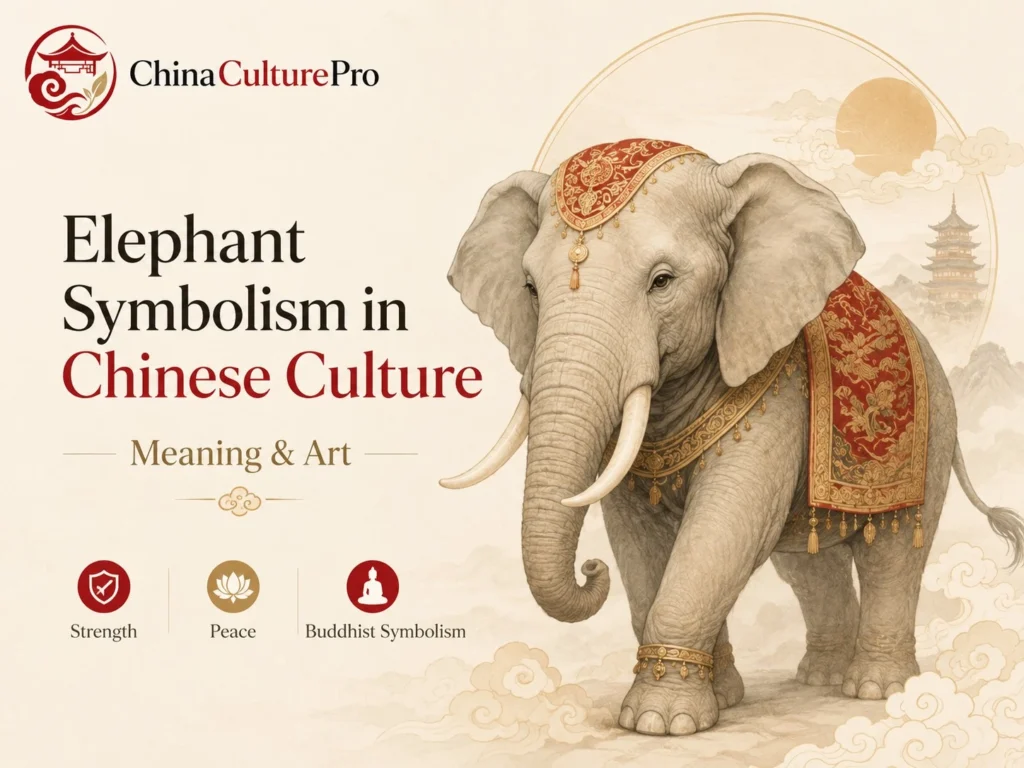

Quick Answer: What Does the Elephant Symbolize in Chinese Culture?
In Chinese culture, an elephant can symbolize strength, stable authority, Buddhist practice, courtly order, or peaceful rule. It has no single meaning across every period and object.
- Strength and gravitas: The animal’s size and controlled movement can support ideas of physical power, dignity, and stability, especially in ritual or courtly settings.
- Buddhist practice: A six-tusked elephant supporting Puxian belongs to a religious image system associated with disciplined action and the bodhisattva’s vows.
- Imperial power and tribute: Real elephants presented to the Ming and Qing courts could participate in diplomacy, submission, celebration, and procession.
- Peace made visible: In the late-imperial rebus taiping youxiang, an elephant carrying a vase expresses peaceful order through language and composition.
- Ordinary representation: An elephant can also be an animal subject or decorative form without any auspicious meaning.
These are historical and artistic meanings, not supernatural powers. An elephant image cannot guarantee wealth, fertility, protection, or changed fortune.
Popular summaries of Chinese symbols and meanings often reduce the elephant to luck, wealth, or good feng shui. Two museum objects show why that shortcut fails. A late Shang bronze elephant from Anyang was an elite ceremonial vessel, while a Liao gilt-bronze six-tusked elephant supported the throne of Puxian, the Buddhist bodhisattva Samantabhadra. The bodies look similar; their cultural jobs do not.
Chinese elephant imagery must therefore be read through date, medium, use, inscription, companion motifs, and cultural system. A Shang vessel, a Buddhist altar image, a Qing tribute elephant, and an elephant carrying a vase cannot share one automatic definition.
Why Did the Elephant Become Auspicious in Chinese Art?
No single origin made the elephant auspicious. Three different mechanisms accumulated over time.
First, real elephants were known in early north China. Smithsonian research notes that an elephant and its keeper were buried in a late Shang royal cemetery at Anyang, while divination records mention elephants as game in royal hunts. The evidence establishes living elephants and their value at the Shang capital; it does not establish that every elephant image was a blessing or that elephants were routinely used for farming and war.[1][2]
Second, Chinese artists built visual rebuses from sound and meaning. In modern Standard Mandarin, 象 (xiàng, elephant or phenomenon) and 祥 (xiáng, auspicious) sound similar but have different tones, so they are better described as a near-sound association than a full homophone. Stronger puns occur when a vase or saddle appears: 瓶 (píng, vase) is exactly homophonous with 平 (píng, peace), while 鞍 (ān, saddle) matches 安 (ān, safety or calm). The object in the composition matters; a lone elephant cannot supply words that are not pictured.
Third, Buddhism introduced another symbolic system. The six-tusked white elephant became the vehicle of Puxian, or Samantabhadra, and elephant-washing scenes developed Buddhist wordplay about the phenomenal world and attachment. These meanings concern practice and insight, not secular luck.
The characters themselves should remain separate. 象 can mean an elephant, image, phenomenon, or manifestation; 像 means a likeness, image, or statue; and Buddhist 相 (xiàng) refers to appearance or form. Similar sound or spelling does not make the concepts interchangeable.
How Elephant Symbolism Changed Across Chinese History
Real Elephants and Ritual Art in Early China
Elephants in Shang art were not merely fantasies about a distant tropical animal. Archaeological and written evidence places living elephants at Anyang more than three thousand years ago. The Smithsonian’s environmental history identifies an elephant-and-keeper burial and court divination records that treated elephants as royal hunting game. Ivory and elephant images further show that the animal was materially and visually valued.[2]
The National Museum of Asian Art’s bronze Spouted Vessel (He) in the Form of an Elephant with Masks (Taotie), Dragons, and Snakes makes the point tangible. Probably made at Anyang around 1100 BCE, the covered ceremonial vessel is not a Qing good-luck ornament. Its animal body and cast decoration belong to late Shang elite bronze culture.[1]
A much later received text, the Lüshi Chunqiu, says that Shang people controlled elephants and used them violently in eastern campaigns. That passage shows how later writers remembered Shang elephants, but it should not be treated as a contemporary field report or proof that elephants were commonly employed in agriculture.[9]
The safest reading is therefore concrete: early elephant vessels participated in ritual display, technical virtuosity, and elite power. Later peace, wealth, and feng shui explanations should not be projected backward onto them.
Buddhist White Elephants and Puxian
Buddhist art gave the elephant a distinct religious identity. Puxian—Samantabhadra, the Bodhisattva of Universal Virtue—is conventionally associated with an elephant, just as Wenshu, or Manjushri, is associated with a lion. The Cleveland Museum of Art’s Caparisoned Elephant, made during the Liao dynasty around the eleventh century, has six tusks and holds Puxian’s throne. Its saddle cloth carries dragons among clouds, combining Buddhist function with Liao material splendor.[3]
The image can evoke Puxian’s practice, vows, and disciplined action, but the object’s identity depends on its whole program rather than color alone. A white elephant without a throne, bodhisattva, six-tusked form, inscription, or supporting Buddhist context is not automatically Puxian’s mount. Damaged and stylized works may preserve only some clues, so museum records and iconographic context take priority.
This elephant should also not be confused with Ganesha. Ganesha is an elephant-headed Hindu deity; Puxian’s elephant is an animal vehicle within Buddhist art. Similar anatomy does not merge the two religious traditions.
Tribute Elephants and Qing Court Auspice
By the Ming and Qing periods, living elephants could operate inside court diplomacy and ceremonial performance. Tribute elephants arrived from states to China’s south and southwest, were housed at Beijing’s Tame Elephant Facility, and appeared in imperial processions. Their political meaning was not simply “friendship.” A Meiji University study of Gurkha offerings in 1792 and 1795 shows that one gift followed Gurkha submission after war and signaled Qing victory, while another celebrated the Jiaqing emperor’s accession.[4]
At court, elephants could therefore visualize imperial reach, ordered hierarchy, and the ability to receive and maintain rare animals. They also took part in birthday celebrations. The Brooklyn Museum notes that Qing processions for an emperor’s birthday featured real elephants carrying vases, a spectacle that connected court ceremony to a rebus for peaceful times.[5]
Artisans transformed that processional image into portable jade, porcelain, textile, and decorative designs. This is where political order and popular auspice meet, but they remain distinguishable: a documented tribute elephant carried diplomatic history, while a small elephant-and-vase ornament condensed peace into visual wordplay.
Ordinary Elephant, Buddhist Elephant, Court Elephant, and Auspicious Motif: What Is the Difference?
The same species can perform six different cultural jobs. Classification should follow the object’s evidence, not whichever symbolic meaning is most familiar.
| Elephant image | Main clues | Cultural system | Primary function | Do not assume |
|---|---|---|---|---|
| Shang ritual elephant vessel | Bronze vessel form; taotie, dragon, or snake decoration; early date | Elite ritual art | Ceremonial use and display | Peace, wealth, or feng shui |
| Puxian’s elephant | Six tusks, throne or lotus support, Buddhist trappings, Puxian context | Chinese Buddhist art | Vehicle of Samantabhadra; practice and vows | Any white elephant is Puxian’s mount |
| Elephant-washing scene | Figures washing or sweeping an elephant; literati or Buddhist setting | Buddhist wordplay and painting | Examining illusion and sweeping away attachment | Bathing custom or money charm |
| Court tribute elephant | Realistic elephant, handler, procession, tribute record, imperial setting | Ming-Qing diplomacy and ceremony | Submission, celebration, imperial order | Neutral diplomatic gift or folk ornament |
| Taiping youxiang motif | Elephant carrying vase, sometimes with saddle and auspicious decoration | Late-imperial rebus art | Wish for peace and ordered prosperity | Every elephant means peace |
| Ordinary elephant subject | No decisive religious, court, or rebus clues | General representation | Animal study or decoration | Luck, protection, fertility, or wealth |
This distinction also places the elephant correctly within the wider landscape of Chinese animal symbolism. It is a real animal with several symbolic histories, not one of the Chinese mythical creatures and not a member of a formal calendrical system.
Common Elephant Motifs and Their Meanings in Chinese Art
Elephant motifs show how Chinese symbolism in art works like visual grammar. A vase, saddle, throne, bodhisattva, attendant, or inscription changes the sentence. Material alone is not enough: an elephant carved in jade and an elephant painted on porcelain may express different ideas, while ivory as a material does not automatically activate elephant symbolism.
Elephant and Vase: Taiping Youxiang
The best-known late-imperial motif is 太平有象 (tàipíng yǒuxiàng), commonly translated as “peace is manifest” or “when the elephant appears, there is peace.” Its power comes from several overlapping cues rather than from one perfect homophone.
The vase, 瓶 (píng), evokes 平 (píng), “peace.” The elephant, 象 (xiàng), can also suggest an appearance, phenomenon, or manifestation. When the animal carries a vase, the composition turns the abstract wish for peaceful order into an image. A saddle may add a separate 鞍/安 (ān) pun on safety or calm, but it should be read only when the saddle is actually present.
The Brooklyn Museum identifies an elephant carrying miniature vases as a rebus for peaceful times and connects the motif to Qing imperial birthday processions.[5] An altar frontal at the Minneapolis Institute of Art likewise identifies its elephant theme as taiping youxiang, “When the elephant presents itself, the universe is at peace.”[6] A Qing jade elephant carrying a vase at the Metropolitan Museum of Art shows how the formula could become a luxury court object.[10]
The phrase can suggest a peaceful reign, public order, or domestic wishes for calm. It does not mean that the object produces peace, and it should not be reduced to “elephant equals wealth.” Without the vase or another decisive cue, the full rebus is absent.
Washing the Elephant: Buddhist Wordplay and Purifying the Mind
The washing-elephant subject belongs to a different semantic world. A mid-seventeenth-century blue-and-white brush pot at the Metropolitan Museum shows figures washing an elephant. The museum explains that the subject, sao xiang, is a pun on the Buddhist idea that the phenomenal world is illusory.[7] Chen Zi’s Qing hanging scroll Washing the White Elephant develops related wordplay around sweeping away attachments, a central aim of Buddhist practice.[8]
English summaries sometimes reduce this to the equation “wash elephant = wash appearances.” That is too mechanical. The motif draws on several closely sounding and semantically related terms, and different labels use “washing” or “sweeping.” Its stable interpretive center is not hygiene but mental discipline: recognizing appearances as unstable and loosening attachment to them.
The scene may include attendants, monks, scholars, water, brushes, or a white elephant. If Puxian is absent, it should not automatically be recategorized as a Puxian image. Nor is it a secular prosperity charm. Its meaning comes from Buddhist-literate wordplay, and it also shows why Chinese porcelain patterns must be read through subject and use rather than decoration alone.
What Does Xiang Mean in Chinese Idioms and Language?
The sound xiang covers several characters and meanings. Only some expressions refer to an elephant as an animal.
| Expression | Which xiang? | Meaning | Why it matters |
|---|---|---|---|
| 盲人摸象, mángrén mō xiàng | 象, elephant | “Blind people feeling an elephant”: judging a whole from partial evidence | The animal drives the parable, but the phrase is critical, not auspicious |
| 包罗万象, bāoluó wànxiàng | 象, phenomena | Encompassing the vast range of things and phenomena | It does not make elephants symbols of encyclopedic knowledge |
| 万象更新, wànxiàng gēngxīn | 象, phenomena or scenes | Everything takes on a new appearance | A phrase about renewal, not an elephant motif |
| 气象万千, qìxiàng wànqiān | 象, scene or aspect | A magnificent, varied scene or condition | The character belongs to visual or atmospheric description |
| 人心不足蛇吞象, rénxīn bùzú shé tūn xiàng | 象, elephant | An insatiable person is like a snake trying to swallow an elephant | The elephant represents impossible scale within a warning about greed |
The board-game pieces written 象 or 相 in xiangqi belong to the vocabulary and rules of Chinese chess. Their names do not turn the animal into a zodiac sign, universal guardian, or good-luck emblem.
Language can help explain a picture when the composition deliberately activates a pun. It should not be run backward: the existence of wanxiang gengxin does not mean an elephant painting promises renewal, just as the parable of blind people and the elephant does not define a Shang bronze.
What a Chinese Elephant Symbol Does Not Automatically Mean
| Common claim | More accurate reading |
|---|---|
| Every Chinese elephant means wealth and good luck | Some late-imperial motifs express peace or auspice. Shang ritual, Buddhist, court, and ordinary animal images have different functions. |
| 象 and 祥 are exact homophones | In modern Standard Mandarin, xiàng and xiáng differ in tone. They can support near-sound association, not a full homophone claim. |
| A raised trunk attracts money and a lowered trunk stores it | No single documented rule governs trunk direction across historical Chinese art. Such charts largely reflect modern commercial convention. |
| Every white elephant is Puxian’s mount | Identification requires Buddhist context and usually several iconographic clues, such as six tusks, a throne, trappings, the bodhisattva, or an inscription. |
| An elephant is one of the Chinese zodiac animals | The twelve-animal cycle does not include an elephant. |
| A Chinese elephant is another form of Ganesha | Ganesha is a Hindu elephant-headed deity; Puxian rides an elephant in Buddhist art. The figures and traditions are distinct. |
| Elephant objects guarantee protection, fertility, or changed fortune | These claims are not effects of the artwork. Historical motifs communicate values, political ideas, teachings, and wishes. |
The same caution applies to modern “feng shui elephant” advice. A household may choose an elephant as a personal sign of stability or protection, but that choice should be labeled as modern use. It should not be presented as a universal ancient Chinese placement code.
How to Interpret or Use a Chinese Elephant Symbol Correctly
Use the following sequence for museum objects, antiques, architecture, tattoos, logos, or home decoration:
- Identify the image type. Is it a real elephant, an elephant-shaped vessel, Puxian’s vehicle, a tribute animal, a washing scene, or an elephant carrying a vase?
- Date the work. A late Shang bronze, Liao Buddhist sculpture, Ming brush pot, Qing court ornament, and modern tattoo follow different conventions.
- Read the carrier. Vessel shape, altar function, processional setting, porcelain surface, architectural location, and personal body art create different interpretive limits.
- Check the complete composition. Count tusks and look for a throne, lotus, bodhisattva, vase, saddle, attendants, inscription, or court setting. A ruyi is its own auspicious object; its presence does not make every elephant part of one fixed formula.
- Test the language precisely. Separate exact homophones such as 瓶/平 from near-sound associations such as 象/祥, and keep 象, 相, and 像 conceptually distinct.
- Separate history from adaptation. A modern logo may place the elephant among Chinese symbols for strength, and a personal design may frame it as one of the Chinese symbols for protection. Those are deliberate modern choices, not proof of one ancient universal code.
For a museum label, lead with the institution’s object name, period, and use. For a modern design brief, name the intended reference: “Qing-inspired elephant-and-vase motif for peaceful order” is more accurate than “Chinese elephant for luck.” Place it within the wider history of Chinese auspicious objects only when the dated context supports that category. For Chinese symbolism in architecture, interpret the building’s date and ritual setting before assuming a guardian function. For commercial copy or a Chinese-symbol tattoo, describe the image as a cultural or personal statement rather than claiming it attracts money, protects a home, or changes fertility.
Final Takeaway
The elephant in Chinese culture is not one timeless lucky symbol. It can belong to Shang ritual, Buddhist iconography, Qing tribute politics, rebus art, philosophical wordplay, or ordinary decoration. Date the work, identify its carrier, read every companion element, and then choose the narrowest meaning supported by evidence.
FAQs About Elephant Symbolism in Chinese Culture
Is the Elephant One of the Chinese Zodiac Animals?
No. The traditional Chinese zodiac contains rat, ox, tiger, rabbit, dragon, snake, horse, goat, monkey, rooster, dog, and pig. Elephant imagery has ritual, Buddhist, courtly, and auspicious histories, but those histories are independent of the calendrical zodiac system.
Does an Elephant’s Trunk Direction Have a Fixed Chinese Meaning?
No cross-dynastic Chinese rule assigns fixed luck, wealth, or protective effects to an elephant’s raised or lowered trunk. Direction may serve balance, movement, or the object’s physical design. Modern shops and feng shui guides often supply their own codes, but those should not be used automatically to interpret historical art.
Is Every White Elephant the Mount of Puxian?
No. White color alone is insufficient. Puxian’s elephant is normally identified through a combination of Buddhist context and visual evidence, which may include six tusks, a throne or lotus support, elaborate trappings, the bodhisattva, an inscription, or a related sculptural group. Damaged objects require particular caution.
What Does a Chinese Elephant Tattoo Mean?
A modern elephant tattoo can express strength, steadiness, peace, disciplined action, or a personal connection to Buddhist or Chinese art. Its exact meaning comes from the chosen composition. An elephant with a vase differs from Puxian’s six-tusked vehicle or an elephant-washing scene. No historical Chinese code fixes trunk direction, color, or number, and the tattoo has no supernatural effect.
Sources
[1] Smithsonian National Museum of Asian Art. Spouted Vessel (He) in the Form of an Elephant with Masks (Taotie), Dragons, and Snakes, F1936.6a-b.
[2] Smithsonian National Museum of Asian Art. Art and the Environment.
[3] Cleveland Museum of Art. Caparisoned Elephant, c. 1000s, 1980.24.
[4] Yuri Komatsubara. “The Gurkha’s Offerings of Elephants and the Qing Court’s Responses in 1792 and 1795”. Meiji Asian Studies 1 (2019).
[5] Brooklyn Museum. Figure of an Elephant with Two Miniature Vases, 20188.
[6] Minneapolis Institute of Art. Altar Frontal, 42.8.288.
[7] Metropolitan Museum of Art. Brush Pot with Scene of Washing an Elephant, 2008.80.
[8] Metropolitan Museum of Art. Chen Zi, Washing the White Elephant, 1976.191.
[9] Chinese Text Project. Lüshi Chunqiu: Ancient Music.
[10] Metropolitan Museum of Art. Elephant Carrying a Vase, 02.18.740.