


Quick Answer: What Is the Zhouli?
The Zhouli (周礼, Zhōulǐ), or Rites of Zhou, is a classical account of government organized through offices and their duties. Also known as the Zhouguan (周官, Zhōuguān), it describes an ordered royal realm through administration, ritual, resources and production.[1][7]
- Structure: Six major divisions named for Heaven, Earth and the four seasons.
- Reading unit: An office entry, often with a staff list followed by responsibilities.
- Special case: The Kaogong Ji (考工记, Kǎogōng Jì), or Artificers’ Record, occupies the Winter position in the received text.[6][7]
Its prescriptions show how authority is imagined and assigned. They are not, by themselves, proof that every listed arrangement operated exactly as written.
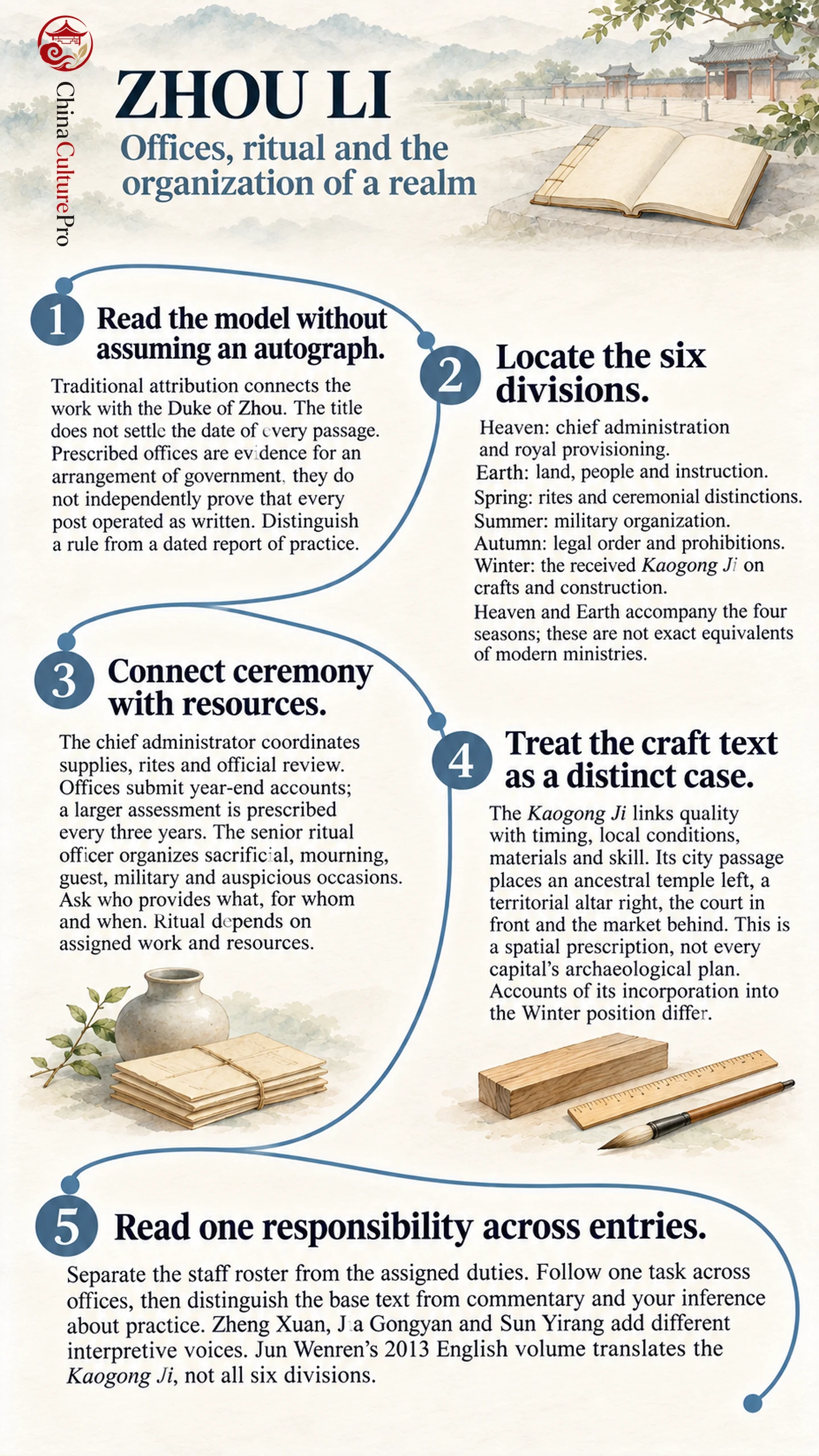
Why would a book called the Rites of Zhou discuss accounts, officials, materials and city planning? Its subject is the organization of a realm. Ceremonial duties form part of that order alongside the management of people, resources and work.
A Model of Government and a Disputed Attribution
Traditional attribution connects the work with the Duke of Zhou (周公, Zhōugōng). That attribution should be distinguished from secure identification of a single author or an original manuscript. The book’s transmitted shape and the history of its final section pose separate questions.[7][8]
Use the Zhou dynasty (周朝, Zhōu Cháo) as the historical world invoked by the title, without making the title settle the date of every passage. A prescription for what an official should do is different from a dated report that a named official actually did it.
The difference becomes visible in the opening of several divisions: the king establishes the realm, assigns positions and sets out offices. What follows is an arrangement of responsibilities. Its systematic organization is valuable evidence for ideas about government, while claims about actual institutions require comparison with other records.[1][2][3][4][5]
The Six Offices: Heaven, Earth and the Four Seasons
These English descriptions identify the main functions of each division. They are not exact equivalents of modern ministries.[1][2][3][4][5][6]
| Division | Main focus |
|---|---|
| Heaven: Tian Guan Zhongzai (天官冢宰, Tiānguān Zhǒngzǎi) | Chief administration, royal provisioning and the coordination of official business. |
| Earth: Di Guan Situ (地官司徒, Dìguān Sītú) | Land, people, production and instruction. |
| Spring: Chun Guan Zongbo (春官宗伯, Chūnguān Zōngbó) | Rites, ceremonial distinctions and ritual service. |
| Summer: Xia Guan Sima (夏官司马, Xiàguān Sīmǎ) | Military organization and related commands. |
| Autumn: Qiu Guan Sikou (秋官司寇, Qiūguān Sīkòu) | Prohibitions, legal order and punishments. |
| Winter: Dong Guan (冬官, Dōngguān) | Occupied in the received book by the Kaogong Ji on crafts and construction. |
Heaven and Earth stand alongside the four seasons in this scheme of classification. Responsibilities also cross the neat boundaries suggested by a modern organization chart: supplying a ceremony, keeping accounts and assigning rank can involve several offices.
Ritual, Resources and Official Accountability
The Dazai (大宰, Dàzǎi), the chief administrator in the Heaven division, coordinates different kinds of government business. Its entry includes the allocation of resources, preparation for major rites and the review of official performance. At year’s end, offices submit accounts and reports; a larger assessment is prescribed at a three-year interval.[1]
Read those reporting duties beside the ritual responsibilities in the same entry. Ceremonial acts require supplies, preparation and assigned personnel. Here, ritual is an administrative undertaking as well as a meaningful arrangement of rank and relations.
The Dazongbo (大宗伯, Dàzōngbó), the senior ritual officer in the Spring division, organizes rites connected with sacrifice, mourning and distress, guests, military affairs and auspicious social occasions. Those categories encompass relationships among states and households, not simply the conduct of an isolated worshipper.[3]
One productive reading question is therefore: who must provide what, for whom and on which occasion? It connects the prescribed ceremony with the network of offices that makes it possible, without treating every listed headcount as an observed workforce.
The Kaogong Ji: Craftsmanship and the Planned City
The Kaogong Ji changes the reading pattern. Instead of continuing only with office rosters and duties, it discusses the work of craftspeople. In its opening, quality depends on the conjunction of timing, local conditions, suitable materials and skill. These are the text’s explanatory categories, not a claim that every associated ancient explanation matches modern science.[6]
Its Jiangren (匠人, Jiàngrén) passage on construction sets out a concrete spatial prescription: an ordered capital with gates and intersecting roads, an ancestral temple to the left, a territorial altar to the right, the court in front and the market behind. Read it first as a spatial statement of political and ritual order.[6]
The text can inform questions about Chinese architecture, but it does not supply a measured archaeological plan of every early capital. Comparison must establish which features a particular site actually shares.
Traditional accounts explain the craft text’s position as filling a missing Winter division. Scholarship also records competing accounts of when and by whom it was inserted, and later attempts to recover Winter offices from other divisions. A perfectly symmetrical set of sixty offices per division is not a secure basis for reconstructing a lost original.[8]
How to Read an Office Entry and Find English Resources
- Separate staff from duties: Record the title and staffing statement, then identify the action the entry assigns.
- Follow one responsibility: Choose accounts, sacrifice or construction and trace its connections across the relevant entries.
- Keep textual layers visible: Distinguish the base text, commentary and your historical inference. Ask what additional evidence would establish actual practice.
An edition with commentary adds further voices. Zheng Xuan (郑玄, Zhèng Xuán) supplied a major commentary; Jia Gongyan (贾公彦, Jiǎ Gōngyàn) provided a later subcommentary. Sun Yirang (孙诒让, Sūn Yíràng) wrote another extensive interpretive work. Their explanations are resources for reading difficult terms, not interchangeable parts of the base text.[7]
For English reading on the craft section, Jun Wenren’s Ancient Chinese Encyclopedia of Technology: Translation and Annotation of the Kaogong Ji was published in 2013. Its scope is the Kaogong Ji, not an English translation of all six divisions. Check an edition’s actual coverage before choosing it for a different office.[9]
FAQs About the Zhouli
Did the Duke of Zhou write the Zhouli?
It is traditionally attributed to him. That tradition does not establish a verified autograph, a single compositional date or his authorship of every received passage.
Why does the Winter Office contain the Kaogong Ji?
Traditional accounts treat it as supplying a missing division. The circumstances of its incorporation have been debated; its craft discussions differ from the office-entry format of the preceding parts.
Is the Zhouli the same book as the Liji or Yili?
No. The Three Rites (三礼, Sān Lǐ) groups the Zhouli with the Yili (仪礼, Yílǐ) and Liji (礼记, Lǐjì). They are three distinct works, not alternative titles of one text.[10]
Sources
[1] Public-domain Chinese text. Zhouli: Heaven Office and the chief administrator
[2] Public-domain Chinese text. Zhouli: Earth Office and the director of the people
[3] Public-domain Chinese text. Zhouli: Spring Office and the director of rites
[4] Public-domain Chinese text. Zhouli: Summer Office and the marshal
[5] Public-domain Chinese text. Zhouli: Autumn Office and the director of justice
[6] Public-domain Chinese text. Zhouli: Winter Office, Kaogong Ji
[7] Ministry of Education, Revised Mandarin Chinese Dictionary. Zhouli: title, traditional attribution and commentaries
[8] Sichuan University, Institute for the Study of Ancient Books. A discussion of the claim that the Winter Office was not lost
[9] CiNii Books catalogue. Jun Wenren, Ancient Chinese Encyclopedia of Technology (2013)
[10] Ministry of Education, Revised Mandarin Chinese Dictionary. San Li: the Three Rites