


Quick Answer: Who Was Wen Zhengming?
Wen Zhengming (文徵明, Wén Zhēngmíng; 1470–1559) was a Ming-dynasty painter, calligrapher and poet associated with Suzhou’s Wu School (吴门画派, Wúmén huàpài). His art brought cultivated places, earlier brush traditions and literary friendship together. [1]
- Best known for: Landscape painting, garden albums and distinctive calligraphy.
- Training: He studied painting with Shen Zhou.
- Useful starting point: Compare a garden album, a collector’s studio and a page of small writing. [1][2]
This guide explains museum works and their context; it does not authenticate privately owned paintings.
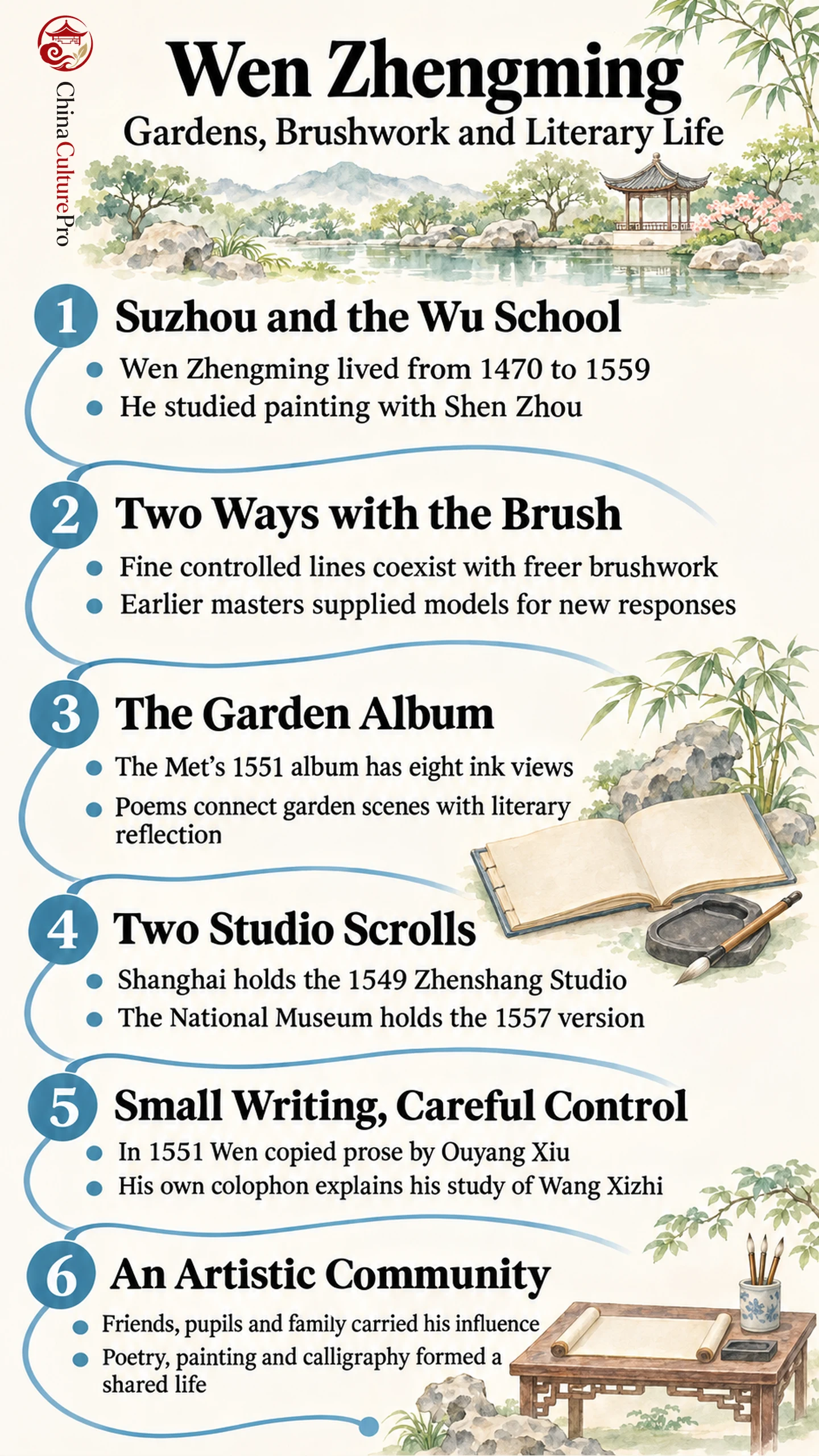
Wen’s gardens and studies connect looking with reading, collecting and friendship. Compare the pictured setting with the handling of brushwork and written text.
Suzhou, Shen Zhou and the Wu School
Wen came from Changzhou, now part of Suzhou, during the Ming dynasty. His artistic standing outlasted repeated disappointment in the imperial examinations: the Palace Museum records ten unsuccessful attempts between 1495 and 1522. He belongs to the Four Masters of the Ming (明四家, Míng sì jiā), alongside Shen Zhou, Tang Yin and Qiu Ying. [1]
Recommendation brought a Hanlin Academy appointment in 1523. He returned to Suzhou in 1527. His career therefore included court employment, followed by a long life devoted to the arts. [5]
Fine Lines and a Freer Brush
Wen’s painting has both closely controlled and broader, freer manners. He studied earlier masters including Zhao Mengfu, Wang Meng and Wu Zhen; one neat landscape does not define his entire range. [1]
The National Museum’s 1557 Zhenshang Studio scroll rewards attention to precise outlines. Two men examine a scroll inside a study furnished with books, bronzes and an inkstone. Confident lines distinguish rocks, architecture and clothing. These details connect brush control with the material world of scholar painting. [5]
Three Works: Gardens, Collecting and Calligraphy
These are separate objects. Dimensions describe the image or written sheet, excluding the mounting.
| Work | Date and collection | Format, material and image size |
|---|---|---|
| Garden of the Inept Administrator | 1551; Metropolitan Museum of Art | Eight-leaf album; ink on paper; each image 26.4 × 27.3 cm. [3] |
| Zhenshang Studio | 1549; Shanghai Museum | Handscroll; ink and color on paper; 36 × 107.8 cm. [4] |
| Record of the Pavilion of the Drunken Old Man | 1551; National Palace Museum, Taipei | Calligraphy hanging scroll; ink on paper; 53.5 × 28.6 cm. [6] |
The Garden Album: Poetry Alongside Painting
The Met’s eight-view album concerns Wang Xianchen’s garden in Suzhou, also known as the Humble Administrator’s Garden. Its ink views and accompanying poems connect the garden’s physical features with a reader’s literary associations. [3]
The surviving site has undergone extensive renovations. Wen’s scenes express a period response to Chinese gardens; they cannot serve as a precise map today. [3]
Calligraphy, Friendship and Artistic Legacy
Small regular script (小楷, xiǎo kǎi) is central to Wen’s calligraphy. In the Taipei work, he transcribed Ouyang Xiu’s prose and added his own explanatory colophon. His study of Wang Xizhi informed this exercise. Closely arranged characters and steady, finely controlled strokes give a practical way to recognize the work’s discipline. The literary author and the calligrapher are different people. [6]
Large running script (行书, xíng shū) offers another of his calligraphic styles. Summer Retreat in the Eastern Grove carries Huang Tingjian-inspired poems written in 1512 and a colophon added in 1515. These dates belong to written additions. Inscriptions and seals help distinguish such layers. [7]
Wen’s influence extended through friends, pupils and family members, including two sons and a nephew. His retirement combined reading, writing, poetry, painting and sociability: a sustained artistic community, rather than an isolated life outside society. [2]
FAQs About Wen Zhengming
Did Wen Zhengming paint only in ink?
No. The 1549 Shanghai Zhenshang Studio is a color painting on paper. His monochrome garden album represents one choice within a wider practice. [4]
Was Wen Zhengming a court artist?
He held a Hanlin Academy appointment from 1523 before returning home in 1527. His subsequent reputation centers strongly on Suzhou’s artistic world. [5]
Are the two Zhenshang Studio scrolls the same work?
No. Shanghai’s scroll dates to 1549; the National Museum holds a 1557 version made for the same friend, the collector Hua Xia. They should be identified by collection and version. [4][5]
Sources
[1] Palace Museum. Wen Zhengming
[2] Smithsonian National Museum of Asian Art. Wen Zhengming: Leader of the Wu School
[3] Metropolitan Museum of Art. Garden of the Inept Administrator
[4] Shanghai Museum. Wen Zhengming, Zhenshang Studio
[5] National Museum of China. Zhenshang Studio handscroll
[6] National Palace Museum, Taipei. Record of the Pavilion of the Drunken Old Man
[7] Metropolitan Museum of Art. Summer Retreat in the Eastern Grove