


Quick Answer: Who Was Wang Mian?
Wang Mian (王冕, Wáng Miǎn), commonly dated 1287–1359, was a Yuan-dynasty painter and poet from Zhuji in Zhejiang, especially celebrated for ink plum (墨梅, mòméi) painting. [2]
- Look for: Rough, forceful branches set against delicately drawn flowers. [1]
- Compare: Descending branches in his 1355 paper scroll with the tinted night setting of A Prunus in the Moonlight. [2][3]
- Read beyond the image: Original poems and later inscriptions can belong to different moments in a painting’s history. [2]
The historical painter should be distinguished from his fictional portrayal in The Scholars. [4]
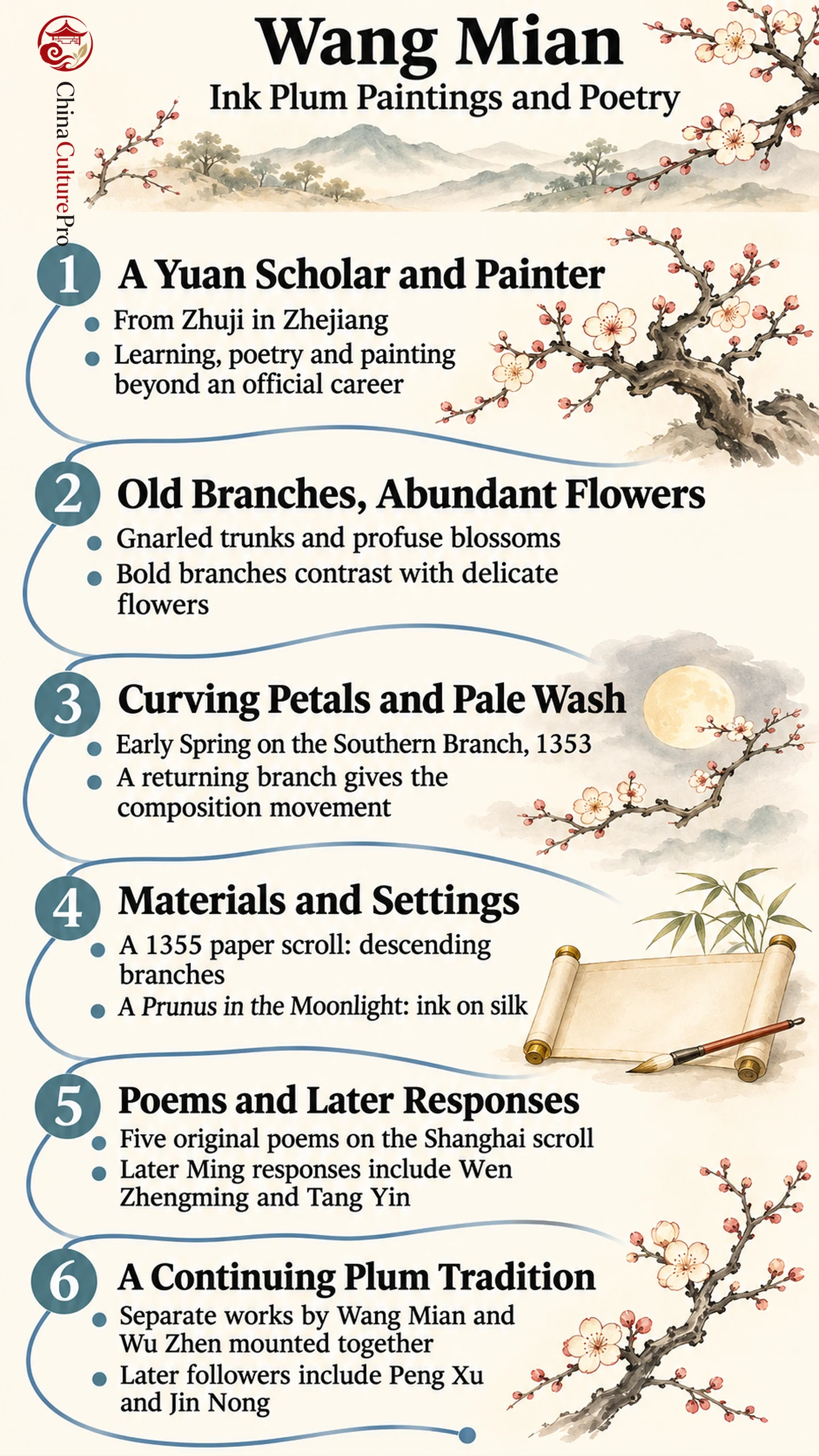
A plum branch gives Wang Mian room to contrast weight with fragility: an old trunk can carry a mass of small flowers. The works below show how that contrast changes across hanging scrolls, materials and settings.
A Yuan Scholar Who Sold Plum Paintings
Wang Mian’s career unfolded under the Yuan dynasty. After unsuccessful examinations, he declined appointments under Mongol rule and supported himself by selling plum paintings. His scholarly learning did not lead to an official career through the imperial examinations. [3]
His intellectual interests also included philosophy, politics and military planning. Poetry and painting belonged within this broader scholarly ambition, rather than replacing it. [1]
How His Ink Plum Paintings Work
A distinctive contribution was the combination of gnarled old trees with profuse flowers. This developed the earlier Song tradition of more sparsely arranged plum branches into a fuller, more concentrated image. [7]
In Fragrant Snow at Broken Bridge, delicate description of blossoms works alongside bold, calligraphic handling of rough branches. The contrast connects observation of a plant with the expressive brushwork associated with literati painting. [1]
Early Spring on the Southern Branch uses circled petals (圈瓣, quān bàn): flowers are drawn through curving brush movements. A pale surrounding wash helps them stand out. The trunk moves right before a long branch returns toward the upper left. Follow these painting techniques before interpreting symbolism. [4]
Four Museum Works to Compare
The measurements below refer to the painted image, rather than the entire mounting. All four are hanging scrolls.
| Work | Date | Material and image size | Collection |
|---|---|---|---|
| Fragrant Snow at Broken Bridge | 14th century | Ink on silk; 113 × 50.2 cm | Metropolitan Museum of Art. [1] |
| Ink Plum Blossom | 1355 | Ink on paper; 67.7 × 25.9 cm | Shanghai Museum. [2] |
| A Prunus in the Moonlight | 1300s | Ink on silk; 164.6 × 94.6 cm | Cleveland Museum of Art. [3] |
| Early Spring on the Southern Branch | 1353 | Ink on silk; 151.4 × 52.2 cm | National Palace Museum, Taipei. [4] |
The moon and tinted background in A Prunus in the Moonlight establish a nighttime setting. Its pale flowers need to be read within that setting, rather than automatically identified as snow. [3]
Poetry, Mounting and Artistic Afterlives
The Shanghai scroll carries five poems by Wang Mian himself. Its mounting also preserves later Ming response poems, including contributions by Wen Zhengming and Tang Yin. Reading inscriptions and seals therefore means distinguishing the artist’s voice from subsequent responses. [2]
Twin Purities of Plum Blossoms and Bamboo combines separate works by Wang and Wu Zhen. Mounting them together invites comparison of their painting and calligraphy; it does not establish a shared painting session. [5]
Peng Xu, active in 1488–1521, continued the vigorous branch handling, leaving pale streaks within dark ink to suggest bark and reserving flower petals against a gray wash. [6]
Wang Mian’s flowering compositions influenced Jin Nong. [4]
FAQs About Wang Mian
Did Wang Mian invent ink plum painting?
No. Song painters, including Yang Wujiu, supplied precedents for his work. [4]
Was Wang Mian mainly a lotus painter?
Surviving works chiefly show plums. Wu Jingzi’s eighteenth-century novel The Scholars portrays him as a lotus specialist. [4]
What do the pale flowers mean?
Early flowering made plum an emblem of renewal, purity and endurance through adversity. Plum blossom symbolism adds another layer to the visible brushwork. [1]
Sources
[1] Metropolitan Museum of Art. Fragrant Snow at Broken Bridge
[2] Shanghai Museum. Ink Plum Blossom, hanging scroll
[3] Cleveland Museum of Art. A Prunus in the Moonlight
[4] National Palace Museum. Early Spring on the Southern Branch
[5] National Palace Museum. Twin Purities of Plum Blossoms and Bamboo
[6] Cleveland Museum of Art. Ink Plum by Peng Xu
[7] Palace Museum. Wang Mian’s Plum Painting and the Southern Song Tradition in Yuan Literati Painting