


Quick Answer: What Are Scallion Pancakes?
Scallion pancakes, or cong you bing (葱油饼, cōng yóu bǐng), are savory Chinese flatbreads made from wheat dough. Green onion pancakes is another common English name.
- Ingredients: The familiar base is flour, water, scallions, fat and salt.
- Texture: Oiled, rolled layers give a crisp surface and a tender, slightly chewy interior.
- Eating context: They can be breakfast, a street snack or a restaurant side dish.
Despite the word pancake, the classic version uses dough rather than a poured batter. Thickness, fat and toppings vary; eggs and dipping sauce are not required ingredients.
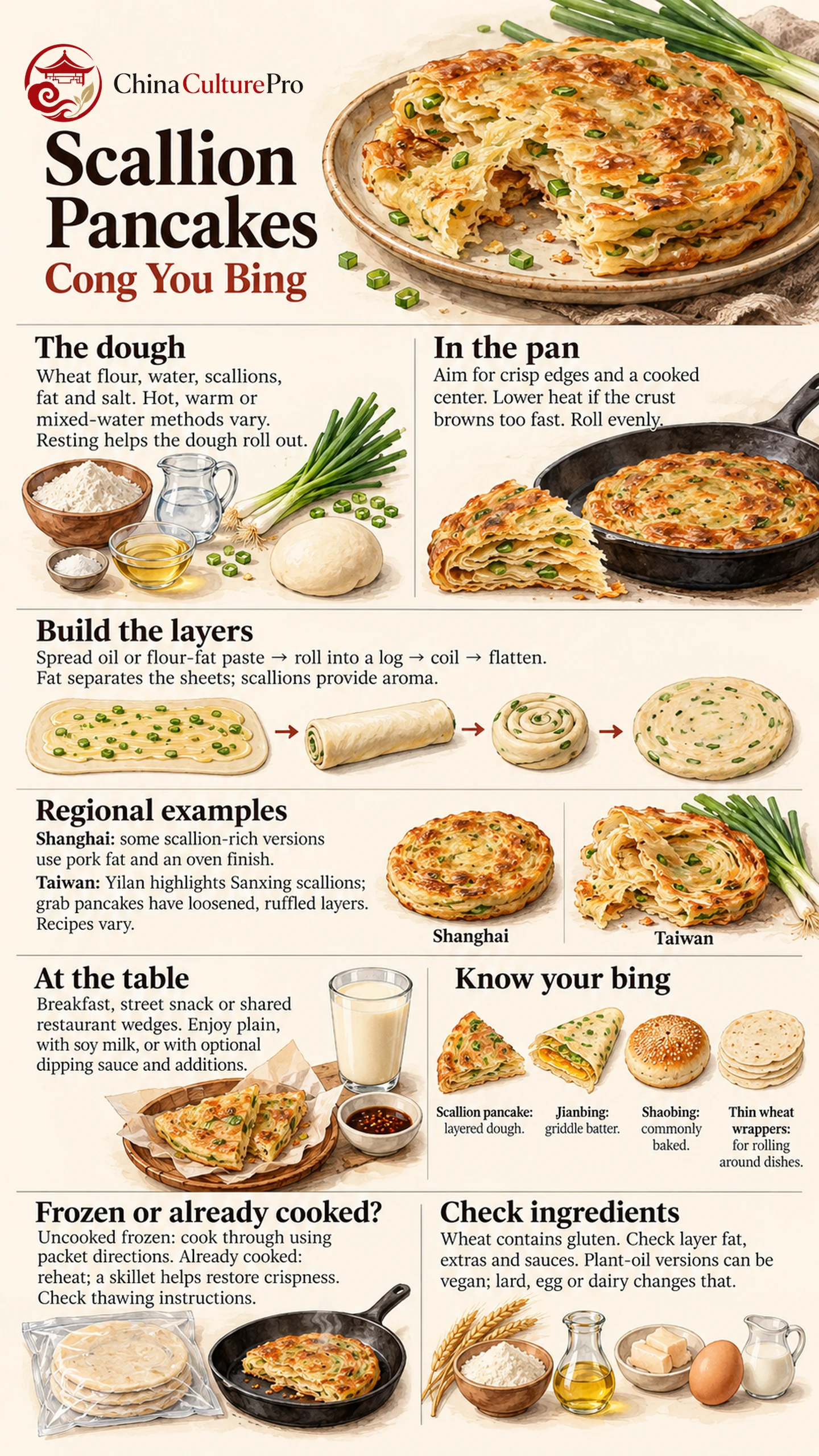
A fresh scallion pancake breaks with a crisp edge, revealing thin folds of dough flecked with green onion. The inside still has a gentle chew. This combination places it among the most recognizable Chinese flatbreads, while its English name can obscure the rolling and layering that make it distinctive.
What Goes Into Cong You Bing?
Wheat flour and water provide the body of the pancake. The dough needs enough stretch to become a thin sheet, while chopped scallions supply their fresh allium aroma. Salt seasons the dough or filling. Neither eggs nor milk are necessary to make this basic combination.[1]
Fat has two jobs: separating the rolled dough inside and helping the outside brown in the pan. Plain oil can be brushed onto the sheet, or flour and fat can be mixed into a spreadable paste. That paste need not be cooked first and is not essential to every version. Vegetable oil and lard produce different aromas, so a meat-free appearance does not identify the fat used.[2]
Chop scallions small enough to distribute them through the filling without making the thin sheet difficult to roll. Their aroma should run through the pancake, rather than coming only from a garnish on top.
How Scallion Pancakes Get Their Layers
Hot-Water Dough and Resting
Hot water changes how wheat flour forms a dough, often making it less springy and easier to roll thin. A hot-water dough can still have some chew; it does not become gluten-free. Other recipes use warm water or combine hot and cool water, balancing tenderness with enough structure for shaping.[1][3]
Resting also matters. A covered dough can relax before rolling, so it resists the rolling pin less. If it keeps shrinking back, forcing it outward is not always the best response. The useful aim is a supple sheet that can be handled without constant tearing, rather than the most heavily kneaded dough possible.
Oil, Rolling and Coiling
One common shaping sequence creates layers this way:
- Roll the rested dough into a thin sheet and spread it with oil or flour-fat paste, scallions and seasoning.
- Roll the sheet into a log, enclosing the oiled surfaces inside it.
- Coil the log into a spiral and tuck the loose end underneath.
- Flatten and roll the coil into a pancake, keeping its thickness reasonably even.
The rolled surfaces become separate layers as the pancake cooks. This is a form of lamination, meaning sheets of dough separated by fat. Some methods repeat the rolling, but more handling does not automatically produce a better pancake.[3]
Pan-Frying for Crisp Edges and a Cooked Center
The pan must brown the surface while allowing heat to reach the center. If the outside darkens too quickly, the pancake can look finished while remaining doughy inside. Uneven rolling makes that balance harder: a thick middle and thin edges will not cook at the same rate.
Turn the pancake as needed and adjust the heat to its thickness and browning. The target is a cooked interior with distinct layers and a crisp exterior. Lower the heat if the crust is browning before the middle cooks through.
Regional Styles: Shanghai and Taiwan
Shanghai: Scallion-Rich Pancakes and Oven-Finished Versions
In Shanghai cuisine, scallion pancakes are familiar neighborhood snacks. Some street versions are generously filled with scallions and enriched with pork fat. A documented local method combines pan-frying with an oven finish, producing a browned crust around a softer center.[4]
The oven finish helps explain why a vendor’s pancake may differ from a thin, skillet-only home version. It does not mean every Shanghai pancake uses the same dough, fat or equipment. A regional name offers useful context, while the actual preparation tells you more about the bite you will get.
Taiwan: Scallion Pancakes and Flaky Grab Pancakes
Taiwan offers several related scallion-pancake forms. In Yilan, Sanxing scallions are associated with local scallion pancakes and filled scallion pastries, giving a concrete regional link between an agricultural ingredient and a street snack.[5]
Another menu name is cong zhua bing (葱抓饼, cōng zhuā bǐng), often called a flaky or grab pancake. During cooking, its edges can be pushed inward with a spatula to loosen the layers and give the pancake a more ruffled appearance.[6] The distinction is in the preparation and finished structure. It is not a reliable rule that all Taiwanese versions are thicker, use lard or contain Sanxing scallions. Additions also vary from one seller or product to another.
How Scallion Pancakes Are Served
At a Chinese breakfast stall, a pancake may be handed over whole or folded for eating on the move. At a restaurant, wedges make it easy to share as a starter or a starchy accompaniment. The same food can move between these settings without becoming a different dish.
As Chinese street food, its appeal includes the contrast between the hot, crisp surface and the softer layers inside. Plain versions let the scallion and fat carry the flavor. For breakfast, soy milk offers a familiar drink alongside the savory bread.
A dipping sauce may combine soy sauce and vinegar, with garlic, ginger or chili according to the preparation. Other servings add an egg or use the pancake around fillings. These choices change the meal, but they are additions rather than a definition of cong you bing. A pancake served without sauce is not missing an essential component.
Scallion Pancakes vs Other Chinese Flatbreads
The Chinese term bing (饼, bǐng) appears in names for a wide range of breads, pancakes and pastries. It does not identify one recipe or translate neatly into a single English category. These familiar savory examples differ in both their base and their usual purpose.
| Food | Base and method | Typical identifying feature |
|---|---|---|
| Scallion pancakes | Wheat dough, oiled and rolled, then pan-fried | Scallions within a layered, crisp-chewy flatbread |
| Jianbing | Batter spread thinly over a griddle | A crepe-like base, often folded around sauces and additions |
| Shaobing | Dough, commonly baked | Many versions have a sesame exterior, layers or fillings |
| Spring pancakes / thin wheat wrappers | Thin wheat dough sheets, cooked for wrapping | A pliable wrapper for vegetables, meat or other dishes |
The batter-versus-dough distinction helps separate a typical jianbing order from cong you bing. Shaobing has its own regional range, including baked sesame examples.[7][8] Use these clues together with the menu description; a single topping or the word pancake cannot identify every version.
Frozen Pancakes and Reheating
First establish whether a frozen pancake still needs cooking or is already cooked and only needs reheating. Read whether the packet describes an uncooked dough product or an already cooked pancake; their first preparation steps are different. Some uncooked products go directly from freezer to skillet. Follow the packet’s directions for thawing, added oil and cooking method.[9]
For a cooked pancake, a skillet can warm the center and help restore the surface crispness. Microwave heating alone tends to leave a softer result; it does not reproduce the same dry, browned surface. Freshly cooked pancakes also lose their crispness as they sit, especially when trapped steam moistens the exterior. Reheating may improve the contrast, although the texture need not match a pancake straight from its first cooking.[2]
Ingredient and Dietary Checks
For Chinese vegetarian food, judge the complete preparation rather than the visible scallions:
- Wheat: Conventional flour-based pancakes contain gluten. A vegetable filling does not change the flour.
- Fat: Plant oil can suit a vegan preparation, while lard or other animal fat cannot. Check the dough and layer filling separately.
- Extras: Egg, dairy or meat may be added to a particular product or serving, even though they are unnecessary in the basic dough.
- Sauces and contact: Check dipping sauces and ask about shared pans or work surfaces when an ingredient must be avoided.
Packaged pancakes provide a useful ingredient list, but one product’s list is not a rule for the whole category. A documented frozen version, for example, lists wheat, green onion and vegetable oils without egg.[10] “Plain” or “original” describes a flavor choice, not a guarantee of vegan ingredients.
FAQs About Scallion Pancakes
Are scallion pancakes made from batter?
Classic cong you bing use wheat dough that is rolled and layered. A batter spread thinly over a griddle is a different preparation, even if an English menu also calls it a pancake.
Are scallion pancakes vegan?
They can be. Check the dough, layer fat, toppings and sauce. Vegetable oil alone does not settle the question, and a pancake made with lard is not vegan, even without a meat filling.
Why are my scallion pancakes tough or doughy?
Possible causes include dough that resists rolling, damaged layers, uneven thickness or heat that browns the outside before the center cooks. Look at the whole process rather than changing one ingredient automatically.
Can you cook scallion pancakes from frozen?
Some products allow it, but follow the directions on that package. A raw frozen pancake needs cooking through; an already cooked frozen pancake needs reheating. Their instructions are not interchangeable.
Sources
[1] Taitung District Agricultural Research and Extension Station. 蔥油餅
[2] Maggie Zhu. Chinese Scallion Pancakes
[3] Hetty McKinnon / King Arthur Baking. Scallion Pancakes
[4] Minhang District / Shangguan News. 明星“安利”、国际“金奖”、祖传手艺……这些厉害小店,原来“藏”在这→
[5] Yilan County Tourism. 必吃美食攻略
[6] Ministry of Agriculture Children’s Website. 蔥抓優格沙拉捲
[7] Shanghai Municipal Government. Ten essential cooking verbs in Chinese
[8] Beijing Municipal Government. Recommended Cycling Routes in Xicheng District
[9] Oro Home Kitchen. Cooking Instructions/FAQ
[10] Wei-Chuan USA. Frozen Green Onion Pie