


Quick Answer: What Is Peach Blossom Study?
Peach Blossom Study (桃花书屋图, Táohuā Shūwū Tú) is a hanging scroll by Shen Zhou (沈周, Shěn Zhōu), dated to 1470 and held by the National Museum of China in Beijing. Ink and light color on paper depict a study among trees, water and rising mountains. A later inscription recalls the home Shen shared with his younger brother, giving the tranquil landscape a personal, mournful dimension.[1][2][3]
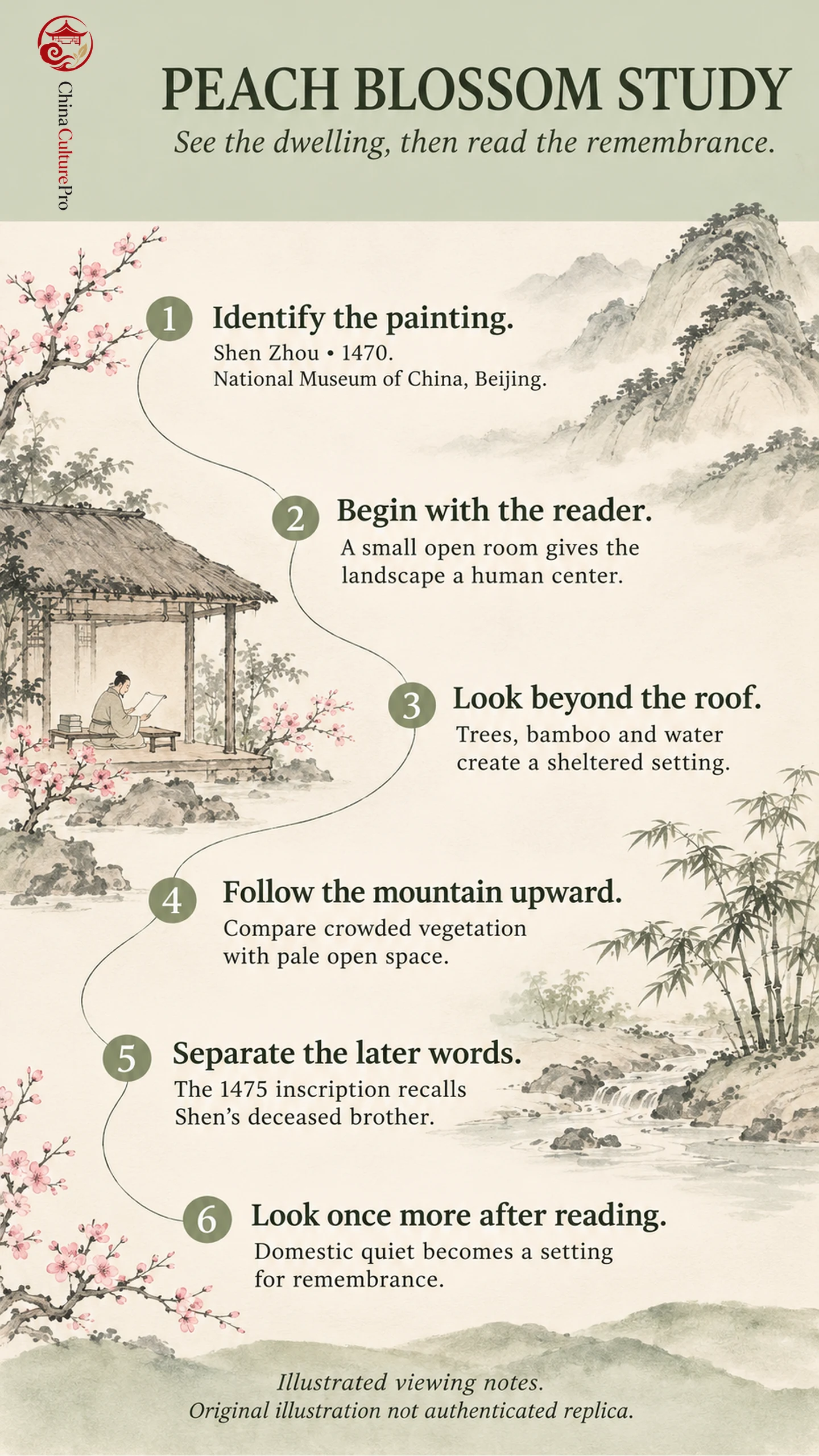
A small reader occupies an open room near the foot of a large mountain. At first, this looks like an image of uninterrupted quiet. The artist’s later words change that first impression: the peaceful dwelling also becomes a place remembered after a family loss.
The National Museum of China Scroll at a Glance
| Field | Identification |
|---|---|
| Common English title | Peach Blossom Study |
| Artist | Shen Zhou, 1427–1509 |
| Painting date | 1470, Ming dynasty |
| Format | Hanging scroll |
| Medium | Ink and light color on paper |
| Published dimensions | 74.5 × 30.6 cm |
| Collection | National Museum of China, Beijing |
The dimensions and 1470 date appear in the published research record. Rounded captions sometimes give approximately 74 × 31 cm. The museum identifies the work as a vertical scroll, so it should be approached differently from the long narrative handscrolls that also feature peach blossoms.[1][2]
Begin with the Small Room and Its Reader
Start low in the picture, where the open side of a modest building reveals a seated figure with reading material. The dark roof, slender supports and clearly bounded room make the human setting easy to locate within the denser vegetation.
Then look just beyond the room. Trees and bamboo gather around the dwelling, while water passes across the foreground. Their overlapping forms create a protected setting without sealing it off completely. The room remains open to the landscape it inhabits.
Here, “study” means a place for reading and cultivated life, rather than a preparatory exercise for a larger flower painting. The guide to the Chinese scholar’s study explains that cultural setting. In this image, the small reader makes the place meaningful: the building is occupied, and the landscape has a human center.
Avoid identifying the seated figure as a securely documented portrait from appearance alone. His small scale lets us recognize an activity more readily than an individual likeness. The later inscription supplies the family association that the figure’s face cannot establish.
The Mountain Enlarges a Domestic Setting
From the roof, follow the trees upward toward the tall mountain at the right. Repeated folds, terraces and fine dark accents carry the eye toward the summit. The house appears increasingly small as the surrounding landscape opens above it.
The pale interval to the left of the main mountain is equally important. It provides breathing room between the nearer trees and the larger forms behind them. Compare that open passage with the more crowded vegetation around the dwelling: the picture alternates closeness and distance within its narrow vertical format.
Fine outlines remain visible in the trees, roof and rock structures. Rather than treating the entire scene as a soft wash, look for the small marks that hold these forms together. The broader guide to Chinese landscape painting helps connect the domestic foreground with the larger mountain setting.
Do not let the title make you expect a wall of brilliant pink flowers. In the surviving image, the study, vegetation, mountain structure and written additions all compete for attention. The name and the words matter alongside the visible blossoms.
The Painting and the Inscription Belong to Different Moments
Shen’s inscription identifies the study as his family home and recalls living there with his brother Jinan (继南, Jìnán). It says the picture was made two years before his brother died, and that three further years had passed before these words were added. The inscription’s cyclical year corresponds to 1475.[3]
That relative chronology separates three events:
| Date | Event |
|---|---|
| 1470 | The painting was made before the family loss |
| 1472 | The brother’s death falls here in the inscription’s chronology |
| 1475 | Shen added the words of remembrance |
The verse recalls years of shared life, then turns to the speaker looking at the flowers alone. This is an account of absence within a familiar place. The landscape was already painted; the added text gave the viewer a later perspective on what remained.[3]
Read the room again after learning that sequence. Its quiet can still suggest reading and retreat, but it now also supports remembrance. This is a concrete example of how inscriptions and seals can change the interpretation of an image without changing its original painted forms.
Later Records Preserve the Work’s Personal History
A later collector’s record preserves the family inscription and additional poems associated with the painting. Modern research also connects the surviving scroll with a recorded viewing in 1616, when its inscriptions were transcribed. Such textual matches help trace a painting across later collections.[2][3]
Keep those later records separate from the image’s own chronology. A collector’s viewing date is not the date the mountain was painted; a red impression is not automatically Shen’s mark. In the museum image, the large red impression near the top is conspicuous, but its size does not make it the starting point for understanding the domestic scene.
The relationship between picture and writing belongs to Chinese literati painting. Looking at the landscape and reading its accompanying words are complementary acts, especially when the words record an experience that occurred after the picture was made.
How to Look at the Painting and Then Read Its Words
- Find the reader: Begin with the open room near the bottom of the scroll.
- Follow the vertical setting: Move from roof and trees toward the high mountain, comparing dense and open passages.
- Separate the dates: Distinguish the 1470 painting from the 1475 addition of remembrance.
- Look again after reading: Consider how the recalled family loss changes the room’s apparent quiet.
The guide to reading a scroll inscription develops this approach. The overview of Chinese scroll formats explains the vertical hanging format used here.
FAQs About Peach Blossom Study by Shen Zhou
Does “study” mean a preparatory flower sketch?
It means a reading room or dwelling. The painting presents an inhabited landscape, not simply botanical preparation for another work.
Was the painting made after Shen’s brother died?
The inscription says the picture preceded his brother’s death by two years. The words of mourning were added later; painting and remembrance should retain their separate dates.[3]
Is the scene a literal plan of the family home?
The inscription calls it the family home, but that does not make the mountain setting a measured architectural survey. Read the domestic association together with the painting’s composed landscape.[3]
Sources
[1] National Museum of China. Poetic Dwelling in Chinese Painting and Calligraphy
[2] Peng Huiping and Wu Xueshan. The Career and Intergenerational Legacy of the Late-Ming Forger Zhu Xiaohai
[3] Bian Yongyu. Collected Studies of Calligraphy and Painting, Volume 37: Peach Blossom Study Entry