

Quick Answer: How Do You Read a Chinese Scroll Inscription?
Start by identifying the scroll’s format and separating its different written voices. Chinese scrolls can combine an image, poetry, the maker’s comments and contributions by later viewers or owners.[1]
- Locate: Find each text block and its relationship to the image and mounting.
- Read: Establish the writing direction, transcribe the characters and identify names and dates.
- Interpret: Ask who wrote or stamped each mark and what it actually records.
A readable signature or date is evidence to investigate. It does not, by itself, authenticate the whole scroll.
Several hands can share the surface and borders of one Chinese scroll. What looks like a single signed picture may preserve a gift, a poem and responses added much later. Separate these contributions before translating their words or deciding whose name belongs to the painting.
Find the Format and the Reading Direction
A handscroll(手卷,shǒujuàn)is a horizontal roll traditionally viewed a section at a time. A hanging scroll(立軸,lìzhóu)is a vertical display format. Their text can occupy different parts of the object, so first look at the complete work rather than an isolated crop of a signature.[1]
Handscrolls normally unfold for viewing from right to left. A digital gallery can rearrange their sections for screen navigation: one university object guide explicitly presents successive sections from left to right while explaining that the original is read in the opposite direction. Use the catalog’s sequence, rather than assuming that a website’s first thumbnail is the physical beginning.[2]
Within traditional vertical writing, read a column from top to bottom and proceed through columns from right to left. Older texts often lack punctuation, and a person’s name is not necessarily marked off from the surrounding words. A short horizontal title needs its own orientation check; the overall scroll shape does not settle every text block’s direction.[3]
For difficult Chinese calligraphy, secure a reliable transcription before translating. Abbreviated brush forms can make a familiar character look unfamiliar; guessing a polished sentence first makes the original harder to check.
Separate the Artist, Later Writers and Seal Owners
The written additions belong to different roles. A poem can be part of the artist’s composition, while a response by another person may be written on added paper or even within the picture itself. Location helps, but “on the image” does not automatically mean “by the painter.”[4]
| Mark or text type | What to identify |
|---|---|
| Artist’s inscription(題款,tíkuǎn) | A note attributed to the maker, which may include a signature, date, dedication or comment |
| Colophon(題跋,tíbá) | An added response, interpretation or historical comment; identify its writer separately from the painter |
| Seal impression(鈐印,qiányìn) | A stamped mark that may belong to an artist, collector or viewer; read its legend before assigning its role |
Seals can carry personal names, studio names or short sayings. A collector may own several seals, so counting red squares does not count artists or owners. Seals also help document a work’s reception, but genuine paintings can carry false impressions and false paintings can carry genuine ones.[5]
The broader guide to painting inscriptions and seals explains these mark types. For this reading task, keep a separate line in your notes for each writer and seal owner instead of merging every name into one attribution.
A Dated Example: Hongren, a Place and a Recipient
A scholarly annotation of Hongren’s Lake Zhiyang and the Eastern Lake, held by the Museum of Fine Arts, Boston, transcribes the inscription as 癸卯春弘仁寓芝陽東湖上寄伯炎居士. The record dates the work to 1663. Reading this short text in parts reveals several different kinds of information.[6]
Gui-mao(癸卯,guǐmǎo)is the cyclical year designation, followed by 春, “spring.” 弘仁 is Hongren’s name. The middle portion places him at the East Lake of Zhiyang, and the closing phrase identifies Boyan as the recipient. The final honorific describes Boyan as a lay Buddhist; it is not a second painter’s signature.[6]
This is a reading explanation, not punctuation found in the original text. The translation should preserve who writes, where the writer is, when the note is dated and to whom the work is directed.
The stem-branch cycle(干支,gānzhī)repeats its sixty pairs. Gui-mao alone cannot distinguish 1663 from every other occurrence of that designation. Selecting a particular occurrence requires chronological context, such as the writer’s period, an era reference or the catalog’s research. A season still does not give an exact modern calendar day.[7]
Use the sixty-year cycle as a calendar aid, while keeping the inscription’s date separate from a later collector’s date elsewhere on the scroll.
A Five-Step Method for Reading an Inscription
Work from a clear, complete photograph and any available museum transcription. The goal is a note another reader can check against the object, not a confident translation with its uncertainties hidden.
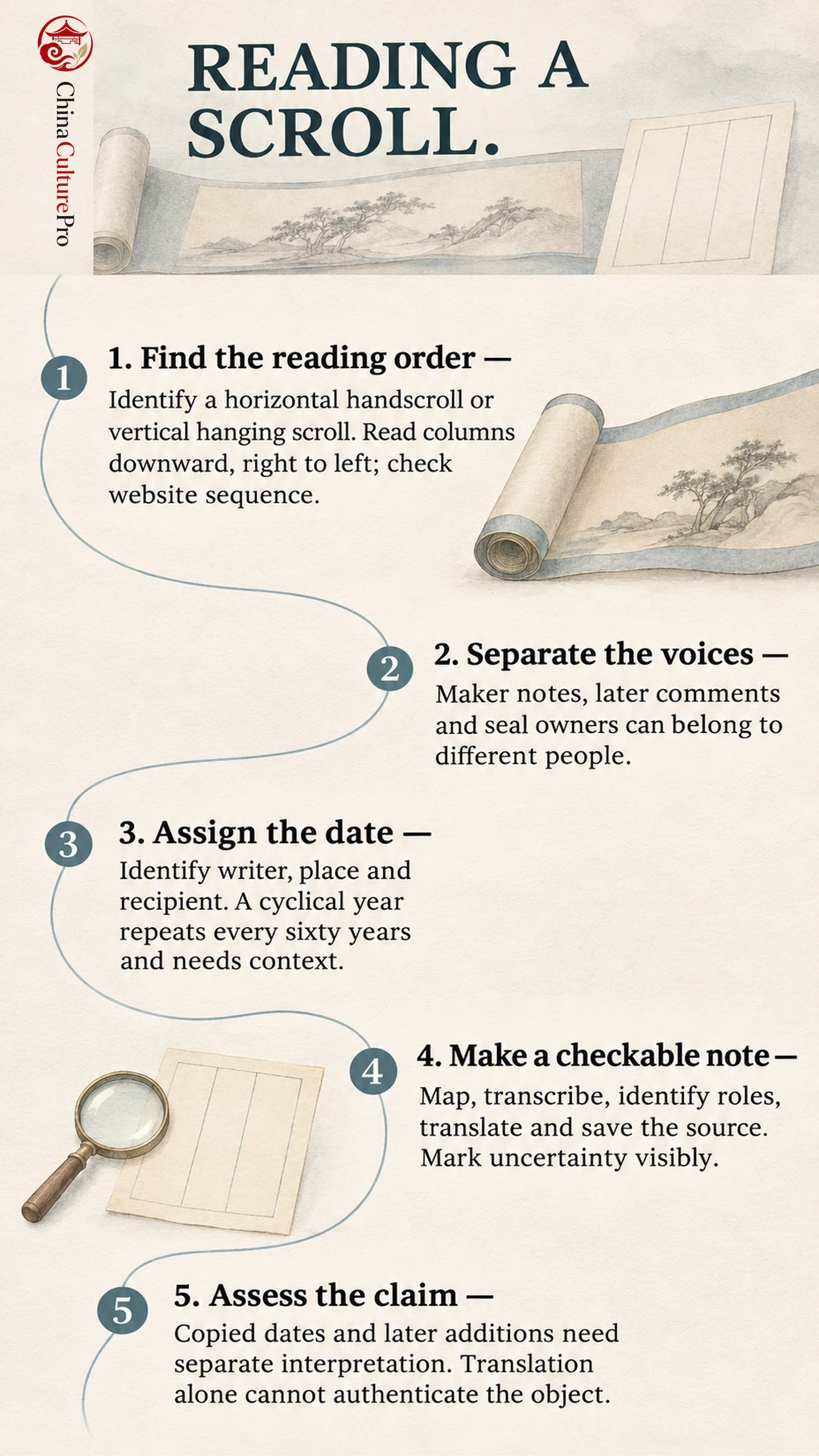
- Map the text blocks: Save the full view and label each inscription, seal and added panel. Preserve their positions before enlarging a detail.
- Transcribe what is visible: Follow the established writing direction. Keep uncertain or missing characters visibly unresolved instead of silently filling them in.
- Separate the information: Identify names, dates, places, dedications and the main poem or statement. Do not assume that the first name encountered is the painter.
- Translate with roles attached: State who is speaking and who is being addressed. Keep the original characters beside the interpretation for checking.
- Record the evidence source: Save the object title, catalog identifier, image or panel location, and the transcription used. Label a catalog attribution as an attribution.
Different contributors can include a painter, calligrapher, commissioner, collector and mounter. Research also examines remounting and the rearrangement of text-bearing material. Your notes should therefore distinguish a visible position today from an assumption about where the text originally belonged.[8]
Treat phone recognition as a draft transcription to check against the image or a scholarly transcription, especially where brush forms are abbreviated. Correcting the reading comes before turning it into a fluent translation.
What Written Marks Can and Cannot Prove
An inscription can preserve a writer’s statement about a work without making that statement correct. For Buddhist Temples amid Autumn Mountains, modern curatorial interpretation rejects the old artist signature and considers some accompanying colophons potentially transferred from other paintings. Their presence is part of the object’s history, not an automatic guarantee of the traditional attribution.[9]
Dates require the same care. The Canonization Scroll of Li Zhong reproduces a petition dated 1157, but the petition and painting are considered later copies. Appended colophons dated 1641 help bound the scroll’s history. The event described in a copied text and the manufacture of the surviving object are different dates.[10]
A useful reading result can therefore remain modest: “This note names a recipient,” “this collector recorded viewing it,” or “this passage reproduces an earlier document.” Authentication requires the wider material, stylistic and documentary evidence. Translation alone cannot provide that conclusion.
FAQs About Chinese Scroll Inscriptions
Are Chinese scroll inscriptions read from right to left?
Traditional vertical columns usually proceed from right to left, with each column read downward. Check each block and the digital image sequence.
Does a red seal identify the painter?
Not necessarily. It may belong to a collector or viewer, or carry a studio name or saying.
Can a cyclical date identify one exact year?
Not alone. The cycle repeats every sixty years, so other chronological evidence is needed.
Can a phone translation authenticate a scroll?
No. Recognizing and translating text does not establish the age, authorship or integrity of the object.
Sources
[1] Smithsonian National Museum of Asian Art. How to “Read” a Chinese Scroll
[2] University of Florida Libraries. Object in Focus: Xuanji Tu Scroll—Reading the Scroll
[3] Dawn Delbanco, Metropolitan Museum of Art. Chinese Calligraphy
[4] Maxwell K. Hearn, Metropolitan Museum of Art. Chinese Painting
[5] Serena Chu, Hong Kong Museum of Art. Vermillion Impressions: Chinese Painting and Calligraphy Seals
[6] University of Chicago, East Asian Scroll Paintings. Hongren: Lake Zhiyang and the Eastern Lake
[7] Hong Kong Observatory. Heavenly Stems and Earthly Branches
[8] University of Hamburg, Centre for the Study of Manuscript Cultures. Colophons on Chinese Paintings, ca. 1100–1900
[9] Pac Pobric, Metropolitan Museum of Art. A Poet’s Journey through Chinese Autumn Mountains
[10] Metropolitan Museum of Art. Canonization Scroll of Li Zhong