

Quick Answer: Who Was Li Kuchan?
Li Kuchan (李苦禅, Lǐ Kǔchán) was a modern Chinese artist and teacher known for bird-and-flower painting (花鸟画, huāniǎo huà). Eagles, lotus and other natural subjects became vehicles for powerful, expressive brushwork.[1][2]
- His xieyi (写意, xiěyì), or freehand expression, brings together simplified forms and a strong sense of character.[2]
- He studied Chinese painting with Qi Baishi and Western painting with Xu Beihong.[1][3]
- Surviving museum works include landscapes, handscrolls and very large lotus compositions.[1][3][4]
An apparently spontaneous surface can emerge from sustained training, observation and repeated practice.

Look first at the weight of an eagle’s body or the sweep of a lotus stem. Then examine how much a small change in a stroke can suggest. This movement between broad form and telling detail offers a useful entrance to Li’s paintings.
Training, Observation and Teaching
Li came from Gaotang in Shandong. He became a pupil of Qi Baishi in 1923, and his training also included Western painting under Xu Beihong.[1][2][3]
His teaching connected study of earlier paintings with direct observation and demonstration. At Hangzhou, he took students outdoors to seek material for painting; he later taught at the Central Academy of Fine Arts.[1]
That combination helps explain why a fluent brushstroke should be read as a practiced action. The visible economy is part of a longer process of learning to see and select.
What Freehand Brushwork Does
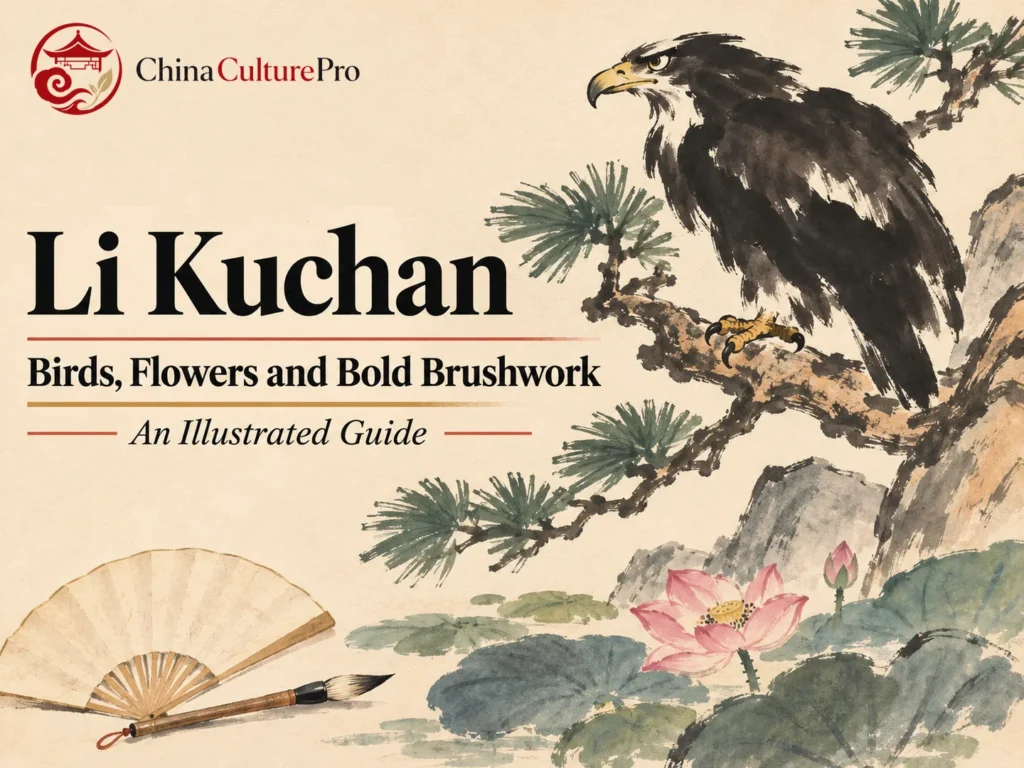
In Pine and Eagle, a single bird stands on a pine trunk. Broad, forceful handling gives the image a robust presence, while the bird’s stance helps establish its character.[2]
When looking closely, separate the jobs of the marks: a dark mass can establish weight, while a turning line gives direction. Compare the body’s overall silhouette with the smaller strokes that articulate its edge.
The distinction between meticulous and freehand painting provides context for this approach. Expressive simplification still depends on the relationship between the parts and the whole.
Four Works across Different Formats
| Work | Date | Material and format | Collection |
|---|---|---|---|
| Landscape | 1928 | Ink and colors on fan-shaped paper, mounted on an album-leaf backing. | National Museum of Asian Art, Smithsonian Institution.[4] |
| Various Subjects | 1972 | Handscroll; ink and color on Japanese paper. | Metropolitan Museum of Art.[3] |
| High Summer (盛夏图) | 1981 | Large hanging work; color on paper; 368 × 580 cm. | Li Kuchan Memorial Hall.[1] |
| Pine and Eagle (松鹰图) | Cataloged broadly as modern | Paper; 96.5 × 45 cm. | Tsinghua University Art Museum.[2] |
Compare the fan’s compact arc with a handscroll’s unfolding sequence and High Summer’s broad surface. Format changes how a viewer encounters the brushwork.
Reading the 1972 Handscroll in Its Time
Various Subjects was made during the Cultural Revolution. Its imagery and accompanying comments have been interpreted as assertions of dignity and endurance under persecution.[3]
The date, text and selected subjects belong together in that reading. It is an interpretation of this particular handscroll, rather than a fixed political translation to apply to every bird or plant he painted.
South Pan, North Li and His Artistic Legacy
The phrase South Pan, North Li (南潘北李, Nán Pān Běi Lǐ) pairs Pan Tianshou with Li Kuchan as major modern freehand bird-and-flower painters.[5]
The two artists were colleagues at Hangzhou in the early 1930s.[3] Their pairing gives viewers a useful task: compare how different painters organize a bird’s weight, a plant’s movement and the surrounding empty space. Shared subject matter need not produce an identical visual rhythm.
FAQs About Li Kuchan
Does freehand painting mean the work was unplanned?
No. His teaching emphasized observation, study, creativity and demonstration—skills behind the apparent freedom of the final brushwork.[1]
Did Li Kuchan paint only eagles?
No. Lotus compositions and an early fan-shaped landscape demonstrate the wider range represented in museum collections.[1][4]
What does “South Pan, North Li” mean?
It compares Pan Tianshou and Li Kuchan as leading freehand bird-and-flower painters. It is a critical pairing, not a teacher–student designation.[5]
Sources
[1] National Museum of China. Li Kuchan Retrospective: Biography and Exhibited Works
[2] Tsinghua University Art Museum. 松鹰图
[3] Metropolitan Museum of Art. Various Subjects
[4] National Museum of Asian Art. Landscape, 1928
[5] Shenzhen Museum. 李苦禅花鸟画卷