


Quick Answer: Who Was Huang Zongxi?
Huang Zongxi (黄宗羲, Huáng Zōngxī, 1610–1695) was a Chinese scholar and Ming loyalist. He wrote Waiting for the Dawn (明夷待访录, Míngyí Dàifǎng Lù), a set of proposals about the duties of rulers, and compiled Cases of Learning of Ming Confucians (明儒学案, Míngrú Xué’àn).[1][6]
- Political argument: Rulers and ministers should act for the benefit of the people.[2]
- Schools: Scholars should have room to question government decisions.[2]
- Scholarship: Huang gathered biographies and writings of more than 200 Ming Confucians.[4]
Huang gave scholars a formal role in criticizing government while keeping the emperor in his proposed system.
What would happen if an emperor sat among the pupils at a lecture and heard a scholar name mistakes in government? Huang turned that scene into a proposal. It brings the political side of his Confucian learning into view.
From Ming Loyalist to Historian
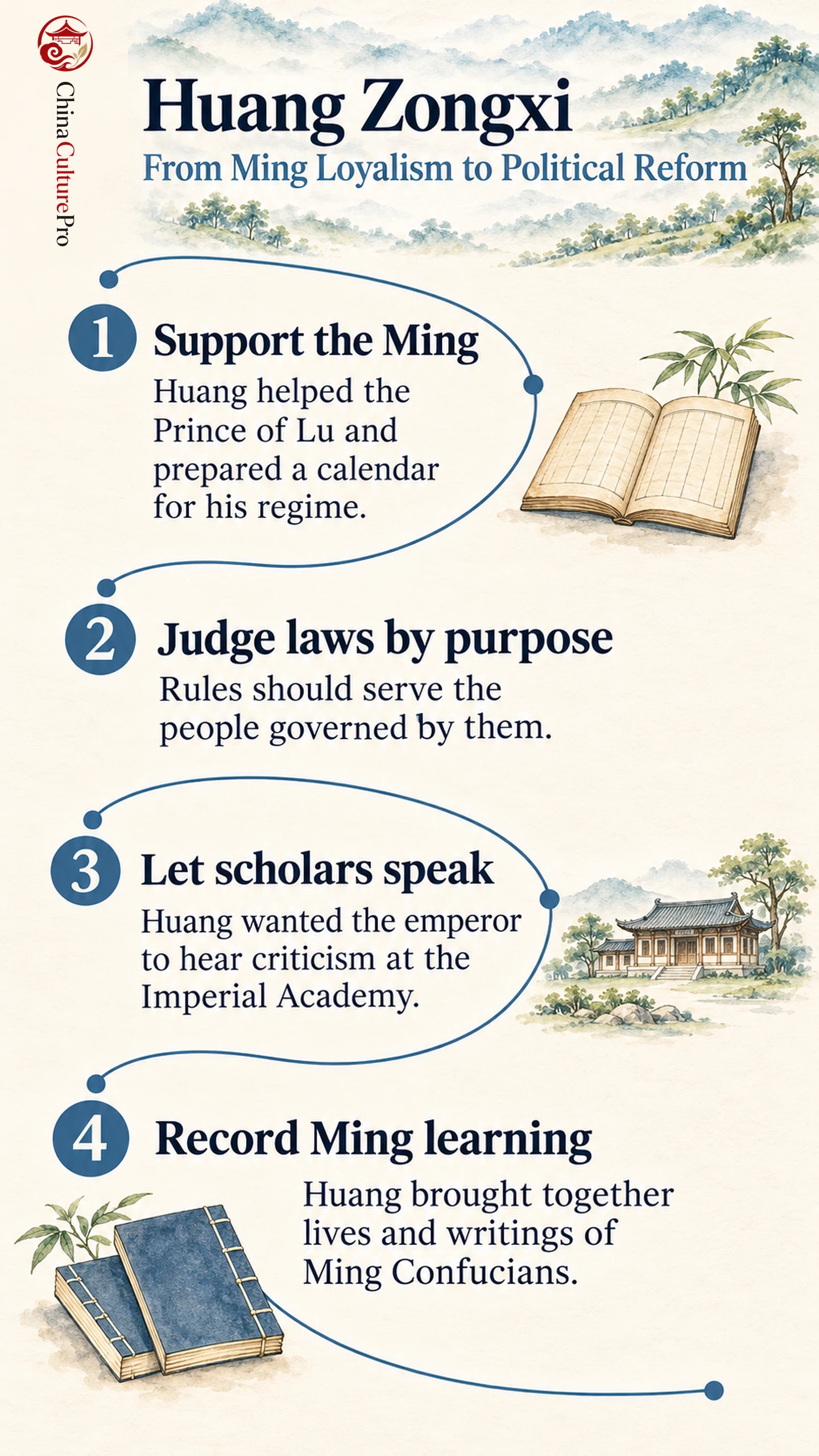
Huang was from Yuyao (余姚, Yúyáo) in present-day Zhejiang and studied with Liu Zongzhou (刘宗周, Liú Zōngzhōu). Following the fall of the Ming dynasty capital in 1644, he took part in the resistance connected with the Prince of Lu (鲁王, Lǔ Wáng). He even prepared a calendar for the prince’s regime.[1]
After withdrawing from the resistance, Huang returned to study and teaching. He revived his teacher’s academy in 1667. Under the Qing dynasty, he avoided nomination for a special examination, but his writings on the Ming were made available to the official history project.[1]
How Waiting for the Dawn Would Limit Imperial Rule
In “On the Ruler,” Huang asks why government exists. It can meet needs that people cannot handle individually. Rulers who treat the realm as family property reverse that relationship by making the public serve them.[2]
In “On Law,” Huang judges rules by their purpose. A rule designed chiefly to keep one family in power can have the force of law without serving the people subject to it.[3]
In “Schools,” Huang proposes a lecture at the Imperial Academy (太学, Tàixué) on the first day of each lunar month. The emperor sits among the students while the head of the academy can criticize political failings. In the districts, Huang would let local deliberation select distinguished scholars to head schools where officials could be called to account.[2]
What Huang Preserved About Ming Confucians
The 62-chapter Cases of Learning of Ming Confucians combines life accounts and selections from scholarly writings. Its chapter on Cao Duan (曹端, Cáo Duān) shows how Huang used an individual life to illustrate the connection between careful reflection and conduct.[4]
Huang shaped the reader’s understanding through his choices. Historian Lynn Struve places his work within ongoing discussions that began before the Ming fell.[5]
The exchange went both ways. Gu Yanwu sent Huang his own notes for criticism.[1]
FAQs About Huang Zongxi
Who was Huang Tsung-hsi?
Huang Tsung-hsi is another romanization of Huang Zongxi. You will find it in Wm. Theodore de Bary’s English edition of Waiting for the Dawn.[6]
Did Huang Zongxi argue for democracy?
Huang wanted rulers held to public standards. His proposal kept an emperor and gave learned institutions a role in public criticism. The school meetings he described were gatherings for teaching and debate.[2]
How did Waiting for the Dawn reach later readers?
The book circulated among some of Huang’s contemporaries. Near the end of the Qing dynasty, Liang Qichao (梁启超, Liáng Qǐchāo) and his followers popularized it as a critique of autocratic power.[1]
Sources
[1] Arthur W. Hummel, editor. Huang Tsung-hsi, Eminent Chinese of the Ch’ing Period
[2] Huang Zongxi. Waiting for the Dawn, On the Ruler, On Law and Schools
[3] Stanford Encyclopedia of Philosophy. Social and Political Thought in Chinese Philosophy
[4] Chu Hung-lam. A Close Reading of the Chapter on Cao Duan in the Mingru Xue’an
[5] Lynn A. Struve. Huang Zongxi in Context
[6] WorldCat. Waiting for the Dawn, A Plan for the Prince, translated by Wm. Theodore de Bary