


Quick Answer: Who Was Liang Qichao?
Liang Qichao (梁启超, Liáng Qǐchāo, 1873–1929) was a reformer, journalist and historian who lived through the end of the Qing dynasty and the early Republic. He joined the Hundred Days’ Reform (戊戌变法, Wùxū Biànfǎ) of 1898 and fled to Japan when the movement was suppressed.[1]
- Reform: He worked with his teacher, Kang Youwei (康有为, Kāng Yǒuwéi), in a movement that looked toward constitutional government.[4]
- Journalism: His New Citizen Journal (新民丛报, Xīnmín Cóngbào) carried his essay series On the New Citizen (新民说, Xīnmín Shuō) from 1902.[2]
- Scholarship: He wanted history to help readers understand how a nation and its people had developed.[5]
Liang addressed readers who might never hold office. His essays put questions about public responsibility and government into circulation far beyond the imperial court.
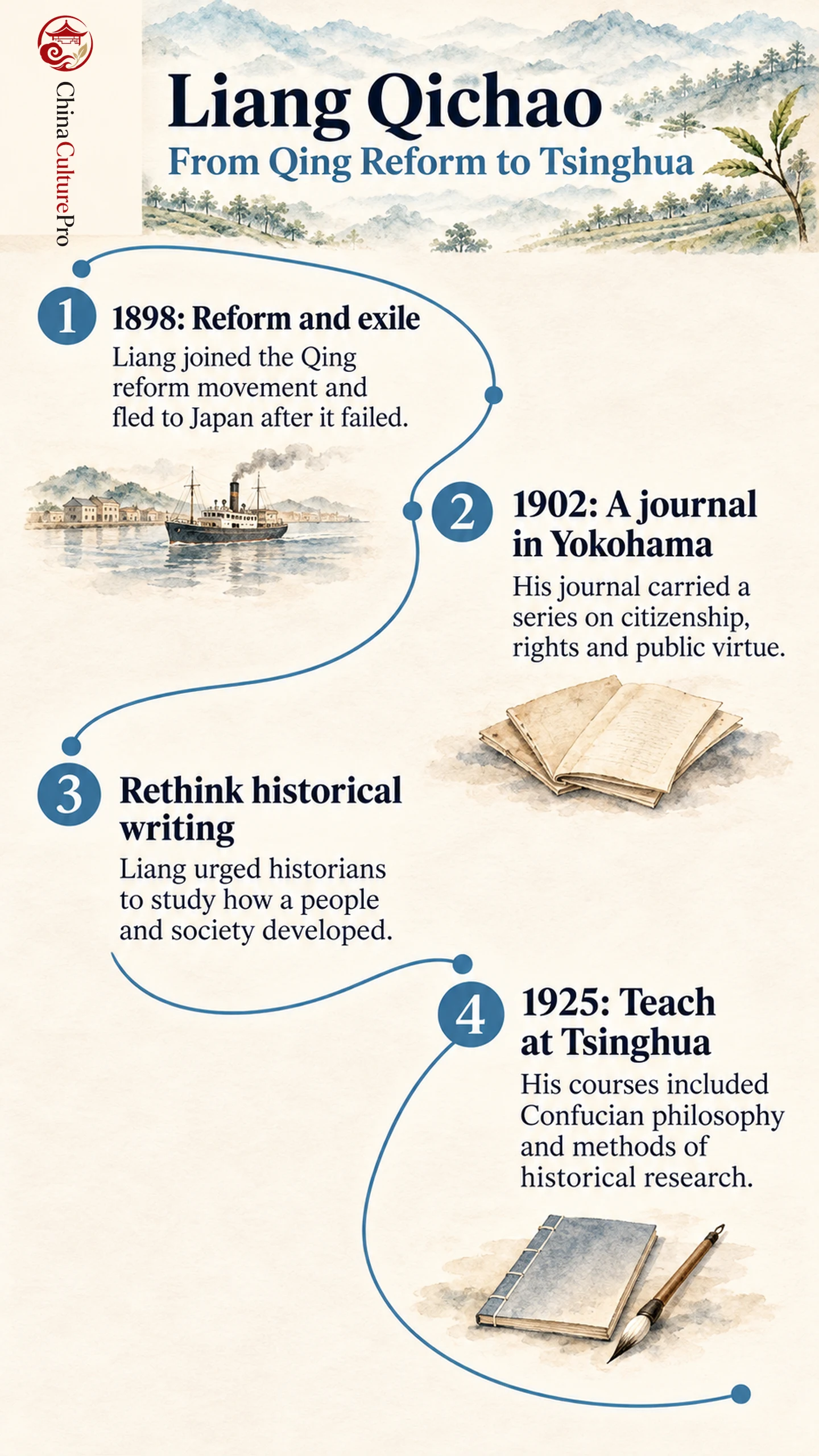
A reader opening Liang’s journal in 1902 could encounter essays on public virtue and individual rights alongside a call to rethink Chinese history. These topics grew from one political question. What would people need to learn and do for a reformed government to work?
From the 1898 Reforms to Exile
Defeat by Japan in the war of 1894–95 gave new urgency to efforts to reform the Qing state. Liang joined Kang and other reformers during the Guangxu emperor’s brief initiative in 1898. When Empress Dowager Cixi ended the reforms, Liang escaped to Japan.[1][4]
Exile gave him a new base for publishing. In Yokohama he started Qingyi Bao, where his 1900 essay Young China (少年中国说, Shàonián Zhōngguó Shuō) appeared. The essay contrasted images of aging and youth to argue that China’s future was open to the work of a new generation.[7]
What Liang Meant by a New Citizen
In On the New Citizen, Liang connected the fate of the country with the conduct of its people. He devoted separate installments to public virtue, awareness of rights, freedom and self-government. These headings show that he treated citizenship as a set of habits to learn as well as a relationship to the state.[3]
The articles reached students and intellectuals in China and Japan as well as Chinese communities overseas. Some people encountered the essays through readings and talks, extending their reach beyond those who bought the journal.[2]
How Liang Wanted to Rewrite History
In New Historiography (新史学, Xīn Shǐxué), published in 1902, Liang argued that inherited histories had placed too much emphasis on dynastic rulers and their courts. He wanted readers to see the people and the development of their society as subjects of history.[4]
His later scholarship still drew deeply on China’s intellectual traditions. He studied Confucian thought and used the history of ideas to ask how readers could cultivate judgment and character.[5] At Tsinghua he went on to teach both Confucian philosophy and historical research methods.[6]
FAQs About Liang Qichao
Was Liang Qichao a Student of Kang Youwei?
Yes. Liang studied with Kang and worked with him during the late Qing reform movement. He later developed a broad publishing and scholarly career of his own.[1]
What Is the Difference Between the Journal and On the New Citizen?
The New Citizen Journal was the periodical Liang began publishing in Yokohama in 1902. On the New Citizen was a series of essays that appeared in it.[2]
Where Did Liang Qichao Teach Later in Life?
He joined the Institute of Chinese Studies at Tsinghua in 1925. He also taught Chinese cultural history in the university division.[6]
Sources
[1] Liang Qichao, Columbia University, Asia for Educators. Renewing the People
[2] Institute of Modern History, Academia Sinica. On the New Citizen, Electronic Edition
[3] Liang Qichao. On the New Citizen
[4] Chinese Education and Society. History Education in Modern China, Editor’s Introduction
[5] Jiang Mei. New Historiography for the Cultivation of the Character of the New Citizen
[6] Tsinghua University Archives. Liang Qichao’s Later Life as a Scholar and Teacher
[7] All-China Federation of Returned Overseas Chinese. Liang Qichao and the Overseas Chinese