
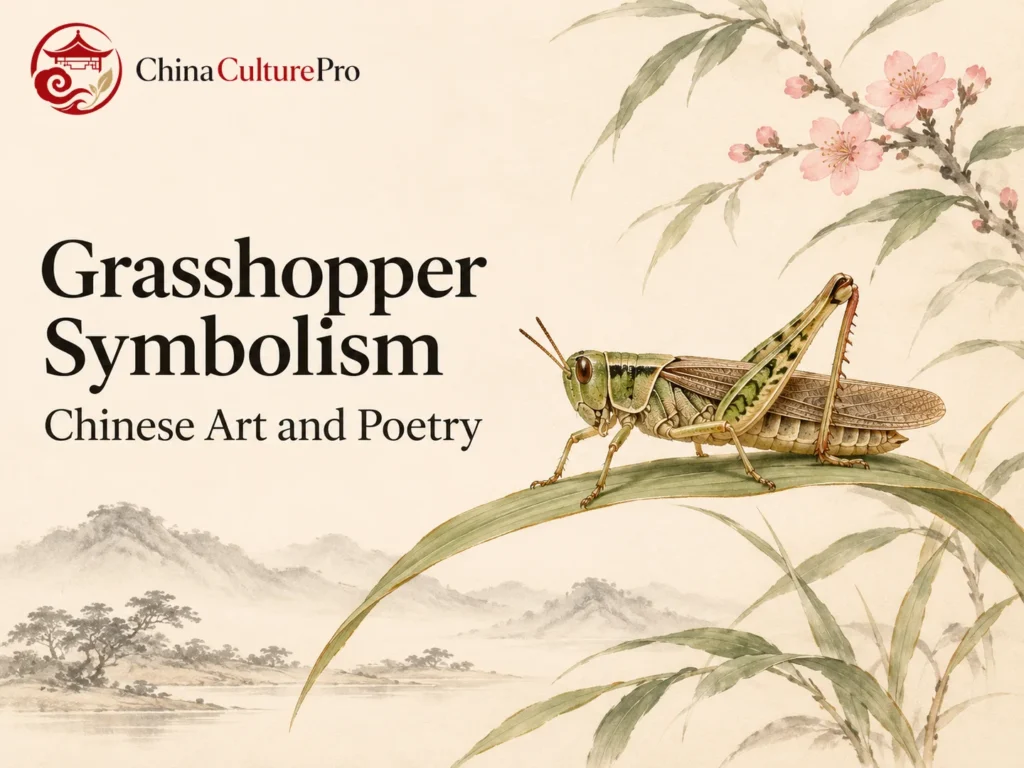

Quick Answer: What Does a Grasshopper Mean in Chinese Art?
A grasshopper (蚱蜢, zhàměng) in a Chinese painting can bring a leaf, flower or garden scene to life. A related literary image in Zhong Si (螽斯, Zhōng Sī), a poem in the Book of Songs, expresses a wish for many descendants. The composition or inscription helps you decide which reading applies.[1][2][3]
- Shape. Look for angled hind legs and wings folded along the body.
- Plants. A grasshopper can occupy a stem or leaf while other insects move through the same picture.[1][4]
- Poetry. The classical wish comes from the poem’s repeated link between a group of insects and future generations.[3][5]
A museum’s insect label and the subject of the artwork are useful starting points.

A grasshopper can be the subject of a small Qi Baishi album leaf or one of several insects in an embroidered album. A bent leg or a thread-thin feeler can tell you how the artist watched the insect. A line of verse can give it a different role.
Grasshoppers in Qi Baishi’s Paintings
In a Qi Baishi album leaf in the University of Michigan Museum of Art, a grasshopper rests on leaves. The artist used ink on paper, and the museum dates the work to around 1920–1935. The insect gives the viewer a single point of attention among the leaves.[1]
Qi’s 1947 Begonias, Butterfly and Grasshopper adds a second insect in a hanging scroll. The tall scroll gives the grasshopper and butterfly room to occupy separate parts of the flower scene. Qi’s 1943 Insects and Plants album offers a broader comparison. The museum describes his fine insect lines against freer strokes for plants and vegetables, paired to evoke aspects of rural life in different seasons.[4][6]
How Qing Embroidery Shows the Insect
A Qing album in the Palace Museum contains six embroidered leaves with birds, flowers and insects. One pairs a grasshopper with a flowering tree identified as haitang in the catalogue. The embroiderers used fine linked stitches for the grasshopper’s feelers. Each small stitch follows the curve, giving an impression of a continuous line. Another leaf uses a different treatment for a dragonfly’s translucent wings.[2]
The album is an example of Gu embroidery, a tradition known for translating painting effects into silk thread. The museum’s description of the plant points to a flowering tree. Compare woody crabapple blossoms when an English title simply says “begonia” for a plant named haitang.[2]
The Descendants Wish in the Poem Zhong Si
In three stanzas, the poem evokes groups of winged insects and repeats a wish for flourishing descendants. English readers may encounter labels such as grasshoppers or locusts for the poem’s insects. In modern Mandarin, the same Chinese term names katydids. In the traditional reading, the gathering of many insects helps express the hope that a family will flourish over generations.[3][5]
A title or inscription that cites the poem is stronger evidence of the family wish than the shape of a single insect. A Hundred Boys scene gives a related wish a different visual form, showing children themselves at play.
FAQs About Grasshopper Symbolism
How can you tell a grasshopper from a cricket in a painting?
Short antennae and thick jumping legs are useful clues to a grasshopper. Some insects called crickets or katydids have very long antennae. Stylized images may hide these clues, so the catalogue name and the setting can help.[1][3]
Does one grasshopper always stand for a large family?
The poem and its traditional reading support that association. A grasshopper in a painting can also be an observed insect resting on leaves or part of a seasonal composition.[1][3][6]
Sources
[1] University of Michigan Museum of Art. Qi Baishi, Grasshopper, object 1949/1.201
[2] The Palace Museum. Gu Embroidery Album of Flowers, Birds and Insects
[3] Taiwan Ministry of Education. Revised Mandarin Dictionary: Zhong Si
[4] The Metropolitan Museum of Art. Begonias, Butterfly and Grasshopper, object 2008.188.4
[5] Wikisource. Book of Songs with Collected Commentary, chapter on Zhong Si
[6] The Metropolitan Museum of Art. Insects and Plants, object 1986.267.237a–l