


Quick Answer: What Does a Dragonfly Mean in Chinese Art?
A dragonfly (蜻蜓, qīngtíng) in Chinese art often brings movement to a pond or garden scene. Paired with young lotus, it can recall early summer. Yellowing bamboo, worn lotus leaves or a poem about cold water can give the same insect a place in a later season.[1][2][3]
- Summer. A dragonfly on the tip of a young lotus leaf appears in a well-known Song poem.[1]
- Seasonal change. On paintings of bamboo and lotus, the condition of the leaves helps place the scene in the year.[2][3]
- Movement. A slender body and fine wings can draw the eye across a stretch of open paper.[4]
Read the plants and inscription alongside the insect.
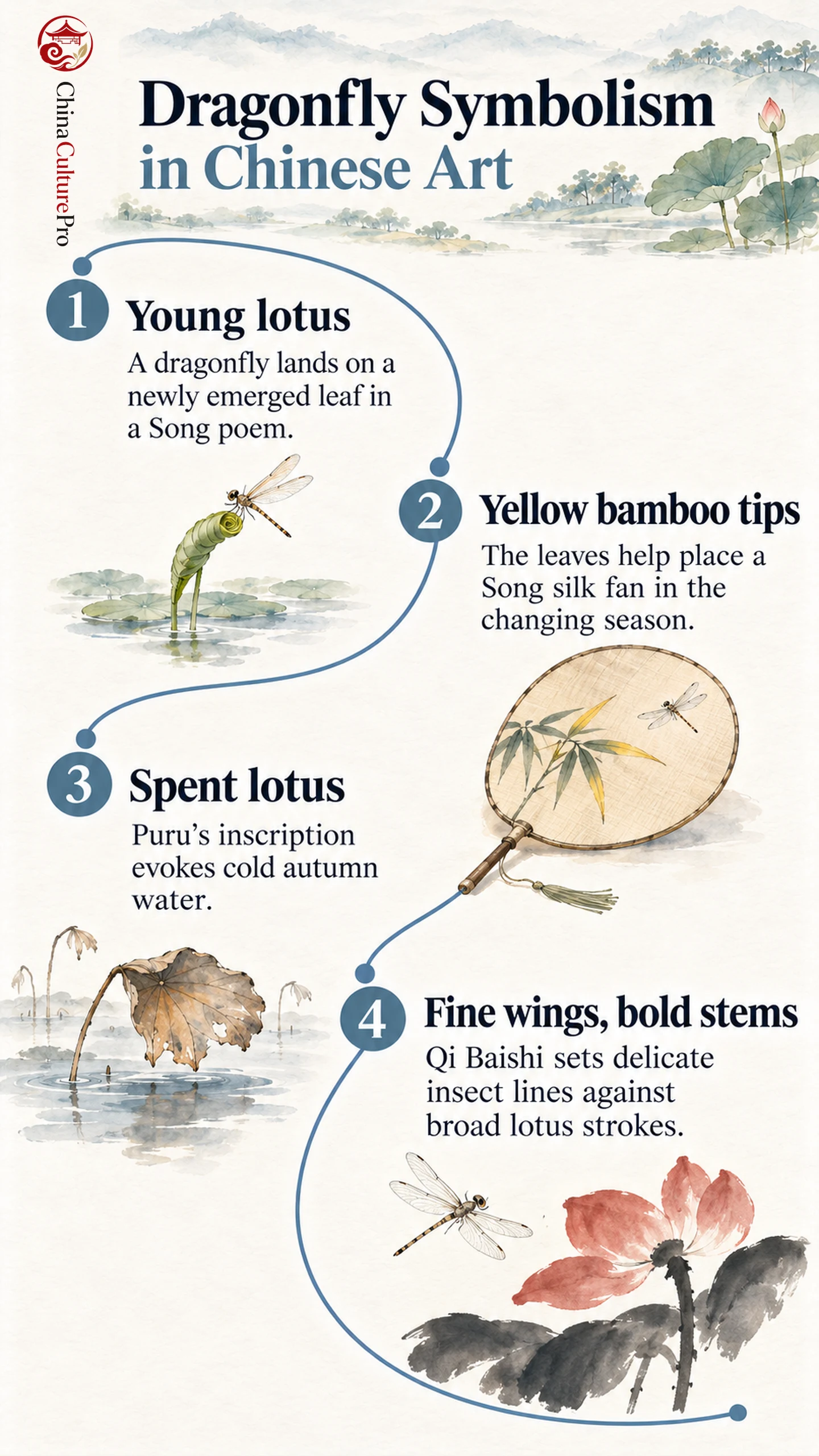
When a dragonfly appears in a Chinese painting, look at the plant beneath it. A tender lotus tip and a crumpled old leaf put the insect in very different moments of the year.
A Dragonfly on Young Lotus in Song Poetry
In Small Pond (小池, Xiǎochí), the Southern Song poet Yang Wanli describes a spring feeding a pool, the shade of a tree on water and a young lotus leaf whose pointed tip has barely emerged. A dragonfly has already settled on it. The timing makes the image vivid: plant and insect meet in a place small enough to overlook.[1]
In a picture, an insect perched on the tip of a young lotus leaf may bring this poem to mind. Check the plant’s stage of growth and any written title or inscription before calling the painting an illustration of Yang’s lines. Other heron and lotus scenes use the same habitat for different subjects.
Late Summer and Autumn in Two Paintings
In Wu Bing’s late twelfth-century Bamboo and Insects, a dragonfly hangs above bamboo on a silk fan painting. A wasp occupies another small patch of open space. Yellow tips on the bamboo leaves suggest late summer or early autumn. The bush cricket in the same picture supplies a separate autumn association through the sound of its call.[2]
In Puru’s Lotus and Dragonfly, spent lotus fills much of the lower part of the scroll. The dragonfly and a kingfisher animate the pond. The inscription speaks of cold autumn ripples, giving the season a direct clue. The inscription gives the season. White Dew is a solar term associated with the arrival of cooler early-autumn weather.[3]
How the Insect Changes the Painting
In a leaf from Qi Baishi’s 1943 Insects and Plants album, the dragonfly hovers in the open upper left. A pair of dark lotus stems arcs toward a seedpod, and red petals sit lower down. The detailed insect gives the eye a small point to settle on before following the heavier strokes across the page. Qi used a similar contrast between detailed insects and freer plant painting throughout this album.[4]
Artists also adapted the pairing to a fan. Tang Yun’s 1959 Lotus and Dragonfly places the subject on folding-fan paper. The curved format spreads the scene sideways and changes the space available to the insect and plants.[5] For another comparison, grasshoppers in Chinese art often occupy a stem or leaf with their long hind legs folded.
FAQs About Dragonfly Symbolism in Chinese Art
Does a dragonfly and lotus always mean summer?
Young lotus can suggest summer, as it does in Yang Wanli’s poem. Spent leaves and a poem about cold water set Puru’s lotus-and-dragonfly painting in autumn.[1][3]
Is the dragonfly connected to the Chinese dragon?
The Chinese name for the insect is qīngtíng. The word for dragon is lóng. Read the insect through the plants, gestures and inscriptions in the picture. A resemblance in an English translation offers little evidence for the painting’s meaning.
Sources
[1] Hong Kong Education Bureau. Appreciation of Classical Chinese Texts: Small Pond, pp. 8–9
[2] Cleveland Museum of Art. Bamboo and Insects, accession 1964.154
[3] National Museum of History. Lotus and Dragonfly, accession 81-00262
[4] The Metropolitan Museum of Art. Modern Chinese Painting, 1860–1980, pp. 35–37
[5] The Metropolitan Museum of Art. Lotus and Dragonfly, object 1986.267.409