


Quick Answer: What Does a Cricket Mean in Chinese Art?
A cricket can evoke its song, the turn toward autumn or an auspicious phrase. In a Southern Song painting, a bush cricket (络纬, luòwěi) helps set the season. A pair of porcelain vases uses a related insect motif with a different interpretation. Cricket cages tell the history of keeping the insects themselves.[1][2][3][4]
- Season: Listen in your imagination for the chirp suggested by the leaves and insects.[1]
- Good wishes: A Chinese insect name can contribute a sound associated with happiness.[2]
- Keeping: A cage’s shape and materials reflect the practice of keeping insects for their sound or for contests.[3][4]
Check the insect name, companion motifs and type of object before deciding which reading fits.
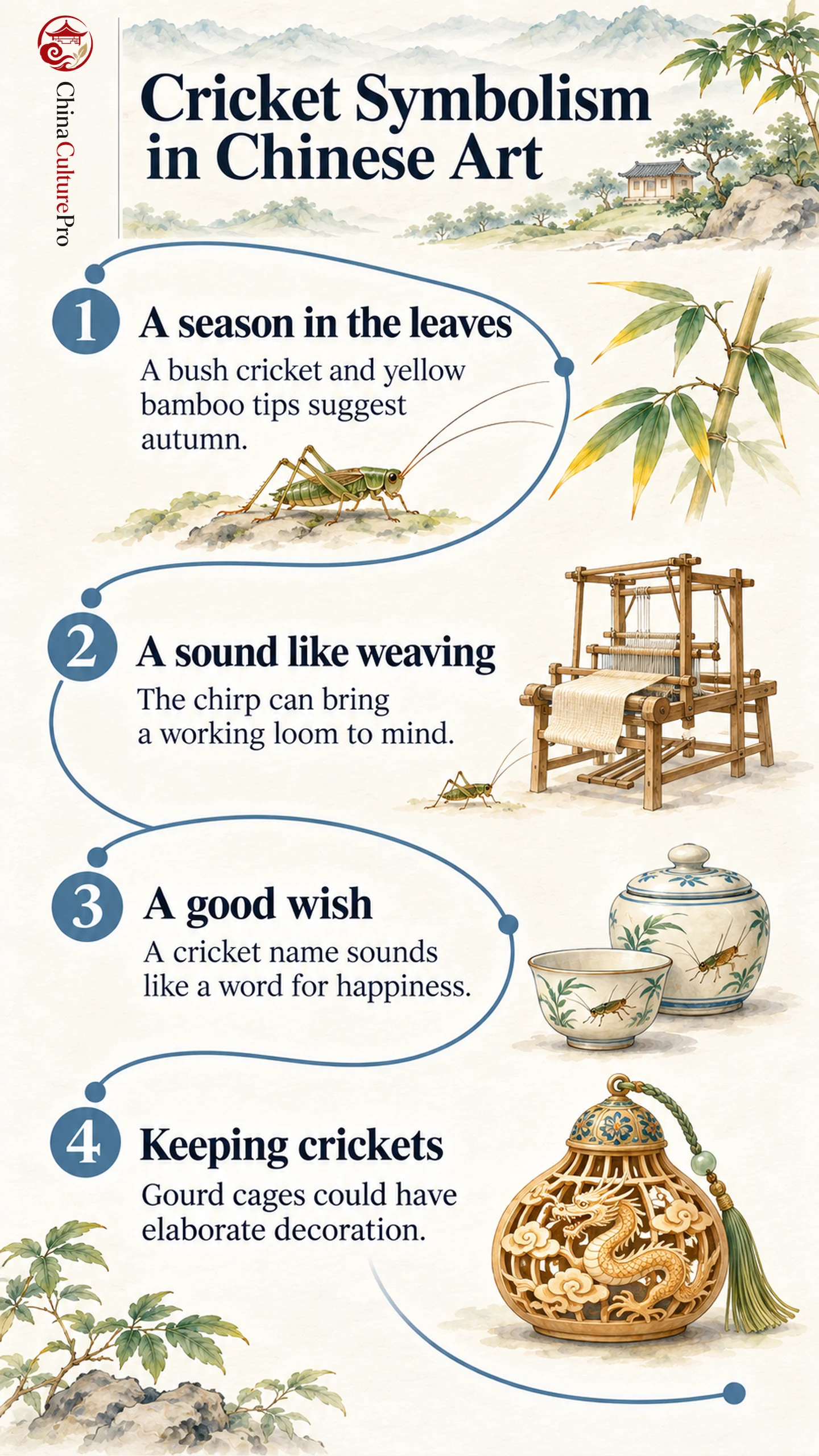
A painted fan can make a viewer imagine a chirp. A keeper’s gourd is evidence of how people brought the living insect indoors.[1][3][4]
The Sound of Autumn on Wu Bing’s Fan
Wu Bing’s Bamboo and Insects is a late twelfth-century fan painting in ink on silk. A bush cricket rests on a bamboo leaf while a dragonfly and a wasp hover. Yellow tips on the leaves suggest late summer or early autumn. Looking at the plant helps connect the small insects to a particular time of year.[1]
The bush cricket’s chirp can recall a working loom. The insect’s traditional nickname “weaving lady” connects the sound to the time when weaving begins before cold weather. The fan can therefore suggest a sound and a seasonal activity through an insect resting on a leaf. The comparison with a loom singles out the bush cricket among the three insects.[1]
For comparison, a dragonfly in Chinese art can contribute a different impression of the season or movement. The nearby insects do not all have to express the same idea.
Qi Baishi used insects to mark autumn in a 1934 hanging scroll. Two crickets and one bee appear alongside chrysanthemums and autumn begonia. The artist named autumn in the inscription, so the written title and the painted plants support the seasonal reading together. This gives the viewer a different kind of clue from the yellow leaf tips in Wu Bing’s fan.[5]
Crickets and Auspicious Wordplay on Porcelain
A pair of porcelain vases dated to 1915–1916 is catalogued in English as Pair of Vases with Crickets. Each is about ten centimeters high. The cricket name 蟋蟀 (xīshuài) has a first syllable close to the sound for happiness, 喜 (xǐ). That association helps explain why a small insect can be interpreted as a good wish on porcelain.[2]
The same catalogue uses 蟈蟈 in the Chinese object title, a name often applied to a bush cricket or katydid. This example shows why the English collection term “cricket” should be checked against the original title. The label’s wordplay and the title’s identification are separate clues. Compare the specific object rather than treating every insect with long hind legs as one named symbol.[1][2]
A Cricket Cage Can Tell a Different Story
Crickets were kept for their chirp and for contests. Wealthy keepers commissioned worked gourds and containers made with materials such as porcelain, glass and metal. A small object could be made for holding an insect and decorated with designs that had their own meaning.[3]
A Qing gourd cage bears a dragon among swirling clouds. The dragon decorates the outside, while the vessel was made to house an insect. You can identify the object’s purpose and then interpret the decoration separately. A motif on the container can tell a different story from the animal it was made to hold.[4]
FAQs About Cricket Symbolism
Is a bush cricket the same as a grasshopper?
Bush cricket is another name used for a katydid. Labels that use “cricket” broadly can make identifications difficult. The Chinese name and the picture can help separate the bush cricket from a grasshopper.[1][2]
Is a cricket always a good-luck symbol?
The porcelain vases support a good-wish reading through sound. Wu Bing’s fan uses the insect with bamboo and other small creatures to evoke a seasonal setting.[1][2]
Sources
[1] Cleveland Museum of Art. Bamboo and Insects by Wu Bing
[2] The Metropolitan Museum of Art. Pair of Vases With Crickets
[3] San Antonio Museum of Art. The Chinese Art of Cricket Keeping
[4] Smithsonian Institution. Cricket Cage, F1984.38.9a-c
[5] Smithsonian Institution, National Museum of Asian Art. The Three Symbols of Autumn by Qi Baishi