


Quick Answer: What Is Gu Embroidery?
Gu embroidery (顾绣, Gùxiù) is a tradition of embroidered pictures associated with the Gu household in Ming dynasty Songjiang, now part of Shanghai. Makers used fine split silk threads to translate painted forms into stitches. A work could also include color applied directly to the cloth.[1][2][3]
- Subjects: Surviving works depict landscapes, flowers, birds and figures.[2][3]
- Technique: Thread color and the placement of stitches give each area its outline and texture.[2][3]
- Example: Han Ximeng embroidered eight album pictures based on earlier paintings.[3]
The term also appears in museum labels for later work in the Gu style.[4]
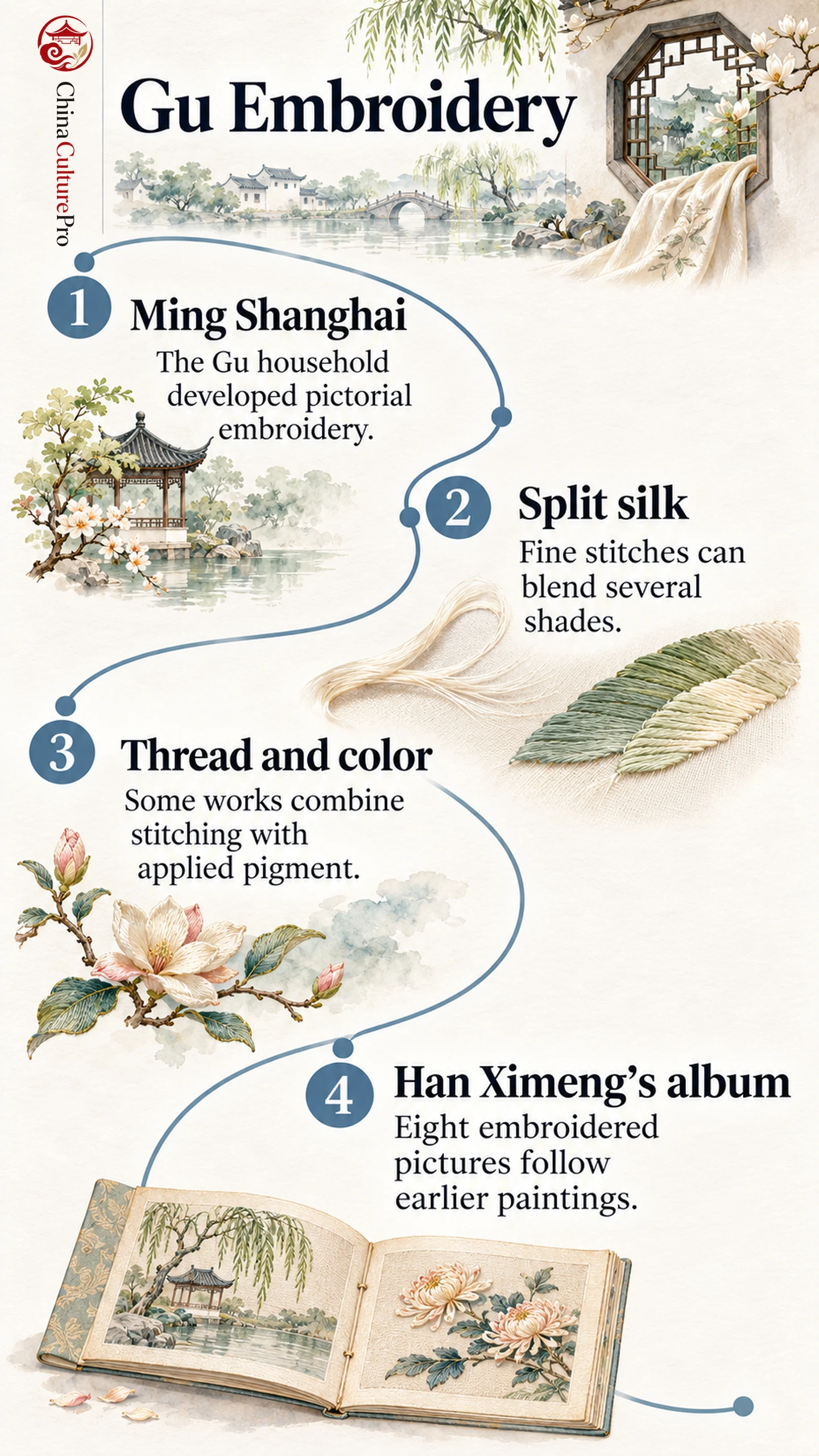
A patch of distant hillside may look like diluted ink. Beside it, the shape of a horse or a branch may be built from rows of tiny silk stitches. Gu embroidery brings both kinds of mark into a single picture.
The Gu Household and Luxiang Garden
The name comes from the family of Gu Mingshi in Ming Songjiang. The Palace Museum associates the household’s embroidery with Luxiang Garden (露香园, Lùxiāng Yuán), which is why records also use forms of the name such as Luxiang Garden Gu embroidery. Women in the family developed the work through painting and needlework. The contemporary Songjiang tradition was included in China’s first national intangible cultural heritage list in 2006.[1][2][5]
Miao Ruiyun and Han Ximeng are two names associated with the tradition. A Shanghai Museum album attributed to Miao has pictures of bamboo, rocks, figures, flowers and birds. The work is mounted as album leaves, a format the viewer can open a page at a time. Another Shanghai Museum record specifies a patterned silk damask ground for a bound Ming Gu embroidery album. The base cloth is part of the object’s construction even when attention is drawn to the stitched figures.[7][3][5][6]
How Silk Thread Takes the Place of Brushwork
The Shanghai Museum describes fine split silk threads used to reproduce the appearance of brush paintings. The practice is also known as picture embroidery (画绣, huàxiù). Fine threads and successive shades let the maker soften transitions while still giving a form a definite edge. Stitch direction and length can change from one part of a picture to another. Close viewing can reveal where the threads are packed together to make a solid shape and where the ground is left visible between features.[2][3][5]
In Han’s horse-washing scene, the Palace Museum describes long and short stitches interleaved and laid flat. Staggering the ends of stitches lets neighboring colors meet without a hard boundary. Han could change the colors and stitch lengths from one form to the next. A hillside also has lightly applied color to extend the embroidered effect. The image combines methods that the guides to Chinese painting and Chinese embroidery explain separately.[3] For a later example of stitching a pictorial design, a documented piece of Ou embroidery records a landscape in Wenzhou.
Han Ximeng’s Album and Later Gu-Style Work
The Palace Museum holds Han Ximeng’s eight embroidered leaves based on paintings associated with the Song and Yuan periods. The subjects include a horse-washing scene, a squirrel among grapes and a dragonfly with a bean plant. Each leaf has its own composition. The horse-washing scene lets the viewer compare how the maker rendered human figures, horses and a slope within the same picture. The album also carries comments by Dong Qichang and Han’s husband, Gu Shouqian.[3]
The Shanghai Museum’s Qing dynasty Eagle and Camellia Blossoms is labelled Gu embroidery and measures 163.7 by 46.1 centimeters. That tall composition shows how different the format of a work in the Gu style can be from the leaves in an album. Its Qing date and style label identify the later tradition without assigning the work to an individual in the Ming household.[4]
FAQs About Gu Embroidery
What does Gu mean in Gu embroidery?
Gu is the surname of the family associated with the tradition in Ming Songjiang. The name Luxiang Garden Gu embroidery connects the work more specifically to the family’s garden.[1]
How does Gu embroidery differ from kesi?
Kesi (缂丝, kèsī) makes a picture by weaving colored wefts into the cloth. In Gu embroidery, the maker places stitches on fabric that has already been woven. Both can evoke painted images.[2]
Does a Gu embroidery label identify the maker?
It can identify the tradition or style. An attribution to one person depends on the particular object and the evidence recorded in its catalogue.[3][4][6]
Sources
[1] Palace Museum. Gu Embroidery
[2] Shanghai Museum. Painting with Threads: Kesi and Embroidery During the Ming and Qing Dynasties
[3] Palace Museum. Han Ximeng’s Album of Song and Yuan Paintings in Embroidery
[4] Shanghai Museum. Eagle and Camellia Blossoms
[5] China Intangible Cultural Heritage Digital Museum. Gu Embroidery
[6] Shanghai Museum. Gu Embroidery Album Attributed to Miao Ruiyun
[7] Shanghai Museum. Gu Silk Embroidery Album on Damask