
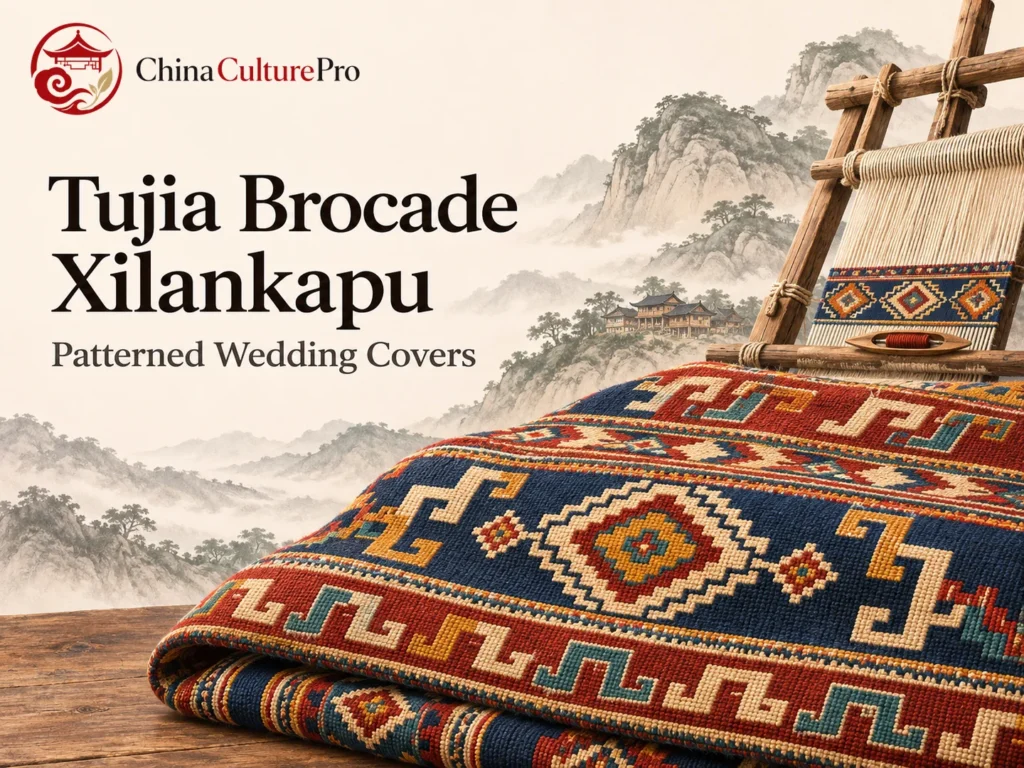

Quick Answer: What Is Xilankapu?
Xilankapu (西兰卡普, xīlánkǎpǔ) is a patterned cover made in Tujia weaving traditions, including the You River area of western Hunan. The name means “flower-patterned cover.” On the slanted loom described in the Xiangxi heritage record, weavers pick the pattern by hand and insert crosswise threads while working from the reverse.[1][2][3]
- Structure: Lengthwise threads run through the cloth. Colored pattern wefts can be inserted only where they are needed.[1]
- Use: The cover is associated with bedding and wedding gifts within the family.[2]
- Place: Xiangxi’s Tujia brocade weaving entered China’s national intangible cultural heritage list in 2006.[1]
The wider Tujia brocade tradition also includes patterned bands.
Turn a woven cover over and the colored threads may look less orderly than on the face. The back can show where a weaver changed colors or carried a thread to another part of the design. For Xilankapu, the weaver traditionally worked with that side facing up.
How the Pattern Is Picked from the Reverse
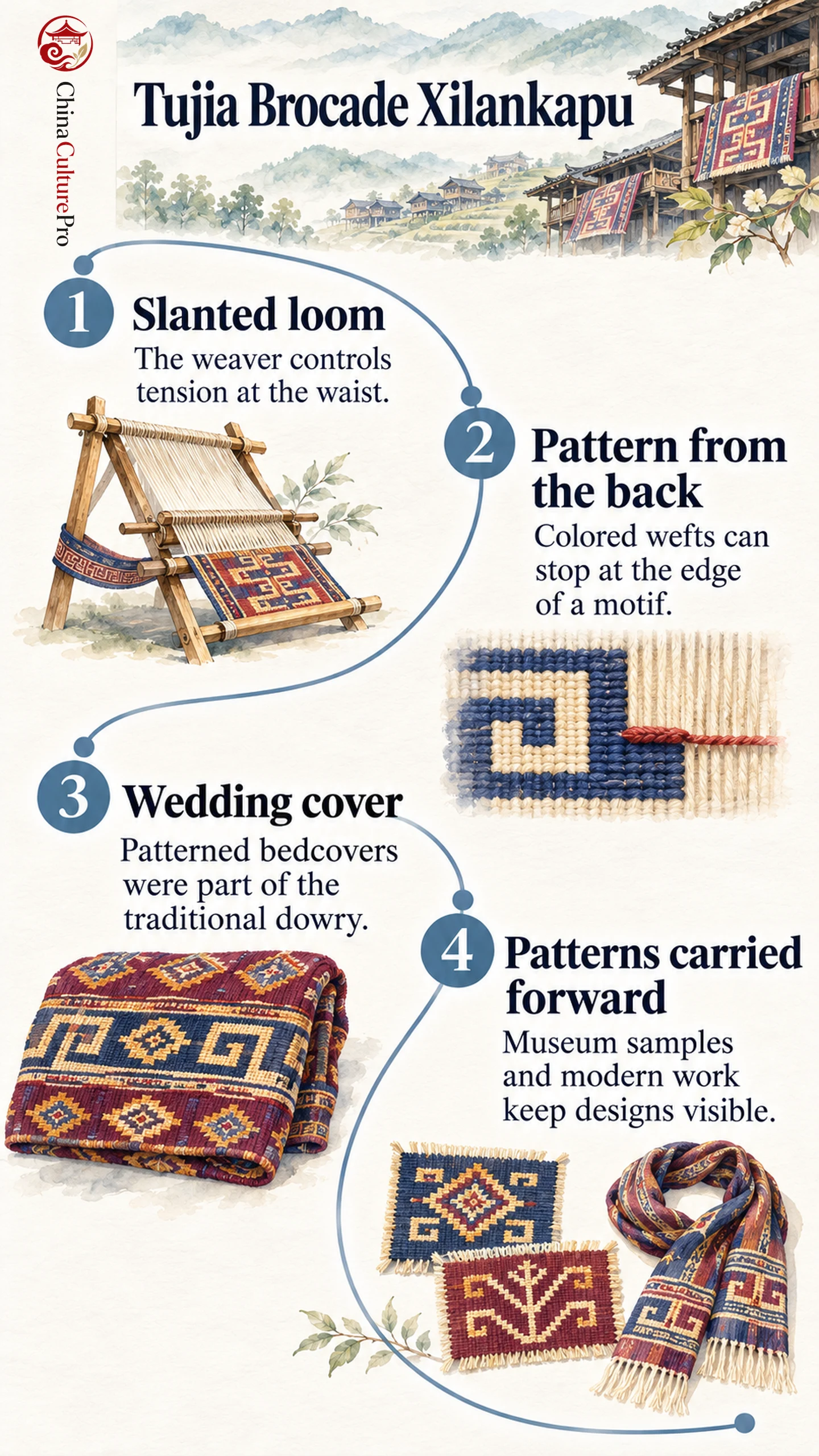
A slanted wooden loom holds the lengthwise warp threads, with tension controlled at the weaver’s waist. The national heritage entry describes a continuous warp and discontinuous weft. A crosswise pattern thread can stop or turn where a patch of color ends. Other threads can form adjacent areas in the same row.[1]
The weaver picks the design from the back. As successive rows go in, a diagonal can develop from short steps, or a hook can turn around a corner. The Xiangxi entry describes both a plain-weave group and a colored twill group. Those categories refer to the weave and the use of color. The materials can vary too. A Longshan training-center account describes silk warp with either silk or cotton weft. A Hubei heritage account describes hemp or cotton warp and colored silk or wool weft.[1][5][6]
The slanted loom also appears in descriptions of Dong brocade. Compare how the pattern threads are selected on each loom rather than using the shape of its frame alone to identify the cloth.
Covers, Bands and Wedding Use
The China National Silk Museum describes the patterned bedcover as a central part of the traditional Tujia dowry. A cover can be read as an object made for a household and as a record of the weaver’s choice and arrangement of patterns. A cover gives a maker space to work the same unit many times, alternating colors or laying different bands next to one another.[2]
The Xiangxi entry also describes patterned bands as a separate kind of Tujia weaving. For a band, a pattern can be made with lengthwise threads, and the weaver can work with the material tensioned between the knees. A band and a cover therefore differ in both function and construction. The guide to Li textile craft offers a separate example of how weaving techniques are tied to particular objects and local knowledge.[1]
Patterns Preserved and Adapted
The China National Silk Museum displayed hook designs alongside plant, animal and other patterns in a 2014 exhibition. Many displayed textiles were woven for a preservation project using designs collected from local weavers and collectors. Weavers reproduced 100 selected designs using narrow handlooms, and the museum acquired the resulting textiles in 2011. The project preserved how makers could put a pattern into cloth as well as what the pattern looked like.[2][4]
Hunan’s reporting describes Longshan weaver Liu Dai’e’s work on scarves and shawls. She adapted the technique to show designs on both sides. That example helps explain why a modern piece can differ from a traditional cover in its size and reverse finish.[3]
FAQs About Tujia Brocade
Is Xilankapu the name of every Tujia woven object?
It specifically names a patterned cover in the Xiangxi account. Tujia brocade is a broader category that also includes bands.[1][2]
Why can the reverse look different from the front?
The way the weft is turned, carried or joined can leave a rougher reverse. Some modern weavers also make designs intended to be seen from both sides.[1][3]
Can a hook motif identify a Tujia textile?
The motif is a useful feature to describe. The weave, object type and documented place are better clues when combined with it.[1][4]
Sources
[1] China Intangible Cultural Heritage Digital Museum. Tujia Brocade Weaving in Xiangxi
[2] China National Silk Museum. Xilankapu: Tujia Brocade in Western Hunan
[3] China Daily via Hunan Provincial Government. Traditional Culture Given a Modern Twist
[4] China National Silk Museum. Western Hunan Xilankapu Exhibition
[5] Ministry of Culture and Tourism. Tujia Weaving Training Center in Longshan
[6] Hubei Intangible Cultural Heritage Network. Tujia Brocade Xilankapu