


Quick Answer: What Is Ou Embroidery?
Ou embroidery (瓯绣, Ōuxiù) is a needlework tradition from Wenzhou in southern Zhejiang, named for the Ou River. Wenzhou makers have decorated clothing and household objects and created independent stitched pictures. The regional tradition entered China’s national intangible cultural heritage list in 2008.[1][2]
- Materials: Threads form the design on a support. One documented curtain form combines colored threads and pigment on a fine bamboo screen.[2]
- Appearance: Wenzhou accounts describe clearly arranged stitches, strong color and pictures of people, landscapes and animals.[1][2][3]
- Use: The work appears on theater costumes, robes and furnishings as well as framed or mounted pictures.[1][2][3]
Identify the support and stitch work on each object as well as the regional label.
In one piece of Wenzhou embroidery, a camphor tree leans out of a building’s upper story. Below, a boat passes a bridge. The picture is a record of a particular place, made with skills also used to decorate clothing and household objects.
From Wenzhou Households to Embroidery Shops
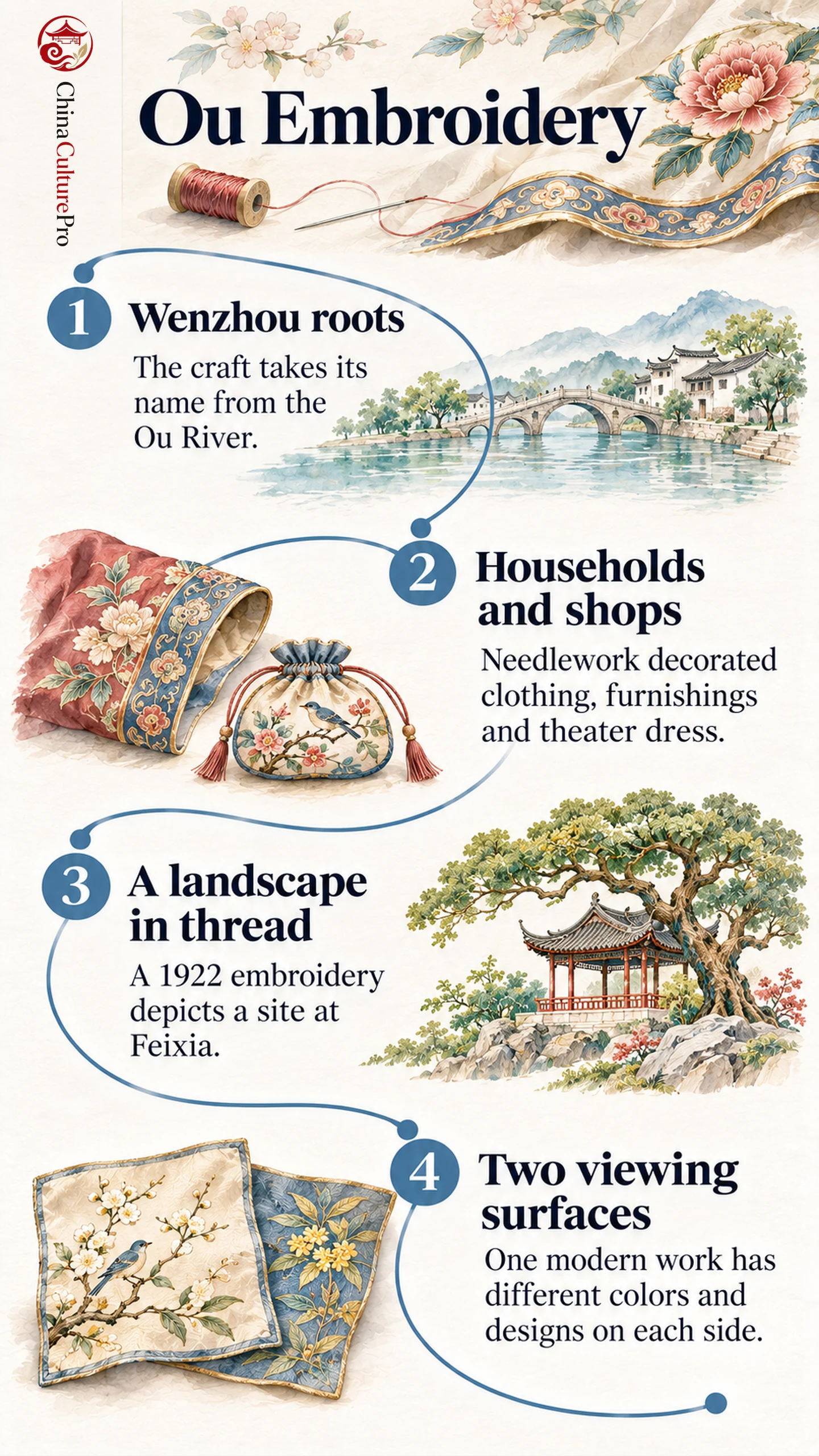
The national heritage entry describes Ou embroidery as a household practice among women in Wenzhou. It records embroidered gauze skirts given as tokens between young people, alongside sewing done for other household uses. An arts federation account lists decorated shoe uppers, children’s headwear, pillows and small pouches.[1][2]
The same federation account records professional shops in Wenzhou in 1853. Embroiderers accepted work for formal robes, theatrical dress, longevity screens and textiles used in temples. A commission for a costume would put the design on a surface that moves when worn. A screen, by contrast, could carry a composition meant to be seen face-on. Those formats affected the scale of the design and how it met the edges of the object.[1][2]
How Ou Embroidery Makes a Picture
Wenzhou craft practitioner Zhang Guomin describes starting with a drawn design. The embroiderer then chooses how to use the stitches for each part of that design. Closely aligned threads can catch light in the same direction and give an area a smooth sheen. Changing their direction or spacing can distinguish a mass of foliage from a fine branch. The guide to Chinese embroidery explains how stitches build texture on a ground.[1][2][3]
The surface is worth checking. Colored threads can make a picture on cloth. An account of painted curtains describes work on a finely prepared bamboo screen, where color and thread are used together. The screen and the embroidered fabric of a robe serve different purposes. In another regional tradition, Gu embroidery includes mounted album leaves that can be opened and viewed individually.[2]
A Wenzhou Landscape and a Two-Sided Work
Jin Zhushan’s view of Feixia in the Wenzhou Museum measures 51 by 36 centimeters. The museum’s researcher dates it to 1922 from an inscription with the maker’s name. The scene shows pavilions on Jigu Hill and the Feixia complex. A camphor tree grows from the rock and extends out of an upper-floor window, which helps identify the site depicted. The Feixia building burned in 1927, so the embroidered picture also preserves a view of an altered place.[3]
In 2017, Shi Chengquan completed a double-sided work titled Wangzhe Xiongfeng. The national heritage profile describes the two faces as differing in both design and color. That example shows how an embroiderer can plan two viewing surfaces within one work. Each side has to read as its own composition, with any threads that would interrupt it kept out of sight.[4]
FAQs About Ou Embroidery
Why is it called Ou embroidery?
Wenzhou sits by the Ou River. Ou is the place name in Ou embroidery, which is also known as Wenzhou embroidery.[2]
Is Ou embroidery always double-sided?
No. Both single-sided and double-sided methods are documented. Different colors or pictures on the two faces are particular approaches within double-sided embroidery.[3][4]
How does Ou embroidery differ from Gu embroidery?
Ou embroidery is associated with Wenzhou. Gu embroidery takes its name from the Gu household of Ming Songjiang and is known for pictorial work after paintings. Both can evoke brushwork, so that resemblance alone does not establish a piece’s origin.[1][3][5]
Sources
[1] China Intangible Cultural Heritage Digital Museum. Ou Embroidery
[2] China Federation of Literary and Art Circles. Wenzhou Ou Embroidery
[3] Wenzhou Net via Zhejiang Online. Ou Embroidery Through the Feixia Landscape
[4] China Intangible Cultural Heritage Digital Museum. Shi Chengquan
[5] Palace Museum. Gu Embroidery