


Quick Answer: What Is the Gaokao?
The gaokao (高考, gāokǎo) is the major college entrance examination route for students seeking admission to higher education in mainland China. It operates within a national framework, with important provincial differences in subjects, scoring and admissions. Its results can strongly shape university options, making it a significant family and social event.[1][11]
- Purpose: It supports selection for university admission.
- Format: Core subjects combine with additional examinations under regional arrangements.
- Meaning: Educational opportunity, family hopes and debates about fairness meet around the exam.
Understand a score in its regional and admissions context before comparing candidates.[6][8]
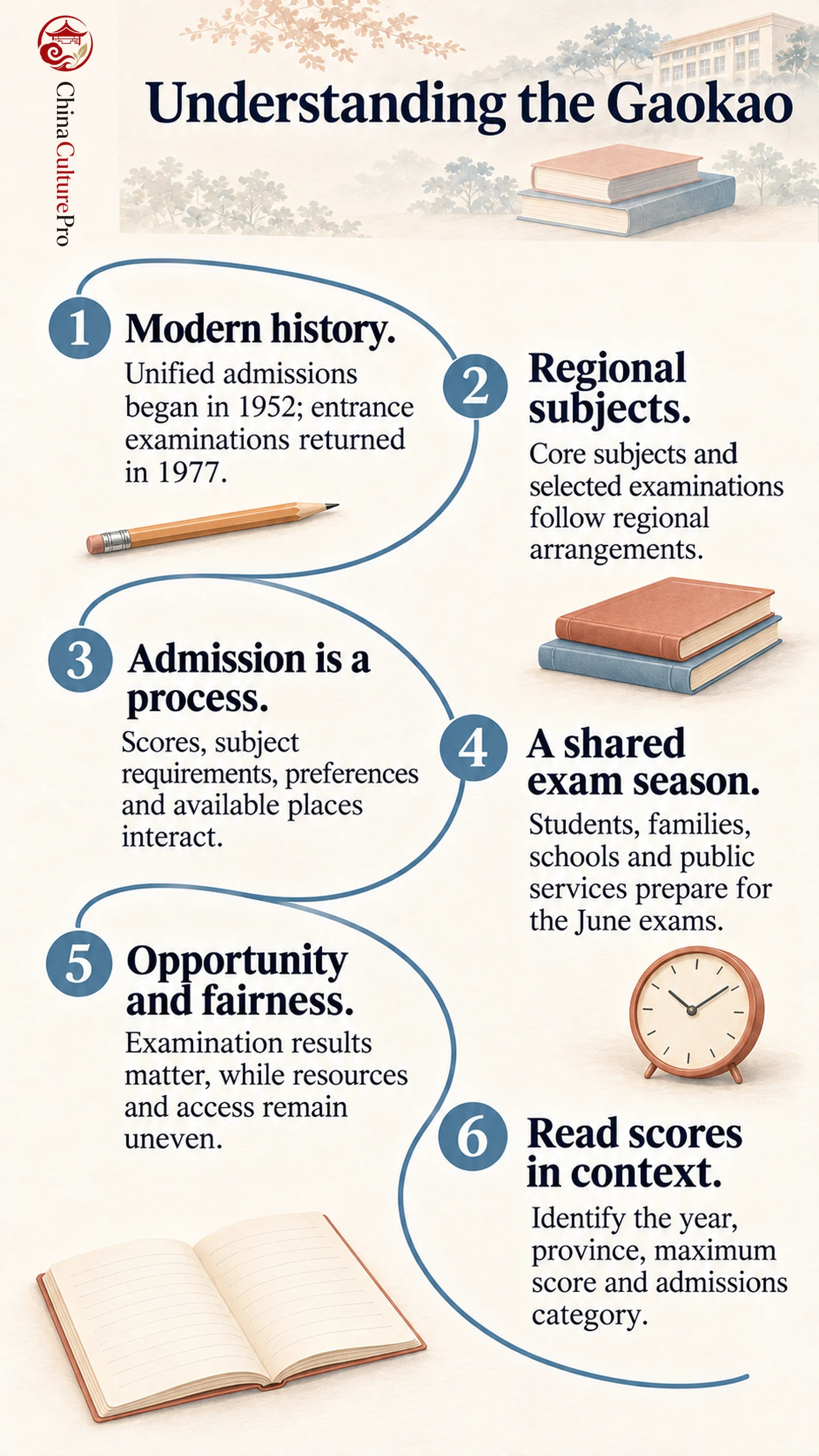
A June examination can organize months of schoolwork, family planning and public attention. Understanding the gaokao reveals how educational ambition connects with modern Chinese culture, while regional differences explain why a familiar national label covers several distinct examination experiences.
A Modern Exam with a Longer Cultural Background
The gaokao belongs to modern university admissions. It is often discussed alongside the imperial examinations (科举, kējǔ), which selected candidates for service in the imperial state. The Qing government abolished that system in 1905. Shared associations between study, examination success and status do not make the two institutions identical. The separate guide to Chinese imperial examinations explains their historical structure.[5]
| Modern milestone | What changed |
|---|---|
| 1952 | Nationwide unified university admissions were established. |
| 1966 | The Cultural Revolution interrupted the examination-based system. |
| 1977 | Competitive university entrance examinations were restored. |
These milestones locate the gaokao within twentieth-century educational and political change. The 1977 restoration reopened an examination route after years of disruption; it was not the invention of examinations in China.[4]
The longer relationship between classical learning, schooling and social expectations belongs to Chinese education traditions. Cultural associations can persist while selection institutions change.
Subjects and Scores: Why Provinces Differ
Chinese language, mathematics and a foreign language form a common core. The foreign-language subject is not necessarily English. Additional subjects and their contribution to the final score depend on the regional arrangement.[2]
The labels “3+3” and “3+1+2” describe reform models that combine core and selected subjects. For a concrete example, Sichuan’s 2026 rules define “3+1+2” as follows:[2][11]
| Component | Subjects in this Sichuan example |
|---|---|
| 3 | Chinese language, mathematics and a foreign language. |
| 1 | Either physics or history. |
| 2 | Two of politics, geography, chemistry and biology. |
Sichuan’s 2026 academic total is 750 points, with some selected subjects using converted grades. Shanghai’s official 2026 undergraduate score notice specifies a 660-point total. The maximum and scoring method both matter when reading a result.[2][3]
From Exam Results to University Admission
Taking the exam and receiving an offer are separate stages. Results enter an admissions process shaped by available places, subject requirements and application preferences (志愿, zhìyuàn). A candidate’s preferences identify the institutions or programs they wish to enter; their ordering can matter to the process.[6][11]
CHSI’s explanation of parallel preferences describes a score-priority process: candidates are considered in score order, then their stated preference order is checked against eligibility and remaining places. The mechanism applies to the parallel-preference process described by CHSI. Forwarding an application is a stage in the process, rather than an unconditional admission offer.[6]
A provincial admission-control threshold is also different from the score associated with a particular institution or program. Shanghai’s 2026 notice publishes distinct thresholds for different categories. Crossing one threshold does not by itself identify the university a candidate will attend.[3]
Family Expectations and a Public Exam Season
The exam’s consequences reach into school life and family routines. Preparation connects students’ own aspirations with adults’ hopes for educational opportunity. Encouragement and practical help can coexist with pressure, and different households provide different resources.
Liu and Helwig’s research interviewed graduates in urban Beijing and rural Xi’an after the 2017 examination. Participants described tensions between their views of education and external exam pressure; the study also examined support from parents and differences in resources. The interviews show how support and pressure could coexist in these particular settings.[7]
The summer exam also creates a visible public season. In 2026, the national unified examinations took place on June 7–8, with some regional subjects continuing on June 9–10. The Ministry of Education’s preparations included transport, noise control and accommodations for eligible candidates with disabilities. These arrangements show how institutions beyond schools help sustain the exam environment.[1]
Fairness, Opportunity and Unequal Starting Points
One attraction of examination-based selection is the idea that academic performance can open opportunities. The fairness debate asks a further question: how equal are the conditions under which students prepare and compete? A standardized assessment does not make school resources or family circumstances identical.
Hamnett, Shen and Liang’s research on regional university access links inequalities to the distribution of highly ranked universities and provincial admissions quotas. This shifts attention from individual effort alone to the organization of educational opportunities. The study helps explain why debates about fairness concern the allocation of places as well as the examination itself.[8]
Summer gaokao results are consequential without being the only possible educational route. Shaanxi’s 2026 higher-vocational classification examinations, for example, combine academic and vocational-skills assessment. Different pathways have their own rules. Understanding young people’s lives requires room for varied goals and experiences beyond a single exam narrative.[9]
How to Read Gaokao News and Score Claims
Before interpreting a headline score, identify the year, province, maximum total and subject arrangement. Then distinguish the candidate’s score, the relevant ranking and the admissions threshold being discussed. Numbers from different systems are not automatically comparable.
For an individual’s application, the authoritative references are the relevant provincial examination authority and the university’s published admissions rules. The Ministry of Education’s 2026 questions and answers direct families to official information and provincial score-release channels. Candidates need the rules for their own place, year and route.[10]
FAQs About the Gaokao
Is the gaokao an English-language exam?
No. The gaokao covers several subjects. A foreign language is part of the common core, and English is one possible language choice; it is not the whole examination.
Is the maximum gaokao score always 750?
No. Sichuan’s 2026 academic total is 750, while Shanghai’s 2026 total is 660. Always identify the applicable regional system.
Is there one national passing score?
No. Admission thresholds vary by region, year and category. Meeting a threshold is different from receiving an offer from a particular institution or program.
Does every route into higher education use the summer gaokao?
No. Higher education also has other admission routes, including higher-vocational classification examinations. Each route has its own assessments and requirements.
Sources
[1] Ministry of Education of China. Pre-Exam Reminder for Candidates
[2] Sichuan Education Examinations Authority. Sichuan College Admissions Arrangements
[3] Shanghai Municipal Education Examinations Authority. Shanghai Undergraduate Admission Thresholds
[4] China Education and Research Network. Chronology of Changes in the Gaokao System
[5] National Museum of China. Register of Provincial Tribute Students from the Xuantong Reign
[6] CHSI. What Are Parallel Preferences?
[7] Gloria Xiao Yu Liu and Charles C. Helwig, SAGE Journals. Autonomy, Social Inequality, and Support in Adolescents’ Reasoning About the Gaokao
[8] Chris Hamnett, Shen Hua and Liang Bingjie, King’s College London. The Reproduction of Regional Inequality Through University Access: The Gaokao in China
[9] Shaanxi Education Examinations Authority. Shaanxi Higher Vocational College Classification Examinations
[10] Ministry of Education of China. Ten Questions and Answers About the Gaokao
[11] Ministry of Education of China. Seven Years of Comprehensive Gaokao Reform