

Quick Answer: What Shapes Chinese School Culture?
Chinese school culture includes the relationships, routines, expectations and shared activities that organize school life. This guide focuses on primary and secondary education in mainland China. A class, its teachers, the timetable and campus events all help shape students’ experiences, alongside curriculum requirements and family circumstances.[1][2]
- Class life: Students learn and take part in activities within organized groups.
- Learning: Academic study sits alongside arts, physical activity and practical subjects.
- Community: School events, friendships and communication with families extend beyond lessons.
Specific examples reveal shared structures while leaving room for differences among schools.[6][7]
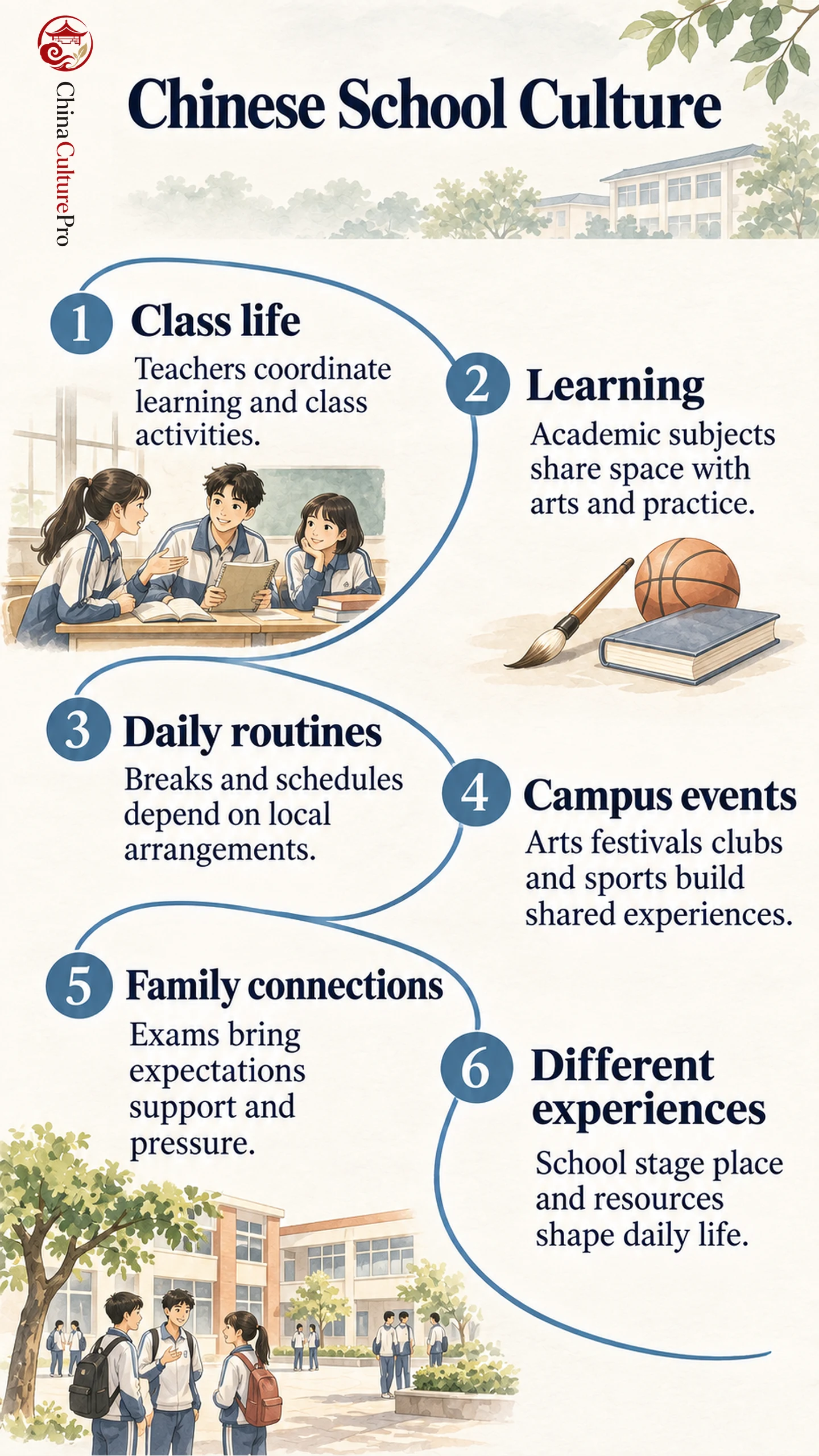
Lessons, breaks, group responsibilities and campus events shape school life alongside academic study. Understanding these settings connects schools with modern Chinese culture and helps explain how relationships among students, teachers and families develop in different educational settings.
The Class as a Shared Social Unit
Alongside subject teachers, a class commonly has a homeroom teacher (班主任, bānzhǔrèn). This teacher coordinates class management, student development, contact with families and communication among teachers.[2][3]
The Ministry of Education’s 2009 framework includes organizing a class meeting (班会, bānhuì), guiding student committees and arranging group activities. Meetings provide a setting for discussing class matters. Students also take responsibilities within the group, with roles organized by the school.[2]
This organization can make a class a continuing social reference point. Classmates share work and events, form friendships and encounter disagreements. Jinzhang Zhou’s study of one North China secondary school also examines the pressures teachers face while coordinating educational and administrative responsibilities. The teacher’s experience is part of school culture as well as the student’s.[3]
Learning: Subjects, Practice and Participation
Academic learning is one part of a broad curriculum. Chinese language and literature (语文, yǔwén), mathematics and other academic subjects coexist with arts, physical education and practical learning. The 2022 compulsory-education framework separately identifies labor education and information technology and connects learning across the primary and junior-secondary stages.[1][4]
Curriculum aims and actual classroom experiences should be distinguished. The official explanation emphasizes connections with students’ lives and practical activity. That describes an educational direction; how a lesson unfolds depends on its subject, teacher and class. These aims sit within a longer history of education traditions.[4]
Practicing characters in a language lesson and studying calligraphy as an art have related but different aims. Distinguishing calligraphy and everyday writing helps explain why classroom handwriting practice is not necessarily an artistic performance.
The School Day: Lessons, Breaks and Local Arrangements
A timetable coordinates lessons and the intervals between them. Lunch, rest, activities and travel to or from school form other parts of a student’s day. Boarding and day-school arrangements create different routines, so a single set of opening and closing times is a poor description of school life throughout the country.
Beijing’s 2024 guidance provides a concrete example of change. It called for fifteen-minute breaks in principle in compulsory-education schools, while allowing schools to arrange schedules according to their circumstances. It also encouraged outdoor relaxation, social interaction and appropriate activity during breaks. This is a particular local policy, rather than a universal national bell schedule.[5]
The interval between lessons can therefore be a social part of the day, not simply empty time between academic tasks. To understand a reported routine, identify its year, school stage and location.
Assemblies, Clubs and Campus Events
Assemblies and events bring students together beyond an individual classroom. They can combine collective ceremonies with opportunities to present work, perform or pursue shared interests. The following are documented school examples, rather than a national events checklist:
| Occasion | What the school record shows |
|---|---|
| Arts festival | Shanghai Yuannan Middle School’s 2025 opening included a flag-raising ceremony and a student dance; its program covered calligraphy, painting, music and drama.[6] |
| Club recruitment | Shanghai High School’s September 2025 student-union address introduced clubs spanning literature, arts, sports and science.[7] |
| Sports meeting | The High School Affiliated to Minzu University of China held a 2025 spring event combining sports and traditional cultural content.[8] |
These occasions give students roles as organizers, performers, teammates and audiences. They can also carry a school’s civic and cultural messages. A photograph of a ceremony and a photograph of a club activity show different aspects of the same institution.
Exams, Family Expectations and Support
Assessment is consequential, particularly near transitions between educational stages. The gaokao is a specific university-entry examination context, rather than a description of every school lesson or every child’s day. Its importance can bring students’ aspirations into contact with expectations from home.
Liu and Helwig’s interviews with graduates in urban Beijing and rural Xi’an after the 2017 exam explored both support and pressure. Participants’ accounts connected educational aims with family resources and teaching conditions. Those findings concern the students studied, while illustrating why expectations are experienced differently.[9]
Teacher-parent communication connects school with family life. The homeroom framework includes coordination concerning students’ learning, behavior and development, extending beyond examination marks.[2]
Why School Experiences Differ
School stage, region, institutional type, facilities and household circumstances all help establish context. An account of a senior-secondary boarding school cannot simply be applied to a primary day school. Likewise, the opportunities described by one well-resourced campus do not establish what every student can access.
Student participation also deserves attention. Zhang and Wyness’s 2024 study examines a participatory initiative in one primary school, using children’s and teachers’ perspectives on decisions affecting school life. It documents one approach to involving students in their school environment.[10]
When reading a school account, distinguish national curriculum aims, local arrangements and what actually happened in the particular classroom. Students also have identities and relationships beyond school; youth culture provides another perspective on those lives.
FAQs About Chinese School Culture
Do all Chinese schools follow the same timetable?
No. Stage, location and school arrangements matter. Beijing’s 2024 break-time guidance is one local example and should not be treated as every school’s schedule.
Is Chinese school culture only about exams?
No. Academic assessment matters, while class relationships, arts, sports, clubs and practical activities also shape school life.
What does banzhuren mean?
It refers to the homeroom or class teacher, whose role combines teaching with class coordination, student development and communication with families.
Can one classroom video represent schools throughout China?
No. A video captures a particular class, activity and moment. Identify the school stage, location and context before drawing wider conclusions.
Sources
[1] Ministry of Education of China. Compulsory Education Curriculum Framework and Standards Released
[2] Ministry of Education of China. Regulations on Homeroom Teachers in Primary and Secondary Schools
[3] Jinzhang Zhou, SAGE Open. The Everyday Professional Experiences of Homeroom Teachers in a Chinese Secondary School
[4] Ministry of Education of China. Questions and Answers on the Curriculum Framework
[5] Beijing Municipal Education Commission. Guidance on Break Time in Compulsory Education Schools
[6] Shanghai Yuannan Middle School. Campus Culture and Arts Festival Opens
[7] Shanghai High School Student Union. Club Recruitment Address at the Weekly Flag-Raising Assembly
[8] High School Affiliated to Minzu University of China. Traditional Ethnic Sports and Spring Sports Meeting
[9] Gloria Xiao Yu Liu and Charles C. Helwig, SAGE Journals. Autonomy, Social Inequality, and Support in Adolescents’ Reasoning About the Gaokao
[10] Mengyao Zhang and Michael Wyness, Child Indicators Research. Children’s Participation in Decisions Affecting Their School Life in China