


Quick Answer: Who Was Ding Ling?
Ding Ling (丁玲, Dīng Líng, 1904–1986) was a writer of modern Chinese literature. She became known for Miss Sophia’s Diary (莎菲女士的日记, Shāfēi Nǚshì de Rìjì), wrote fiction and essays during the war years, and published a novel about land reform in 1948.[1][2]
- Early fiction: Sophia’s diary records desires and decisions she keeps from her friends.
- Wartime writing: Ding’s work from the Yan’an (延安, Yán’ān) period examines what happens when women’s wartime work clashes with expectations at home.[4][5]
- Land reform: The Sun Shines over the Sanggan River (太阳照在桑干河上, Tàiyáng Zhào zài Sānggān Hé Shàng) depicts a village as its residents face changes in who controls the land.[8][9]
Her work ranges from the private voice of a diary to the conflicting voices of a village.
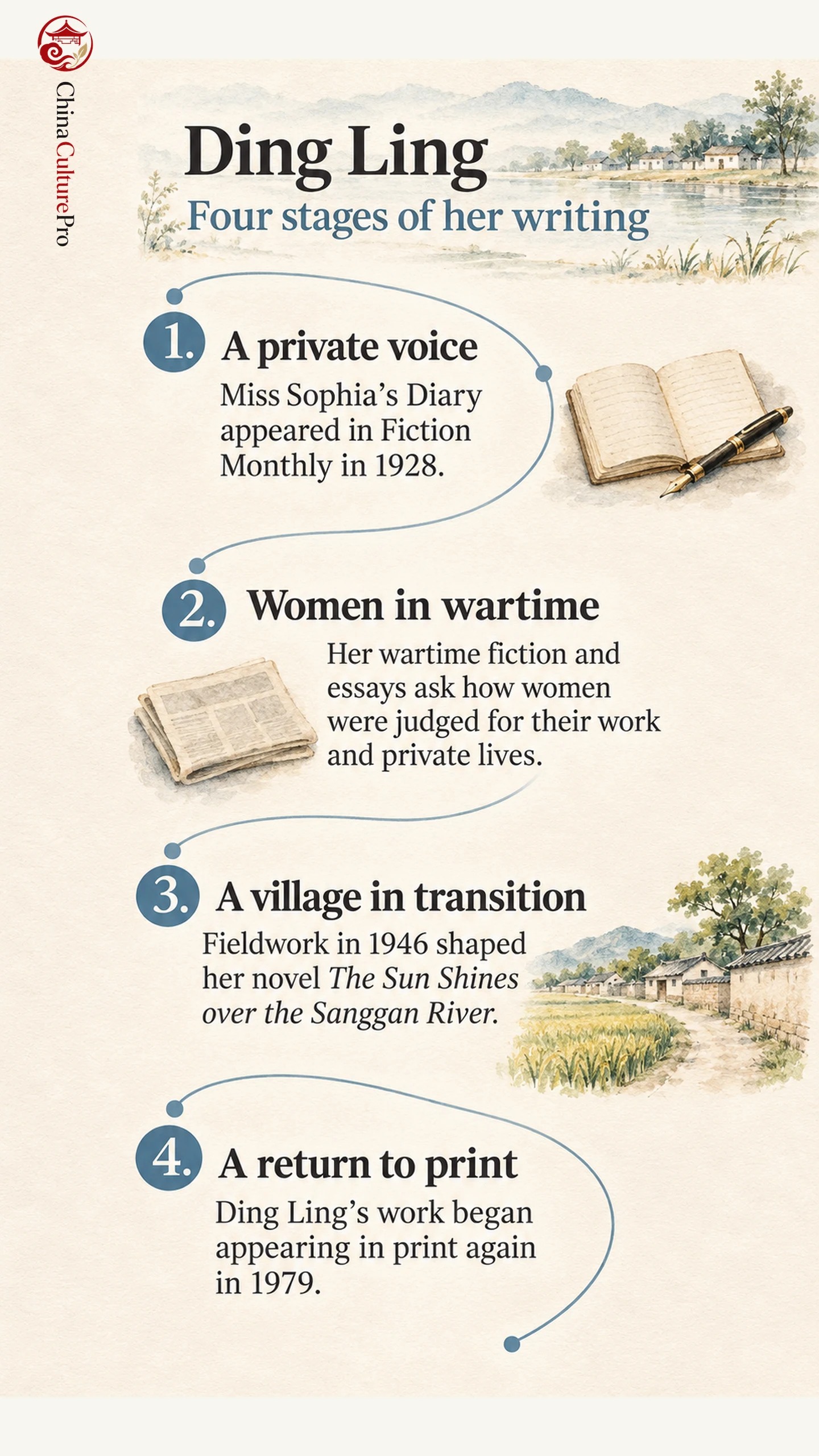
Ding Ling began publishing in the late 1920s, after the May Fourth Movement (五四运动, Wǔsì Yùndòng) had challenged older social conventions. Her early work placed women’s private judgments at the center of stories that readers could encounter in a literary magazine.[1][2]
What Miss Sophia’s Diary Lets a Reader Hear
Ding wrote the story in 1927. Its first appearance in Fiction Monthly (小说月报, Xiǎoshuō Yuèbào) was in February 1928. The first-person entries let the reader follow a young woman’s shifting thoughts as she deals with illness, loneliness and attraction.[2][3]
Sophia looks for a room near Ling Jishi (凌吉士, Líng Jíshì), the man she wants to see. She tells a friend she wants to live closer to someone else. In the diary, she notices that her chosen room lies between the friend’s home and Ling’s dormitory. By the end of the entry, she has talked herself out of moving. The reader hears both what Sophia chooses to tell her friend and what she admits to herself.[3]
Yan’an, Xia Village and the March 8 Essay
Ding reached northern Shaanxi in 1936 and later edited the literary supplement of Liberation Daily (解放日报, Jiěfàng Rìbào). In the 1941 story When I Was in Xia Village (我在霞村的时候, Wǒ zài Xiácūn de Shíhou), Zhenzhen (贞贞, Zhēnzhēn) returns to her village after captivity and intelligence work during the Japanese occupation. Some villagers treat her captivity as a reason to shame her even after she has helped the resistance.[4][5][6]
The essay “Thoughts on March 8” (三八节有感, Sānbā Jié Yǒugǎn), appeared in the same newspaper in March 1942. Ding describes women whose child care responsibilities make it harder to stay in public work, then asks why they are blamed for falling behind. Her essay documents a conflict between public work and family responsibilities in Chinese women’s history.[5][7]
Why Ding Ling Wrote About Land Reform
In her foreword, Ding recalls joining a land reform team in 1946. She had planned a longer story extending into land distribution and army recruitment. After further fieldwork, she dropped those parts and concentrated on the struggle leading up to redistribution.[8]
The novel moves among residents of a fictional village called Nuanshuitun (暖水屯, Nuǎnshuǐtún), shortened to Nuanshui in the 1954 translation.[8][11] One tenant gives back land he has received because the prospect of standing apart from a landlord frightens him. For this tenant, gaining land does little to dispel the fear of losing a landlord’s protection.[9]
Censure and a Return to Print
Ding held senior literary posts after 1949. She was labeled a rightist in 1957, her works were banned, and she was persecuted during the Cultural Revolution (文化大革命, Wénhuà Dàgémìng). Her work began appearing in print again in 1979. The Chinese Writers Association dates a further official decision clearing her name to 1984.[1][4]
FAQs About Ding Ling
Why do some editions call her Ting Ling?
Ting Ling is an older romanization of Ding Ling. It appears on the title page of the 1954 English translation of her Sanggan River novel.[1][8]
Are Miss Sophia’s Diary and Miss Sophie’s Diary the same story?
Yes. Miss Sophie’s Diary is the title used in W. J. F. Jenner’s 1985 translation collection.[10]
Where can I read Ding Ling in English?
The 1989 collection I Myself Am a Woman includes Gary J. Bjorge’s translation of the Xia Village story and Gregor Benton’s translation of the March 8 essay. For the novel, look for the translation by Yang Hsien-yi and Gladys Yang. The 1954 edition spells the river Sangkan.[5][8]
Sources
[1] Renditions, Chinese University of Hong Kong. Ding Ling, biography and bibliography
[2] Lan Dizhi. Women’s anger and struggle, Guizhou Social Sciences, 1998
[3] Ding Ling. Miss Sophia’s Diary, Chinese text
[4] China Writers Association. Ding Ling, Yan’an literary figure
[5] Louise Edwards. Women Sex-spies, The China Quarterly
[6] Akiyama Yōko. Reconsidering When I Was in Xia Village
[7] Ding Ling. Thoughts on March 8, Chinese text
[8] Ding Ling, translated by Yang Hsien-yi and Gladys Yang. The Sun Shines over the Sangkan River, 1954 edition and author’s foreword
[9] Saraswathi Menon. A Classic of Chinese Land Reform, Review of Agrarian Studies
[10] CiNii Books. Miss Sophie’s Diary and Other Stories, 1985 Jenner edition
[11] China Federation of Literary and Art Circles. The Sun Shines over the Sanggan River, publication and narrative context