


Quick Answer: Who Are the Derung?
The Derung people(独龙族,Dúlóngzú), also called Dulong or Drung in English, are an officially recognized ethnic group in China. Their principal community setting is the Dulong River valley in Gongshan County, northwestern Yunnan. Language, oral narratives, striped woven cloth and seasonal gatherings offer different ways to understand their culture.[1]
A useful account keeps historical practice and present life in view together. Older descriptions of record keeping or women’s facial tattoos do not establish what every family does today. Weaving projects, language documentation and contemporary gatherings show culture being carried forward through different kinds of work.
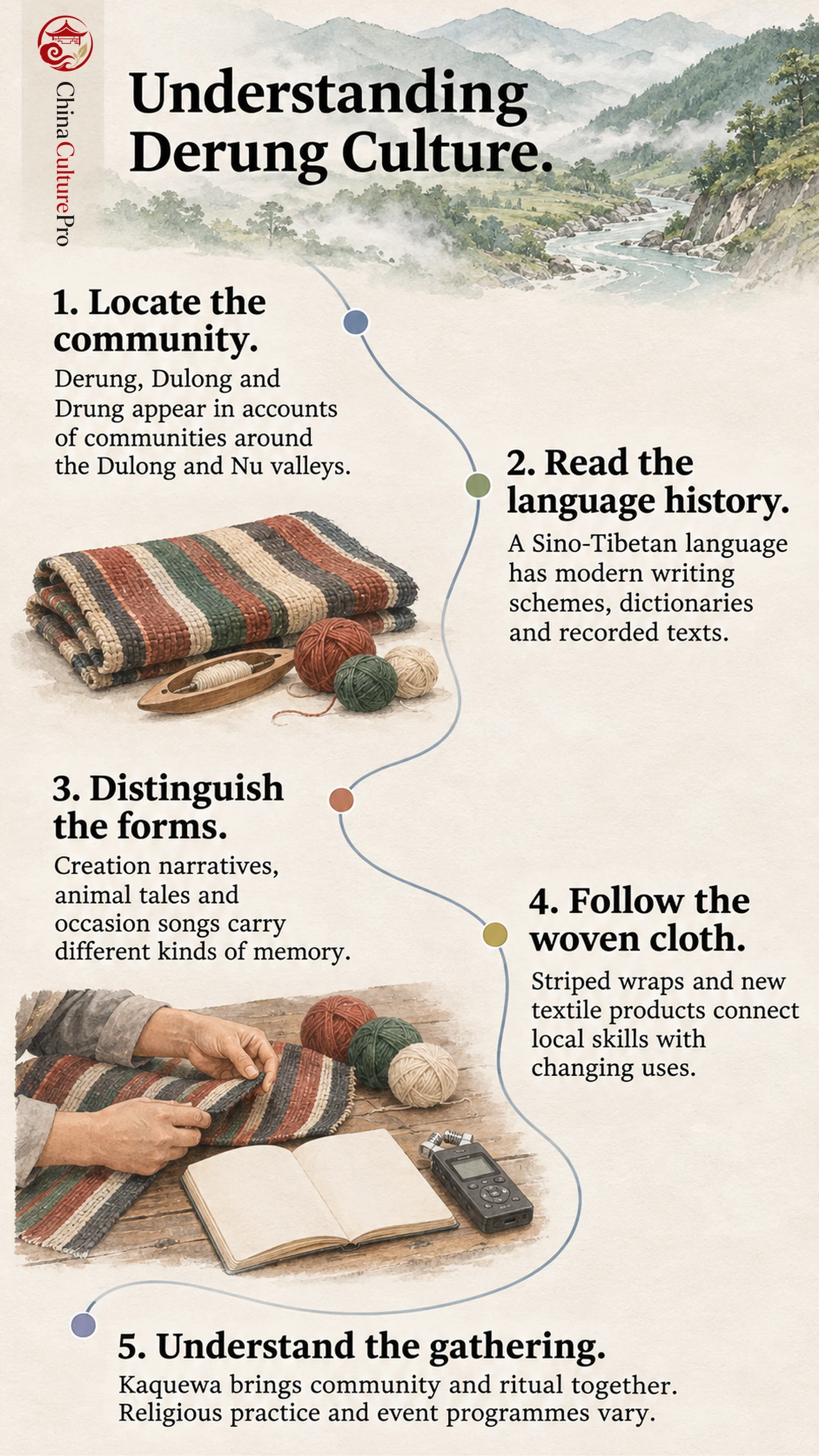
The stripes of a woven wrap are an immediately visible part of Derung culture. Spoken stories and the words used between relatives are less visible, but equally important. This guide follows those forms of knowledge from their river-valley setting to the people and activities through which they continue.
A River-Valley Setting and Several Names
The Dulong River valley lies in Gongshan Derung and Nu Autonomous County, within Yunnan’s Nujiang region. Derung communities also live around the Nu River valley to the east. The geography matters because a description of one settlement does not necessarily represent every community associated with the name.[1]
English spellings include Derung, Drung and Dulong. Linguistic publications also use Trung or T’rung. When comparing accounts, the spelling is only a starting point. The village, river valley and language variety tell the reader more about the people actually being described.[2]
The neighboring Nu communities have their own identities and linguistic diversity. Some local speech varieties are closely related across ethnic classifications. Consequently, a language map and an official ethnic list answer different questions. Neither should be used as a shortcut for the other.[2]
Derung Language, Writing and Documentation
The Derung language(独龙语,Dúlóngyǔ)belongs to the Sino-Tibetan family. Descriptions distinguish varieties associated with the Dulong and Nu river valleys. A grammar published in 2019 documents Trung through sound patterns, word formation, sentence structure and texts, demonstrating the language’s complexity beyond a short list of translated words.[2]
Historical records describe notched wood and knotted cords as means of keeping information. These methods should be distinguished from a script representing speech. A Latin-letter Derung writing scheme was devised in 1979, discussed and approved in 1983, and trial teaching began in 1984. It is therefore misleading to turn an account of earlier life without writing into a claim that no writing system has ever existed.[1]
A 2015 draft Trung–English–Chinese dictionary offers a concrete example of documentation. It credits Li Aixin, Li Jinming, Yang Jiangling and Ross Perlin, and concentrates on Dulong River varieties, especially the Third Township variety around Kongdang. Its introduction describes limited implementation of the orthography and includes both headwords and example sentences.[3]
The draft records a particular stage of collaborative work and cannot establish today’s literacy or schooling practices. It also shows why local speakers’ knowledge is essential. Variation within a language can disappear from view when an outsider sees only a single translated headword.[3]
Stories, Songs and Historical Memory
Derung oral traditions include creation narratives, animal tales and songs attached to social occasions. Their range makes “folklore” a useful broad heading but an incomplete description of what a particular speaker is doing. A storyteller explaining the world and a singer greeting a gathering use different forms.[4]
| Oral form | Examples of its subject or setting |
|---|---|
| Creation and flood narratives | Accounts concerning the separation of earth and sky, human origins or a great flood. |
| Animal fables | Stories involving animals such as rabbits, tigers and crows. |
| Songs for occasions | Singing connected with New Year, a new house or other community events. |
These forms belong alongside other Chinese folk tales, while retaining their local language and telling context. A translated title identifies a story, but does not preserve every feature of its performance.
Historical women’s facial tattooing requires the same attention to context. Explanations have included beauty, adulthood and protection from abduction, among others. Accounts preserve several interpretations and describe the practice declining after 1949. It does not establish one universal origin or a rule for women today.[4]
The Dulong Blanket and Weaving Today
The Dulong blanket(独龙毯,Dúlóngtǎn)is a striped woven textile associated with traditional dress. Broad bands of color give the cloth its distinctive striped appearance. It should be understood as a made and worn textile, with its own material and social uses, rather than reduced to a decorative ethnic pattern.[5]
Photographic documentation from a craft-support project includes local weavers and textiles from the mid-2010s. In 2016, two Derung women took part in textile experimentation in Shanghai before returning with new designs. The example connects a local skill with exchange beyond the valley. It also complicates the idea that a tradition can continue only by making an unchanged product.[5]
A March 2025 account from Dizhengdang village describes weaving in local courtyard workshops. New products included small pillows, bags and scarves developed through training and collaboration. These are specific contemporary uses of weaving, rather than evidence that the traditional wrap has vanished.[6]
For readers comparing minority dress traditions, the useful questions concern the maker, material, intended wearer and use. A wrap worn at a gathering and cloth made into a new accessory can express different choices within a continuing craft tradition.
Kaquewa, Belief and Community Gatherings
Kaquewa(卡雀哇,Kǎquèwā)is a Derung New Year festival with community gatherings, singing, dancing and ritual practices. Historical descriptions include invitations conveyed through notched wood and celebrations moving between villages. The festival entered China’s first national intangible cultural heritage list in 2006, under project X-23.[7]
Those elements explain why the festival belongs within Chinese intangible cultural heritage. Its value includes social relationships and transmitted knowledge, as well as an event’s visible performances. A stage programme is one way of presenting culture, but it cannot stand in for every household or village experience.
Religious life also has more than one strand. Traditional accounts describe relationships with deities and the natural world, while later documentation records Christian practice in some communities. A Derung identity alone does not establish a person’s religion or participation in every ritual.[5][7]
Contemporary events may combine inherited forms with new performance formats. The public Kaquewa programme reported in 2025 included songs, dance and a dramatic presentation of life in the Dulong valley. The dated programme shows one organized celebration and its particular performance choices.[8]
FAQs About Derung Culture
Are Derung, Dulong and Drung the same people?
These names commonly refer to the same ethnic group in English accounts. Check the locality when a source discusses a particular community or language variety.
Is the Derung language unwritten?
It has modern Latin-letter writing and documentation. Historical accounts of life without a traditional script need to retain their time context.
Do all Derung women have facial tattoos?
No. Facial tattooing is a historical practice associated with some older women, and its origins have several interpretations.
Sources
[1] National Ethnic Affairs Commission. Derung Community and Language Overview
[2] Ross Perlin. A Grammar of Trung, 2019
[3] Trung Dictionary Committee. Concise Trung-English-Chinese Dictionary, Draft of September 2015
[4] National Ethnic Affairs Commission. Derung Customs and Oral Literature
[5] Beijing Contemporary Art Foundation. Dulong People Arts and Craft Project
[6] Yunnan Ethnic and Religious Affairs Commission. Weaving Workshops in Dulongjiang, March 2025
[7] China Intangible Cultural Heritage. Derung Kaquewa Festival
[8] Yunnan Ethnic and Religious Affairs Commission. The 2025 Kaquewa Programme