


Quick Answer: What Was the Chu-Han Contention?
The Chu-Han Contention (楚汉之争, Chǔ–Hàn zhī zhēng) was the struggle for power after the Qin empire fell, conventionally dated 206–202 BCE. Liu Bang (刘邦, Liú Bāng), king of Han, fought Xiang Yu (项羽, Xiàng Yǔ), ruler of Western Chu (西楚, Xī Chǔ). Liu Bang won and took the imperial title in 202 BCE. [1][2][4]
- 206 BCE: Xiang Yu divided the former Qin realm among kings and assigned Liu Bang the kingdom of Han.
- 205 BCE: Xiang Yu defeated Liu Bang at Pengcheng (彭城, Péngchéng), but Han regrouped.
- End of the war: Han and allied forces surrounded Xiang Yu at Gaixia (垓下, Gāixià). [1][2][4]
The struggle also depended on regional commanders whose troops and territories gave them room to bargain. [1][3][4]
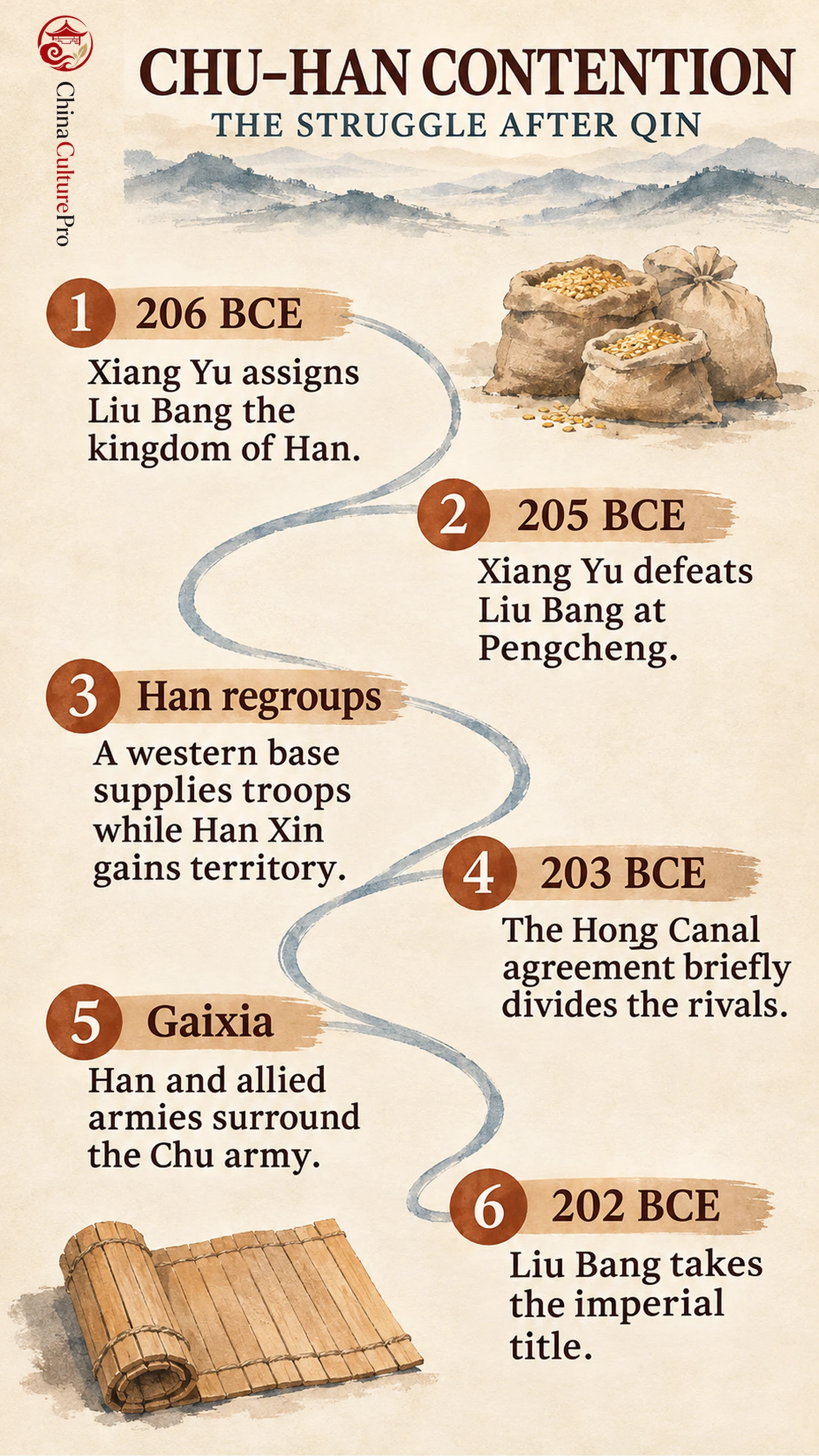
Xiang Yu could win a battle and still lose allies elsewhere. Liu Bang could retreat and raise another army. The war turned on who could hold territory, supply troops and bring several commands together at the same time.
How Qin’s Fall Produced Rival Kingdoms
Xiang Yu and Liu Bang rose during the rebellions that brought down the Qin dynasty. Liu Bang received the surrender of the last Qin ruler, but Xiang Yu led the stronger military coalition. He declared himself hegemon king of Western Chu and appointed rulers to eighteen kingdoms across the former Qin empire, including Liu Bang’s Han. The arrangement gave many commanders power of their own. [1][2][4]
Xiang Yu assigned Liu Bang Hanzhong (汉中, Hànzhōng), Ba and Shu. He divided Guanzhong (关中, Guānzhōng), the former Qin heartland within the passes, among three former Qin generals. The two places mattered for different reasons. Hanzhong gave Liu Bang his royal seat. Taking the former Qin heartland would give him a larger base for recruiting and supplying troops. [1][2][4]
The distribution also produced conflicts outside Han. In Qi, Tian Rong resisted the kings assigned by Xiang Yu. Xiang Yu’s campaign in the east diverted forces at a moment when Liu Bang was moving back into Guanzhong and preparing to march east. [1][2][4]
Why Liu Bang Recovered After Pengcheng
In 205 BCE, Liu Bang occupied Pengcheng, Xiang Yu’s base. Xiang Yu returned and routed his army. Some allies switched sides after the defeat. Xiang Yu held Liu Bang’s father and wife as hostages. The defeat threatened the coalition, but it left Liu Bang a western base to which he could turn for men and supplies. [1][2][4]
Liu Bang had left Xiao He in the west, where he recruited replacements and gathered supplies. Even after the defeat Han could build another field army. At Xingyang (荥阳, Xíngyáng), Han depended on provisions from the nearby Ao Granary. Xiang Yu repeatedly threatened the route between them. Control of territory in the west could raise troops, while the campaign in the east depended on getting food to them. [2][4]
Han Xin (韩信, Hán Xìn) fought on other fronts. His campaigns brought the regions of Zhao and Qi into the coalition opposing Chu. When he sought a royal title in Qi, Liu Bang granted it. This was part of a war in which the king of Han needed a capable commander and had to reckon with the authority that commander gained from his victories. [2][3][4]
Peng Yue also attacked Chu supply lines, operating outside the main Han army. When Xiang Yu moved east to respond, pressure on the Han position in the west could ease. The campaign around Xingyang and the fighting in Chu’s rear made demands on the same troops. [1][2][4]
How the Hong Canal Truce Gave Way to Gaixia
In 203 BCE, the rivals agreed to divide their spheres at the Hong Canal (鸿沟, Hónggōu). Chu retained the east and Han the west. Xiang Yu returned Liu Bang’s family members and withdrew. Liu Bang pursued him on his advisers’ recommendation, but Xiang Yu defeated him at Guling before promised allied armies had joined. [1][2][4]
According to the Records of the Grand Historian, Liu Bang secured the cooperation of Han Xin and Peng Yue by promising them territory. Their troops joined Liu Bang and other allied forces for the encirclement at Gaixia. Sima Qian depicts Xiang Yu hearing songs from his home region and fearing that Chu had already fallen. The text also describes an army short of food and surrounded by several forces. [1][2][3]
What the Han Victory Changed
Xiang Yu broke out of the encirclement with a small following. Sima Qian’s account ends his flight at the Wu River, where he took his own life. Liu Bang accepted the imperial title in 202 BCE and is known to history as Gaozu (高祖, Gāozǔ). The new court kept the Qin system of administering commanderies directly in some regions and initially left large territories under allied kings. The Han dynasty emerged from both that inheritance and the arrangements made to win the war. [1][2][4][5]
The regional kingdoms remained a political question after the fighting. The Han court later reduced the power of several kings outside the Liu family. Governing the new empire required decisions about how much authority the center could exercise over territories that had helped bring it into being. [3][4][5]
Sima Qian tells the story in separate accounts of Xiang Yu, Gaozu and Han Xin. Xiang Yu’s annals dwell on the last night at Gaixia. Han Xin’s biography gives a commander’s negotiations and choices more space. Reading the accounts together makes it easier to separate the literary portrait of a defeated ruler from the negotiations that brought an army to the battlefield. [1][2][3]
FAQs About the Chu-Han Contention
Why do some histories date the start of Han to 206 BCE?
Liu Bang became king of Han in 206 BCE, so some dynastic tables start there. He took the imperial title in 202 BCE, after the victory over Xiang Yu. [2][4][6]
Was Xiang Yu’s Western Chu the old Warring States kingdom of Chu?
Western Chu drew on the name and prestige of the older Chu state. It was a new polity in Xiang Yu’s settlement after Qin, with Pengcheng as its center. [1][4]
Did the Chu songs at Gaixia really happen?
Sima Qian’s account includes the songs, but they cannot be independently verified from the surviving evidence used here. The episode conveys how the text portrays Xiang Yu’s isolation during the encirclement. [1][4]
Sources
[1] Sima Qian. Records of the Grand Historian, Chapter 7: Annals of Xiang Yu
[2] Sima Qian. Records of the Grand Historian, Chapter 8: Annals of Gaozu
[3] Sima Qian. Records of the Grand Historian, Chapter 92: Biography of the Marquis of Huaiyin
[4] Michael Loewe. The Former Han Dynasty, in The Cambridge History of China
[5] Mark Edward Lewis. The Early Chinese Empires: Qin and Han
[6] Cambridge University Press. Chronology of Dynasties