
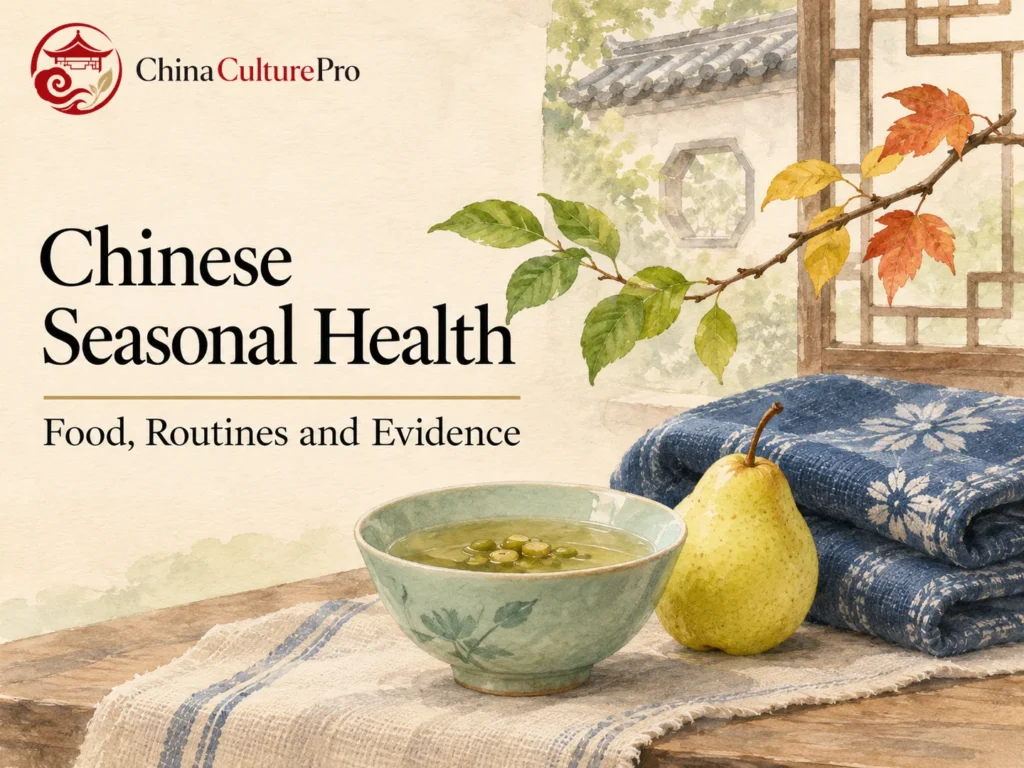

Quick Answer: What Are Chinese Seasonal Health Traditions?
Chinese seasonal health traditions adapt food, rest, activity and emotional life to the changing year. They belong to yangsheng (养生, yǎngshēng), the broader practice of nurturing life.[1]
- Spring, summer, autumn and winter carry different meanings in the classical framework.
- Seasonal eating includes familiar foods as well as traditional warming and cooling classifications.
- Calendar markers provide cultural orientation; actual weather and individual needs still matter.
- Modern evidence must address a particular practice and claim, rather than validate the whole framework at once.
These traditions explain cultural habits; a seasonal label alone does not establish a medical benefit.
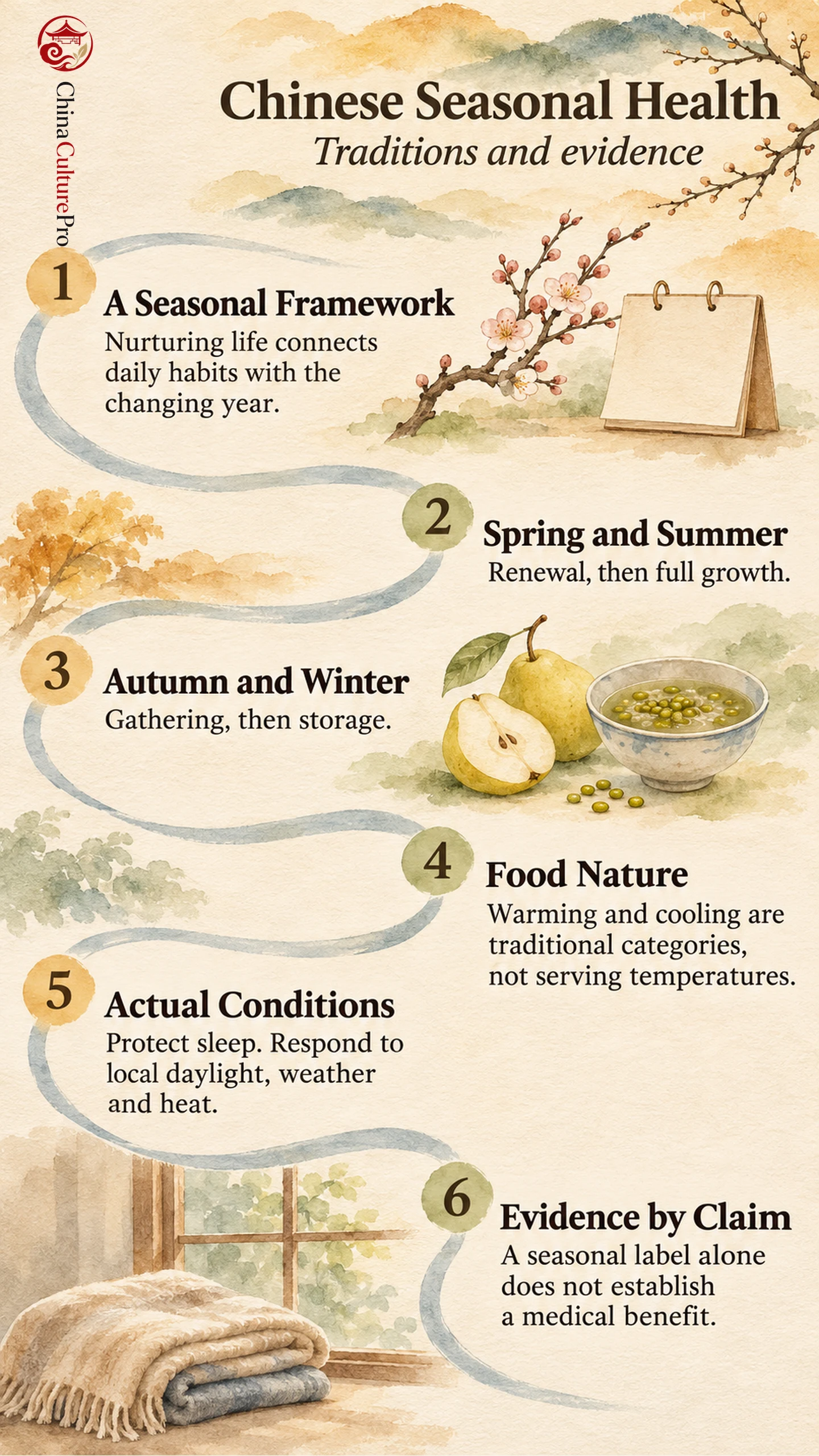
The appeal of seasonal health culture lies in its attention to ordinary life: when to rest, what to cook and how to respond to changing surroundings. Understanding its vocabulary helps explain a family soup or a winter routine without turning either into a universal prescription.
Why the Seasons Organize Traditional Health Culture
The Huangdi Neijing (黄帝内经, Huángdì Nèijīng), especially its Suwen (素问, Sùwèn) section, connects human life with recurring changes in nature. Seasonal regulation concerns movement, emotions and rest as well as diet. Its account uses yin and yang (阴阳, yīn yáng) to explain alternating activity, withdrawal, warmth and coolness.[1]
The 24 solar terms (二十四节气, èrshísì jiéqì) supply a finer calendar rhythm. They divide the Sun’s apparent annual path into 15-degree intervals. Their names reflect, in part, the climate and agricultural activities of ancient central China; they are not a forecast that every location will experience identical weather on the same date.[2] The solar-term guide explains the calendar system, while the Huangdi Neijing guide places seasonal thinking within the larger medical classic.
The Four Seasons in the Classical Framework
The seasonal sequence moves from emergence to growth, gathering and storage. These are traditional organizing ideas, rather than measured biological states.[3]
| Season | Traditional emphasis | Examples within the classical regimen |
|---|---|---|
| Spring | Emergence and renewal | Walking freely, relaxing bodily constraint and encouraging an open mood |
| Summer | Full growth and activity | Early rising, emotional composure and attention to heat and fluid loss |
| Autumn | Gathering and settling | Earlier rest, a quieter disposition and concern with dryness |
| Winter | Storage and inwardness | Warmth, earlier bedtime and rising after daylight returns |
The table describes an inherited seasonal ideal. It does not require a person to follow a historical sleep schedule literally, or to interpret an uncomfortable day as evidence of an imbalance in a particular organ.[3]
Seasonal Foods and the Meaning of Warming and Cooling
Recognizable examples make the tradition easier to understand. Mung bean soup is associated with summer cooling, while mutton soup appears in winter warming traditions.[4] Pear is described as cooling and moistening in traditional food classification, helping explain its association with autumn dryness.[5] Spring guidance may emphasize vegetables and a less meat-heavy diet.[6] These examples illustrate a framework, rather than provide a compulsory menu.
Warming and cooling describe a food’s attributed nature within Chinese medicine, rather than simply its temperature in the bowl. The classification places mung beans and watermelon among cooling foods, mutton and chives among warming foods, and some staples in a neutral category.[5] Thus, a hot bowl of mung bean soup can still belong to a cooling tradition. Serving temperature and traditional nature answer different questions.
For the wider dietary framework, see Chinese food therapy. The role of a shared bowl within a meal belongs to Chinese soup culture; adding medicinal ingredients introduces a separate question about their suitability and safety.
Adapting Sleep and Activity without Copying a Timetable
Classical seasonal advice relates sleep and activity to changing daylight. Its summer and winter instructions belong to that historical account of the year.[3] A modern reading should preserve adequate sleep rather than use late retiring and early rising as an instruction to shorten it. Adults aged 18–60 generally need at least seven hours each night; recommended amounts vary with age.[7]
Similarly, responding to summer warmth does not mean seeking strenuous exercise in dangerous heat. Staying cool, drinking fluids and moving outdoor activity to cooler parts of the day are concrete heat precautions.[8] A traditional summer soup is a food, not a substitute for those measures.
Local conditions matter more than a calendar label when deciding what to wear or when to go outside. The seasonal names retain their historical meaning even where the weather differs from the central Chinese setting that helped shape them.[2]
What Modern Evidence Can and Cannot Confirm
Separate three questions when assessing a claim: Is this a documented custom? Does the habit fit general health guidance? Has its specific claimed effect been tested? A positive answer to the first does not settle the third.
A varied diet built around nutritious foods can accommodate seasonal cooking. Current dietary guidance emphasizes adequacy, balance, moderation and diversity, including limiting excess free sugars and sodium.[9] That supports evaluating the whole meal, rather than assuming a soup becomes beneficial because it carries a seasonal name.
Herbal treatment is another category. Research on Chinese herbal products has produced mixed results, and some products have contained contaminants or incorrect ingredients. Their use should be discussed with a healthcare professional, especially alongside other medicines.[10] Neither a winter date nor a traditional warming label establishes that a tonic is necessary, effective or safe for an individual.
FAQs About Chinese Seasonal Health Traditions
Do the 24 solar terms follow the Moon?
They follow the Sun’s position along its apparent annual path. They operate within the traditional Chinese calendar, but are not lunar phases.[2]
Does cooling food have to be eaten cold?
No. Cooling is a traditional classification of food nature. The temperature at which the dish is served is a separate property.[5]
Should everyone take tonics in winter?
No. Seasonal custom does not establish an individual need for herbal treatment. Potential adverse effects, product quality and interactions still need consideration.[10]
Can these traditions be followed outside China?
Their cultural meanings can be appreciated anywhere. Daily habits should respond to actual local conditions; the calendar’s seasonal names partly reflect ancient central China.[2]
Sources
[1] The Chinese Medicine Hospital of Hong Kong. The Essence of Nurturing Life
[2] Hong Kong Observatory. The 24 Solar Terms
[3] The Chinese Medicine Hospital of Hong Kong. Seasonal Regimen
[4] Chinese Medicine Regulatory Office. Health Preservation in Chinese Medicine
[5] Chinese Medicine Regulatory Office. Health Preservation by Food in Chinese Medicine
[6] Hong Kong Civil Service Bureau. Seasonal Health Knowledge in Chinese Medicine
[7] CDC. About Sleep
[8] CDC. About Heat and Your Health
[9] World Health Organization. Healthy Diet
[10] NCCIH. Traditional Chinese Medicine—What You Need To Know