


Quick Answer: Who Was Li Shizhen?
Li Shizhen (李时珍, Lǐ Shízhēn; 1518–1593) was a Ming-dynasty physician and compiler best known for the Bencao Gangmu (本草纲目, Běncǎo Gāngmù), usually translated Compendium of Materia Medica.
- Scope: The work covers medicinal materials from plants, animals, minerals and other sources.
- Method: It gathers earlier writings and contemporary knowledge, comparing names, descriptions and uses.
- Legacy: It is an important record of medical thought and natural knowledge, rather than a list of remedies validated by modern trials.
Reading it historically means asking both what people knew and how they organized that knowledge.[1][2][3]
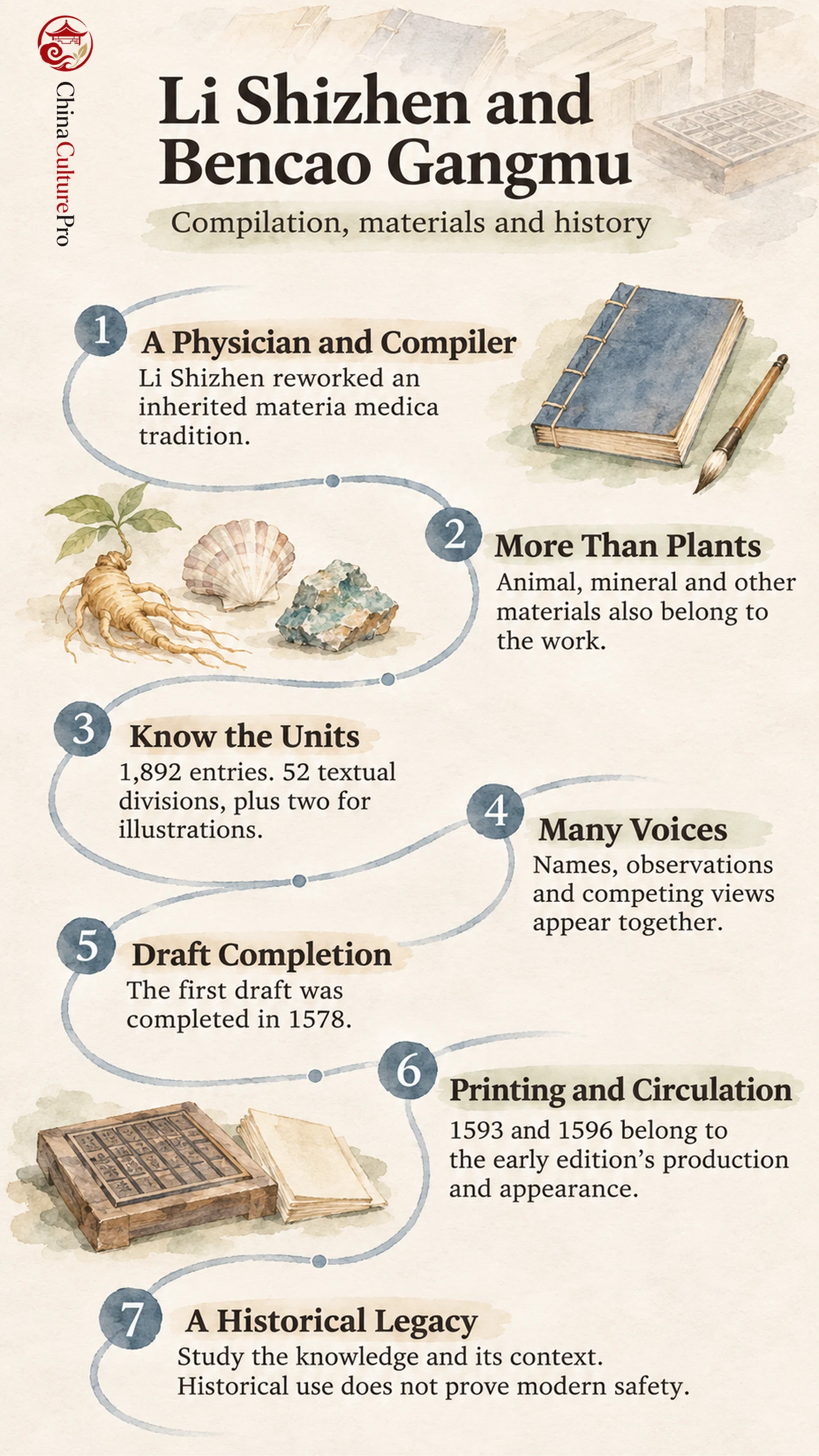
The book’s scale is impressive, but its interest extends beyond its size. It lets readers watch a compiler compare inherited statements, identify problems and argue about things found in the natural and human worlds. That makes it relevant to cultural history as well as the history of Chinese herbal medicine.
A Physician Reworking an Inherited Tradition
Li was born in 1518 into a medical family in what is now Hubei Province. His grandfather and father practiced medicine, and his father was also a scholar. The combination of practical medicine and reading is a useful starting point for understanding his later project.[1]
The materia medica tradition (本草, běncǎo) concerns medicinal substances and the knowledge recorded about them. Li worked within an inherited literature, rather than creating Chinese materia medica from nothing. Problems of identification, conflicting descriptions and classification gave him reasons to revise earlier accounts.[1][4]
His work joined textual scholarship with investigation of materials. Its categories drew on such features as habitat, form, cultivation, medicinal use and culinary use. That mixture belongs to its own intellectual setting; it should not be presented as modern biological taxonomy under different names.[4]
What the Bencao Gangmu Contains
The work is commonly counted as 1,892 entries, with 374 added by Li. It comprises 52 juan (卷, juàn), or textual divisions, with two additional divisions of illustrations, and includes roughly 11,000 prescriptions. These counts describe different units: an entry is not necessarily a botanical species, and a textual division is not necessarily one separately bound book.[3]
Plants are only part of the subject. Animal and mineral materials, along with other objects thought to have medicinal properties, also belong to its scope. The work consequently reaches beyond what an English reader might expect from the word “herbal.”[2]
It records habitats, collecting, processing and nonmedical uses, making it useful for studying daily life and material knowledge.[5]
How Entries Assemble Names, Observations and Arguments
A substantial entry can contain several kinds of information and more than one voice. Reading them separately prevents an earlier writer’s claim from being mistaken for Li’s unqualified conclusion.
| Part of the discussion | Reader’s question | Why it matters |
|---|---|---|
| Names and descriptions | What material is being identified? | Similar names may conceal different things |
| Habitat and collection | Where and how was it obtained? | Knowledge depends on place and access |
| Preparation and other uses | What was done with the material? | Raw material and a prepared product differ |
| Reported uses and competing views | Who claims what, and how is it judged? | Compilation can preserve disagreement |
The compilation acknowledges written sources and knowledge from different social positions. Competing views remain visible, rather than being reduced to one benefit claim.[5]
This also changes the meaning of “new.” An entry added to a compilation is an addition to that book’s inherited inventory, not automatic proof that the compiler was the first person ever to encounter the substance.
Why Completion and Printing Have Different Dates
The first draft was completed in 1578 after a long period of work, commonly described as 27 years. Draft completion did not end the process of revision, preparing a publication and producing a printed edition.[2]
Hu Chenglong (胡承龙, Hú Chénglóng) printed the early Jinling (金陵, Jīnlíng) edition at present-day Nanjing. Catalogues may associate it with 1593, while historical scholarship distinguishes a printed version dated 1593 from its posthumous appearance in 1596. These dates should be explained as parts of a production and circulation history, rather than silently swapped for one another.[3][4]
A later reprint or a modern translation adds another date. When examining a catalogue, first identify whether it describes Li’s draft, an early printed edition, the particular copy held by a library or a recent translation. Otherwise, a genuine date can still be attached to the wrong event.
Reading Its Legacy without Treating It as a Modern Prescription
The work continued to circulate through reprints and across East Asia. Its importance includes the preservation of earlier knowledge and the way it organized materials for later readers. International documentary recognition in 2011 marked its heritage significance.[2][4]
For an English reader, an annotated translation helps separate the original text from explanation. The opening chapters of one complete translation introduce the history of materia medica before moving into discussions of medicines and illness. Modern publication volumes may divide the original material differently from the historical text’s own divisions.[6]
The Huangdi Neijing offers a useful comparison: it is another foundational medical classic, but its conceptual dialogues and textual history differ from this encyclopedia of medicinal matter. Both belong to the broader history of Chinese medicine.
A historical report that a substance was used for an illness does not establish that it works or is safe. Modern safety questions include material identity, preparation, contamination and interactions with medicines. The book is a source to study, rather than a reason to recreate an old prescription independently.[7]
FAQs About Li Shizhen and Bencao Gangmu
Is the Bencao Gangmu only a book about plants?
No. It includes animal and mineral materials and other objects as well as plants, with information extending into natural history and daily life.[2][5]
Did Li Shizhen discover every substance in it?
No. He compiled, compared and reorganized an inherited body of knowledge. An entry added to his work is not necessarily a substance newly discovered by him.[3][4]
Why do accounts give both 1593 and 1596?
They can describe different stages of the early edition’s production and appearance. A date needs its event and edition attached, especially when comparing catalogues and historical studies.[4]
Does historical inclusion prove a remedy is safe?
No. Inclusion documents a historical claim or use. It does not replace present-day evidence about the material, preparation, person and possible interactions.[7]
Sources
[1] Hong Kong Education Bureau. Li Shizhen: Part A
[2] UNESCO. Ben Cao Gang Mu (Compendium of Materia Medica)
[3] Library of Congress. Ben cao gang mu: Wu shi er juan, fu tu er juan
[4] Benjamin Elman. Collecting and Classifying: Ming Dynasty Compendia and Encyclopedias (Leishu)
[5] Paul U. Unschuld. On The First English Translation of the Classic Chinese Encyclopedia, Ben cao gang mu
[6] Li Shizhen, translated by Paul U. Unschuld. Ben Cao Gang Mu, Volume I, Part A
[7] National Center for Complementary and Integrative Health. Traditional Chinese Medicine: What You Need To Know