
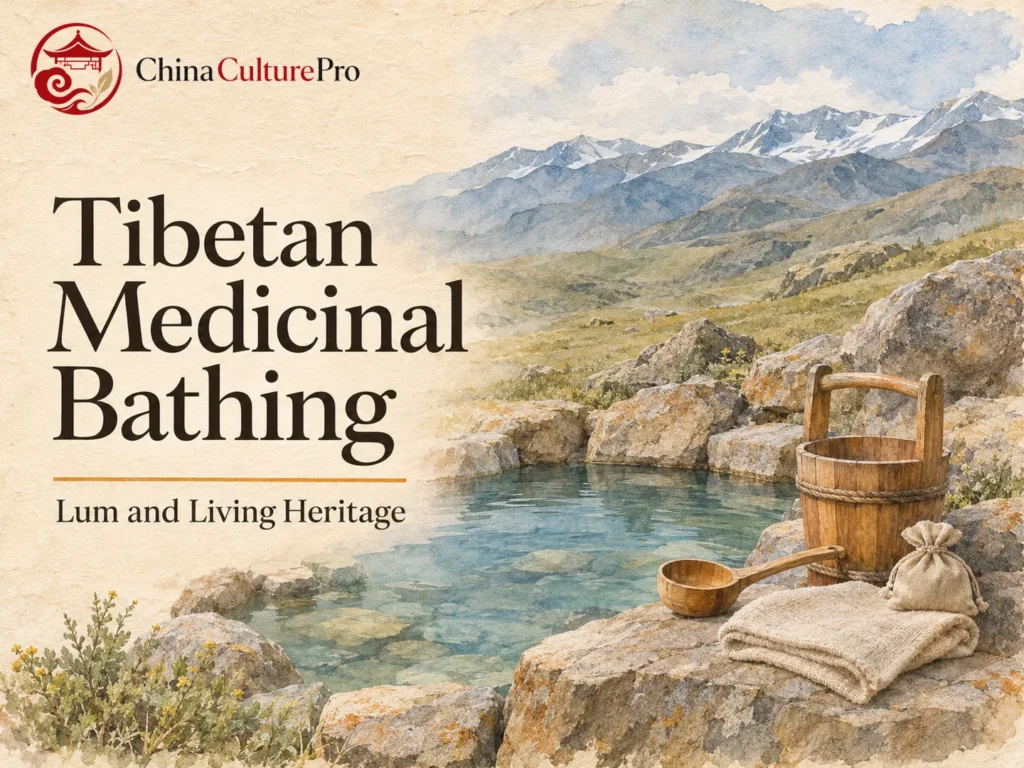

Quick Answer: What Is Lum Medicinal Bathing?
Lum is a Tibetan medicinal bathing tradition within Sowa Rigpa, the Tibetan medical system. It encompasses knowledge and practices involving hot springs, herbal water and steam, with traditional aims concerning health, illness and bodily balance.[1]
- The practice belongs to a particular medical and cultural understanding of the body.
- Preparation and use involve specialist knowledge, rather than a single universal bath recipe.
- Its transmission connects communities, medical practitioners and educational institutions.
- Lum among Tibetan people in China entered the Representative List of the Intangible Cultural Heritage of Humanity in 2018.[1]
Heritage recognition concerns a living tradition; specific medical claims require their own evidence.

Calling Lum a bath describes only its most visible feature. The wider subject includes how people understand health, prepare materials, teach skills and relate to their surroundings. Its cultural history becomes clearer when those relationships remain in view.
The Sowa Rigpa Setting and Its View of the Body
The traditional account uses five elements: earth, water, fire, wind and space. It also describes three dynamics, named Lung, Tripa and Pekan, through which health and illness are interpreted.[2] These are categories within Tibetan medical theory, not measurements supplied by a laboratory test.
The five-element list needs careful reading. It differs from the Chinese Five Phases (五行, wǔxíng): Wood, Fire, Earth, Metal and Water. An identical English phrase such as five elements does not make the two classifications interchangeable. The Five Phases in Chinese medicine guide explains that separate framework.
Hot Springs, Herbal Water and Steam
The traditional account distinguishes natural mineral hot springs from prepared medicinal bathing. Its description of Five Medicinal Nectars includes more than immersion.[2]
| Form | What the description refers to |
|---|---|
| Immersion | Bathing in prepared herbal water |
| Steam bathing | Use of steam in a medicinal bathing setting |
| Sachet application | Application using prepared medicinal sachets |
The work is described through complementary roles: the Manpa is the physician, the Lum Jorkhan prepares medicines, and the Manyok assists.[2] Naming those roles helps explain why a list of plants is an incomplete account of the practice.
There is also a distinction between a natural water source and the preparation made for a particular use. A spring’s cultural importance, a practitioner’s medicinal preparation and a commercial venue’s description are different kinds of information. The broader Chinese bathing and foot-soaking guide supplies a comparison of bathing settings without folding them all into Lum.
Texts, Religion and the Transmission of Skills
The Four Tantras, often rendered Gyud zhi, occupy a central place in Tibetan medical learning. Historical research describes the Tibetan medical tradition as the result of translation, assimilation and intellectual development over centuries, with Buddhist ethics and institutions becoming important to its transmission.[3] This history is more informative than assigning the entire practice to one timeless moment of invention.
Lum’s transmission also includes daily community life, apprenticeship and medical education. The heritage record places the practice in relation to Bon and Tibetan Buddhism.[1] These connections explain cultural setting and lines of teaching; they should not be reduced to decorative religious imagery surrounding a bath.
Comparative research in Bhutan documents water-based practices within a related Sowa Rigpa setting, while distinguishing herbal therapy, hot springs and spiritually significant waters.[4] That research concerns Bhutan, rather than evidence that all Tibetan communities in China use the same arrangements. It is useful precisely because it shows why local context matters.
What the 2018 Heritage Inscription Recognizes
The 2018 decision emphasized transmission, community participation and relationships with natural resources. Its safeguarding discussion included educational materials, documentation and the protection of practice spaces and their environments.[1] Preserving a tradition therefore involves more than keeping a container or recording a formula.
Under the 2003 heritage convention, living heritage includes knowledge, skills and practices recognized by the communities that maintain them. It is transmitted while being recreated in response to changing circumstances.[5] Applied to Lum, this directs attention to people’s continuing ability to teach, interpret and practise, rather than requiring every detail to remain frozen.
The inscription is not a clinical approval process. Its cultural value can be understood on its own terms, while questions about particular treatments are examined through different methods.
Medical Research Has a Different Job from Heritage Recognition
A randomized clinical trial assigned 444 patients with post-stroke limb spasticity to conventional rehabilitation alone or rehabilitation with Tibetan medicated bathing. After four weeks, the combined-treatment group showed greater improvement in muscle-tone scores for selected muscle groups. Follow-up and adverse events were also assessed; reported adverse events were mild.[6]
The comparison is important: the bathing was added to rehabilitation, rather than tested as its replacement. The findings concern a specified patient group and treatment program. They do not validate every spring, preparation or advertised wellness effect carrying the Lum name.
Reading such research requires different questions from reading a heritage entry. Which preparation was used? Who received it? What outcome was measured? What comparison was made? Keeping those questions separate allows cultural significance and clinical evidence to be discussed accurately without making one stand in for the other.
FAQs About Tibetan Medicinal Bathing
Is Lum just another name for an ordinary hot-spring bath?
No. Springs are one setting within a wider tradition of medicinal knowledge and skilled practice.[2]
Is Tibetan medicinal bathing the same as Chinese herbal bathing?
They can share the use of bathing and plant materials, but Lum belongs to Sowa Rigpa and its own concepts and teaching relationships. A shared bathing method does not make medical systems identical.
Does the heritage inscription certify medical effectiveness?
No. Heritage recognition addresses cultural knowledge and its transmission. The effectiveness of a particular treatment requires evidence for that treatment and claimed outcome.
Can a published herbal mixture be treated as a home recipe?
No. An ingredient list is not a complete clinical preparation or an individual assessment.
Sources
[1] UNESCO. Decision 13.COM 10.b.8: Lum Medicinal Bathing of Sowa Rigpa
[2] Ministry of Culture and Tourism of China. Lum Medicinal Bathing of Sowa Rigpa
[3] William McGrath, University of Virginia. Buddhism and Medicine in Tibet: Origins, Ethics and Tradition
[4] Phurpa Wangchuk and colleagues. Water-Based Therapies of Bhutan: Current Practices and Recorded Clinical Evidence
[5] UNESCO. Convention for the Safeguarding of the Intangible Cultural Heritage
[6] Journal of the American Medical Directors Association. Tibetan Medicated Bathing for Post-Stroke Limb Spasticity: Randomized Trial