

Quick Answer: What Is Chinese Food Therapy?
Chinese food therapy (食疗, shíliáo) uses ideas about food, preparation and bodily balance to guide eating within Chinese medical traditions.
- History: Medical writers developed food treatment over centuries, rather than following one founder’s complete system.
- Categories: Foods may be described by warming or cooling nature and by flavor, beyond their nutrient content.
- Daily life: These ideas can shape household choices, cooking and the timing of meals.
Understanding the tradition does not establish that a particular dish treats a disease. Historical practice and modern dietary evidence answer different questions.[1][2][4][5]
Food can be nourishment, care and a way of explaining discomfort at the same table. Reading Chinese food therapy as part of Chinese food culture makes those meanings easier to understand without turning every family meal into a prescription.
Food Treatment Has a History Beyond One Founder
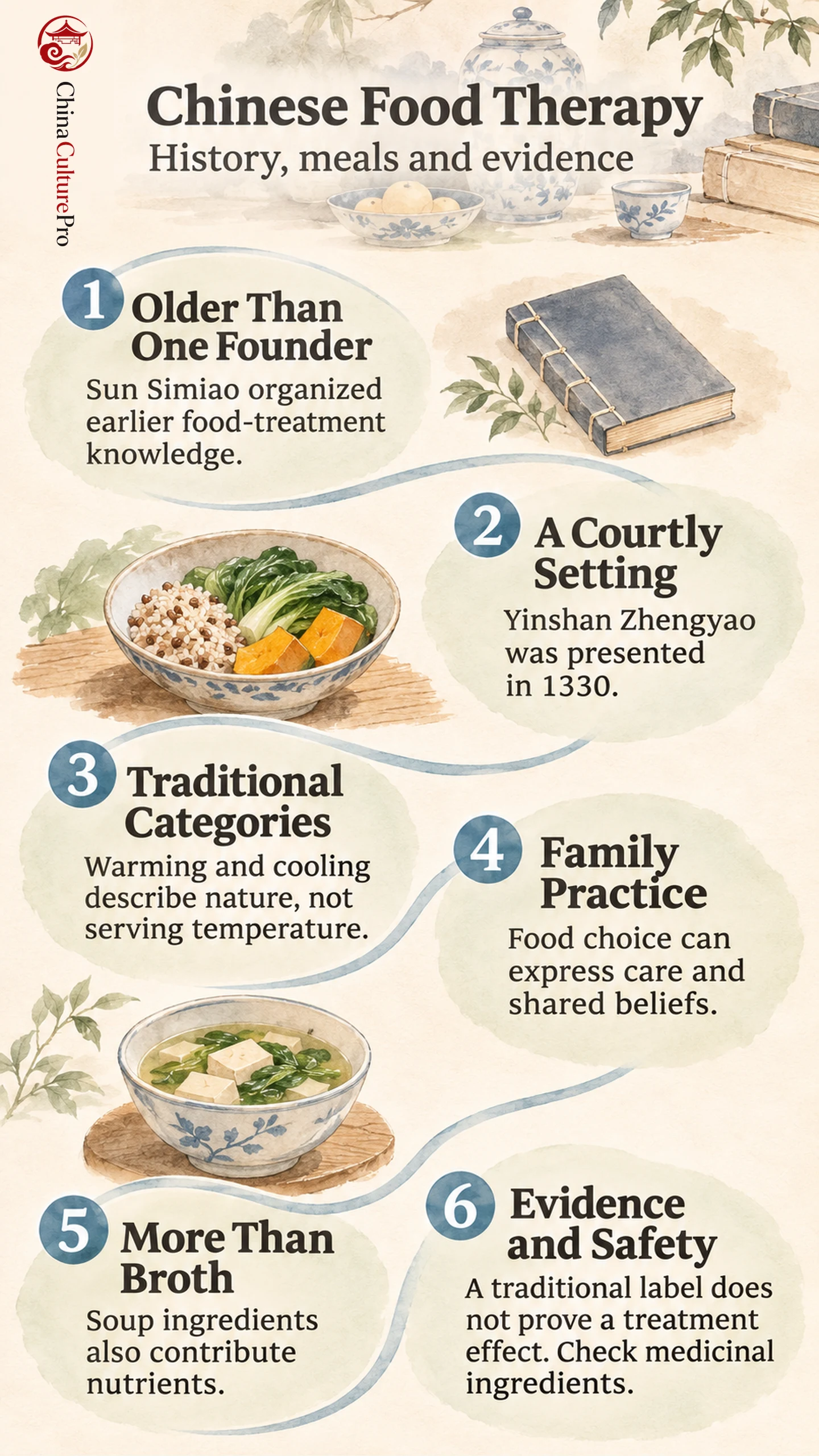
Sun Simiao (孙思邈, Sūn Sīmiǎo) gave food treatment an important place in the Qianjin Yaofang (千金要方, Qiānjīn Yàofāng). Its Shizhi (食治, shízhì), or food-treatment, chapter drew on earlier medical writing. He helped organize an existing body of knowledge; he did not invent the idea that food and health were connected.[2]
Earlier texts, including the Huangdi Neijing (黄帝内经, Huángdì Nèijīng), formed part of that intellectual background. During the Song period, food treatment also became part of literati knowledge and everyday practice. Its history therefore involves readers and households as well as physicians.[2]
The Yinshan Zhengyao (饮膳正要, Yǐnshàn Zhèngyào), associated with Hu Sihui (忽思慧, Hū Sīhuì) at the Yuan court, offers a different setting: an imperial dietary compendium presented in 1330. Research into its non-Chinese terms reveals the importance of language and cultural exchange in reading the work. Chinese dietary history is broader than one timeless list of local ingredients.[3]
How Traditional Food Categories Work
The four natures (四气, sìqì) are cold, cool, warm and hot; neutral is used for milder foods. The five flavors (五味, wǔwèi) are sour, bitter, sweet, pungent and salty. Flavor may describe taste or a traditional function.[1]
The framework also uses yin and yang (阴阳, yīn yáng). Its categories are distinct from nutrient measurements.
| Category or distinction | Example or meaning | How to read it |
|---|---|---|
| Cold or cool nature | Watermelon and mung beans are traditional examples | Not a serving temperature |
| Warm or hot nature | Mutton and chili are traditional examples | Not a serving temperature |
| Neutral nature | Soybeans are one listed example | Not universal suitability |
| Flavor | Sweet, sour, bitter, pungent or salty | Taste or traditional function |
This teaching classification does not establish treatment effects.[1]
From Medical Texts to Family Meals
A study based on interviews with 50 Chinese families in Hong Kong in 1981 recorded food selection, preparation and timing as important ways of responding to illness. Families discussed hot, cold, wet and dry qualities, and used ideas about balance to explain their choices. This documents what particular households believed and did; it was not a trial establishing that their food prescriptions worked.[4]
The study helps explain why a relative may offer food with an accompanying account of what it is thought to do. Such choices can express care and shared knowledge. They do not mean every Chinese household follows identical rules, or that a family explanation is a diagnosis.
Medicinal cuisine (药膳, yàoshàn) explicitly connects cooking with medicinal purposes.[8] Ask what ingredients a dish contains and what role it is meant to serve, rather than assuming a familiar bowl guarantees a familiar formula. Chinese soup culture also includes ordinary cooking and hospitality beyond therapeutic intentions.
Broth and the ingredients in it are nutritionally different parts of a meal. Eating suitable soup ingredients as well as drinking the liquid can improve nutrient intake. A clear bowl of liquid should not automatically be treated as a nutritionally complete meal.[7]
Where Nutrition Evidence and Traditional Claims Diverge
Modern dietary guidance evaluates patterns of eating, nutrient needs and health outcomes. Variety, adequacy, balance and moderation matter; whole grains, vegetables, fruit and pulses can contribute to a healthy diet. Those principles can be followed within Chinese cooking without proving the traditional explanation attached to a dish.[5]
A useful distinction is the question being asked. A historical text can show how a food was classified. An interview can show how families understood it. A clinical claim needs evidence about the actual intervention, people, comparison and outcomes. Neither age nor popularity supplies that missing comparison.
The boundary becomes especially important when a meal includes medicinal ingredients or a concentrated product. Chinese herbal products may interact with medicines, and some have contained incorrect ingredients or contaminants. An attractive soup packet or a “natural” label does not remove those questions. Tell a health professional what you actually take, including supplements and medicinal preparations.[6]
For the wider context, traditional Chinese medicine includes distinct practices with different evidence and safety questions. Food therapy is one historical strand within that larger subject.
FAQs About Chinese Food Therapy
Does cooling food mean refrigerated food?
No. Traditional nature and physical serving temperature are different descriptions.[1]
Is every Chinese soup a medicinal soup?
No. A soup may be an ordinary meal component. To understand a particular bowl, look at its ingredients and intended use rather than assuming that Chinese cuisine automatically means food treatment.
Can traditional food categories replace a prescribed diet?
They should not override dietary care for an identified medical need. A traditional label does not establish nutritional adequacy or the treatment effect required for that person’s condition.[5][6]
Are food ingredients and concentrated herbal products interchangeable?
No. A familiar ingredient name does not make a concentrated preparation equivalent to a culinary portion. Check the actual product and discuss medicinal use alongside other medicines with a qualified health professional.[6]
Sources
[1] Hong Kong Department of Health. Health preservation by food in Chinese medicine – The five cereals, fruits and vegetables
[2] Yuan-peng Chen. Food and Healing in the T’ang and Sung: the Shih-chih Chapter in Sun Szu-miao’s Ch’ien-chin Yao-fang
[3] Yan-shuan Lao. Notes on Non-Chinese Terms in the Yüan Imperial Dietary Compendium Yin-shan Cheng-yao
[4] L. C. Koo. The use of food to treat and prevent disease in Chinese culture
[5] World Health Organization. Healthy diet
[6] National Center for Complementary and Integrative Health. Traditional Chinese Medicine: What You Need To Know
[7] Hong Kong Department of Health. Common Eating Problems in the Elderly
[8] Hong Kong University of Science and Technology. Food & Medicine Homology: Promotion of Chinese Medicinal Cuisine