

Quick Answer: How Do I Start Listening?
Begin with a short solo passage. Listen to how the note starts, what happens while it sounds and how it ends. A plucked string, a drawn bow, a buzzing flute membrane and a set of reed pipes produce different clues.[1][2][3][4][5]
- Plucked strings: Listen for a defined attack followed by a sound that fades or moves.[1][2]
- Bowed strings: Listen for a note that can continue under the bow and glide in pitch.[3]
- Wind instruments: Listen for a vibrating edge to the flute tone or several pitches sounding together.[4][5]
Use a labelled recording to test a first impression before trying to identify an instrument in an ensemble.[6]

When a note starts in a recording, its first moment can tell you something about how it was made. A repeated pluck may sound almost continuous. A bowed note can start sharply. Listen for the pattern across a phrase, then check the instrument credit.[1][2][3][6]
Listen for How Each Instrument Starts a Note
With the guqin (古琴, gǔqín), a player can sound open strings, lightly touch a string to produce a harmonic, or stop a string and move the finger after a pluck. The pipa (琵琶, pípá) also uses plucks, often with clearer attacks in quick passages. Listen for the way each sound changes after it begins.[1][2]
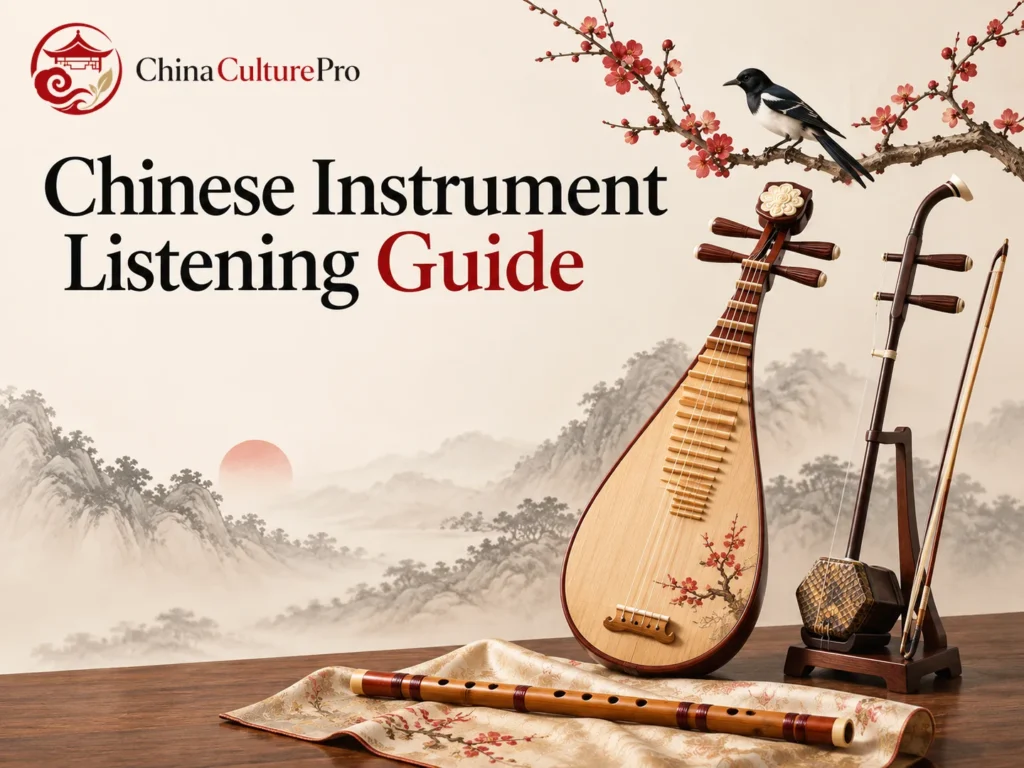
The erhu (二胡, èrhú) is a bowed fiddle. The dizi (笛子, dízi) is a side-blown flute, and its membrane adds a buzz to the flute tone. The sheng (笙, shēng) is a mouth organ whose pipes can produce several pitches at once. Those differences give you a starting point for separating sounds by ear.[3][4][5]
Compare Five Traditional Chinese Instruments
| Instrument | What to listen for | A useful comparison |
|---|---|---|
| Guqin | A plucked note that fades, a light harmonic, or a slide after the attack | Compare one open note with a moving stopped note.[1] |
| Pipa | Crisp individual attacks and repeated plucks that can build a longer sound | Listen for where separated notes become a tremolo.[2] |
| Erhu | A sustained bowed tone and changes in pitch within a note | Follow the note through a slide or change of bow.[3] |
| Dizi | A flute tone with an audible membrane buzz | Follow a held note to hear the buzz alongside the pitch.[4] |
| Sheng | A reed tone that can support several pitches at once | Listen for pitches entering or leaving a chord.[5] |
Try a Short Listening Session
Choose two labelled excerpts from the museum playlist in the Sources section. Try a guqin and a pipa recording first. Listen to a few seconds of each without watching. Describe one difference in your own words, such as how clearly each note begins or how long a sound remains audible. Replay the same part before reading the instrument notes.[1][2][6]
Then choose a labelled wind-instrument excerpt, such as the playlist’s sheng track. When you move to an ensemble recording, check which instruments the credits list. If several instruments are playing, follow one sound through a short phrase. A single bright or sustained note is only a clue. The recording information and an isolated demonstration can help confirm what you heard.[4][5][6]
FAQs About Listening to Chinese Instruments
How can I hear the difference between guqin and pipa?
Compare labelled solo excerpts. The guqin often lets you hear the life of a single pluck, a harmonic or a slide after the attack. A pipa phrase may feature fast, distinct attacks or repeated plucks. The performer and piece shape the sound in both cases.[1][2][6]
Can I identify a Chinese instrument from sound alone?
Timbre can narrow the possibilities. In a recording with several instruments, check the credits or compare a solo demonstration before deciding.[2][4][6]
Should I start with solos or ensembles?
Solos make it easier to hear how an instrument begins and ends a note. An ensemble then helps you hear how that sound interacts with other instruments.[2][6]
Sources
[1] UNESCO Intangible Cultural Heritage. Guqin and Its Music
[2] The Metropolitan Museum of Art. Pipa, Collection Record and Audio
[3] The Metropolitan Museum of Art. Erhu, Collection Record
[4] The Metropolitan Museum of Art. Dizi, Collection Record
[5] The Metropolitan Museum of Art. Sheng, Collection Record
[6] The Metropolitan Museum of Art. Mapping the Art of Music, Audio Guide