


Quick Answer: How Do You Read a Chinese Historical Place Name?
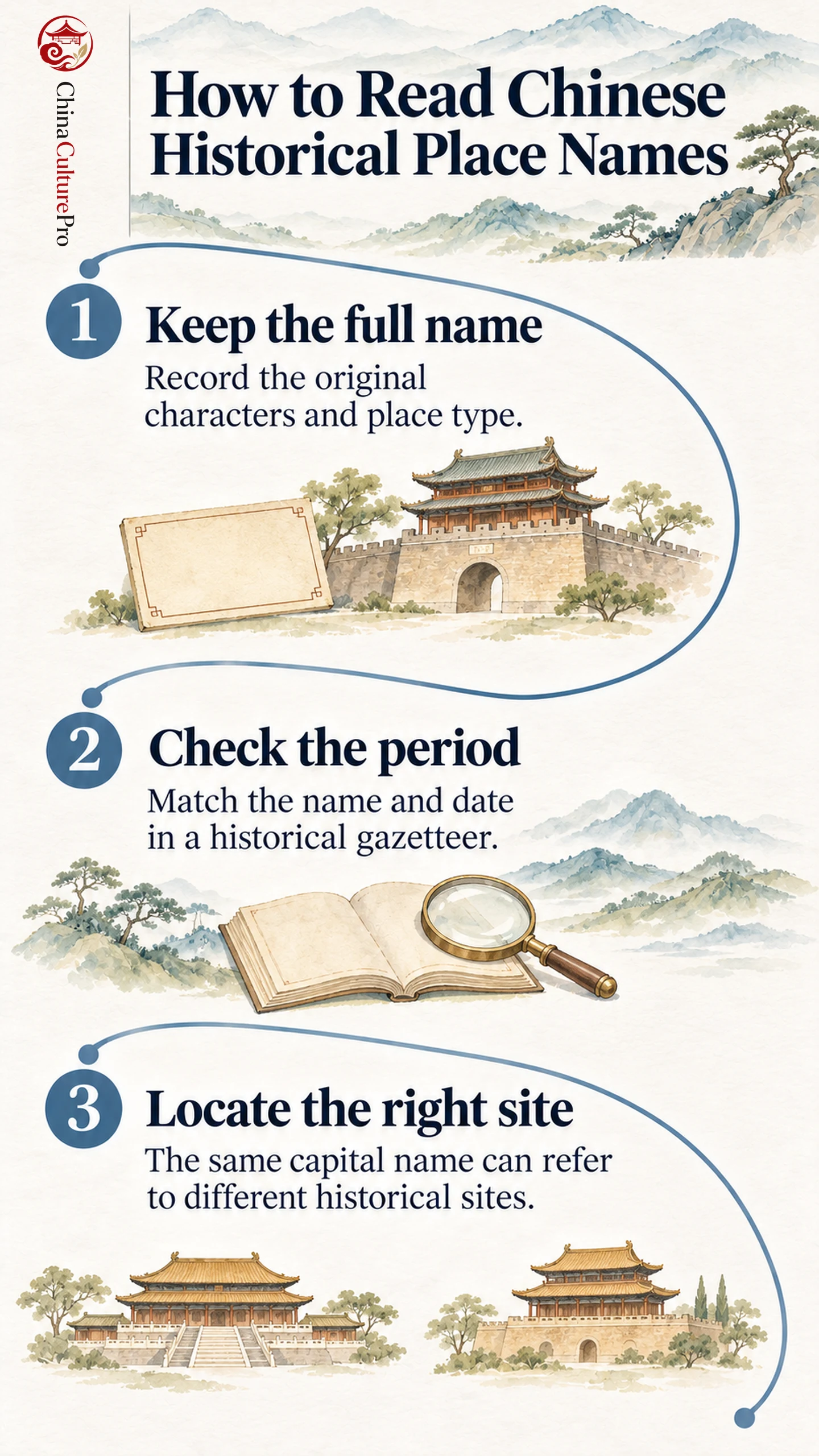
Keep the original characters together with the date and the type of place named. Search a historical gazetteer for a record that matches all three. Then compare the historical record with a modern map at the level your evidence supports.[1][2]
- Characters. Save the spelling in your source, including any official suffix.
- Date. Use the most precise period you can verify before comparing names.
- Place type. Check whether the name describes a settlement, an administrative area or a site within one.[1]
A historical name can have a modern counterpart without sharing its boundaries or pointing to a single surviving building.
A map may put one label beside a dot even when the source describes a district. To locate a name from a family record or an inscription, keep track of both the place and the type of place named in the text.
Separate the Place Name From Its Administrative Rank
An old name may end with a term often translated as county (縣, xiàn) or prefecture (府, fǔ). Preserve the suffix when copying the name. It tells you how the writer identified the place in that period, and can help distinguish it from a settlement with a similar name. Titles and boundaries changed over time, so compare records from the relevant dynasty or year.[1]
An administrative unit can cover a wider area than the city or town where officials worked. A catalog entry can name a province or county to describe where an object was found, while a map marker identifies a much smaller archaeological site. Keep both levels if the record supplies them.
Four Steps to Match a Historical Place
- Copy the name as it appears. Save the original characters, official suffix and any modern translation or romanization printed alongside them.
- Find the event date. Record the date or dynasty associated with the place name. If the source is a later copy, distinguish its printing date from the period it describes.
- Search a historical gazetteer. Try the original characters and the recorded romanized form. Compare the date range, type of place, and any larger district or region in the results.
- Record the best match with its limit. Give the historic name, period, present-day vicinity and evidence. If several records still fit, keep the alternatives and note what would distinguish them.
The Temporal Gazetteer can accept Chinese characters as well as romanized spellings. For an older English text, consult Chinese transliteration systems before treating spelling changes as evidence of different locations.[2]
Chang’an: One Name Across Two Capital Sites
Chang’an (長安, Cháng’ān) appears in accounts of more than one capital period. The Western Han Weiyang Palace site and the Tang Daming Palace site sit within the modern Xi’an area. The names and locations are separately identified in the UNESCO serial property for the Chang’an–Tianshan corridor.[3]
| Site named in the heritage record | Period and reading clue |
|---|---|
| Weiyang Palace site | Western Han Chang’an. The palace name makes the reference more precise. |
| Daming Palace site | Tang Chang’an. The same capital name refers to a different historical setting. |
A note that says only “Chang’an, now Xi’an” preserves useful orientation. Add the dynasty and the named site before treating it as a specific location.
FAQs About Chinese Historical Place Names
Can different spellings point to the same Chinese place?
Yes. Romanization schemes and historical spellings can give one name different English forms. Compare the Chinese characters, time period and region before combining the records.[2]
Why do two historical places share the same name?
A name can be used in different regions or at different times. The historical year, place type and larger administrative unit help distinguish them.[1][2]
Does a historical county match the modern county boundary?
An older unit can have a different extent or administrative seat. Use a source that describes the historical period when those differences matter.[1]
Sources
[1] Harvard University and Fudan University. China Historical Geographic Information System
[2] Harvard Center for Geographic Analysis. Temporal Gazetteer
[3] UNESCO World Heritage Centre. Chang’an–Tianshan Corridor site maps