


Quick Answer: How Do You Read a Chinese Genealogy Page?
Start by identifying the family branch and generation, then trace how the page connects the people it names. A clan genealogy, or jiapu (家譜, jiāpǔ), follows a lineage over multiple generations. Its charts and individual entries can have different layouts and levels of detail.[1][2]
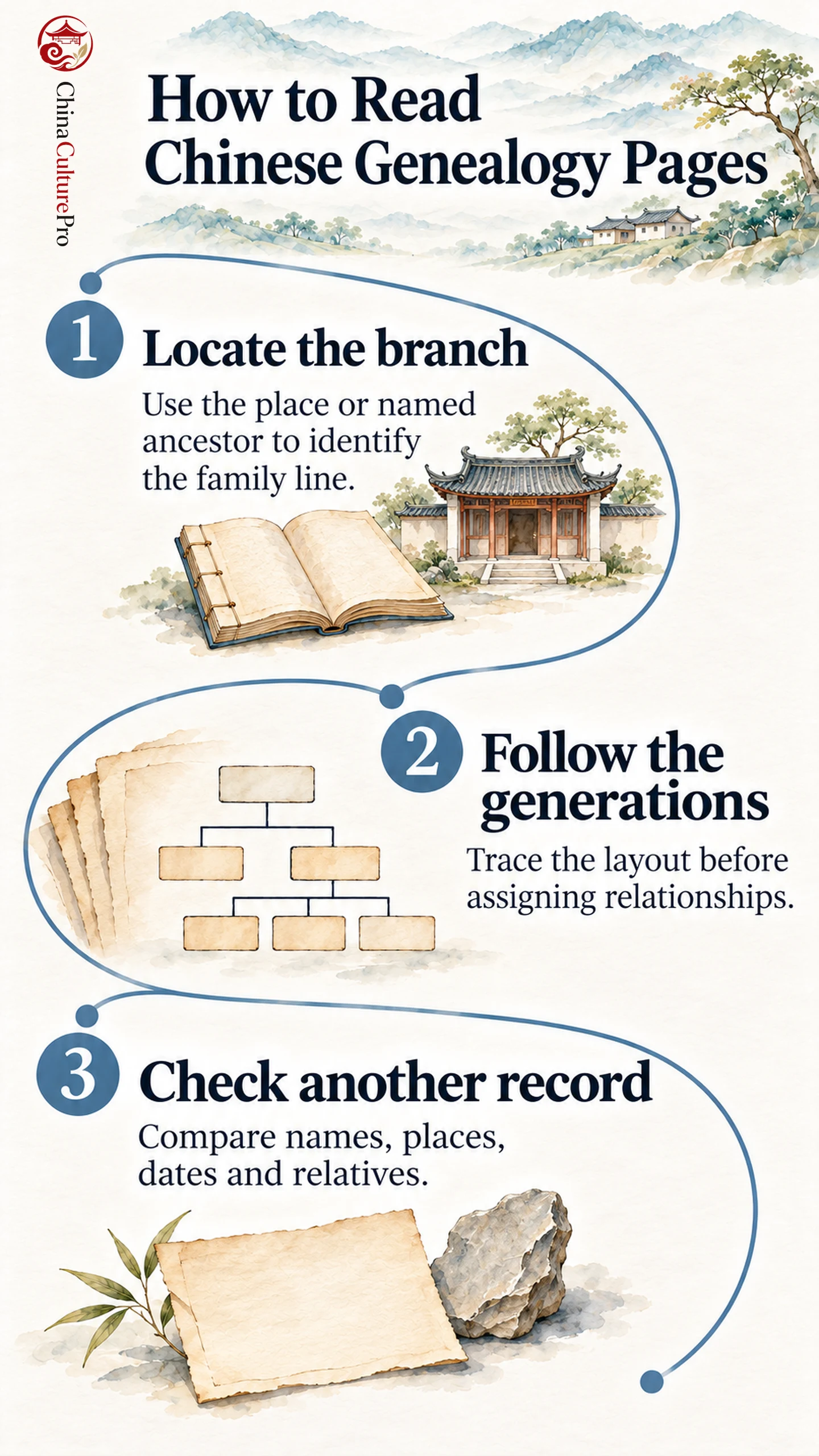
- Branch. Record the place or ancestor that identifies the line.
- Relationship. Follow connectors or other layout cues from one generation to the next.
- Identity. Check names together with place, dates and relatives when those details are available.[2][3]
A shared surname or generation number gives you a lead. Keep the evidence for any specific family relationship in your notes.
It is easy to find a familiar surname in a photographed genealogy and attach it to the wrong branch. The page around the name often tells you more than the name by itself.
Read the Page Layout Before the Names
A jiapu, also called a clan genealogy or zupu (族譜, zúpǔ), can include an account of a founding ancestor, a chart of descent and entries about individuals. Layout varies. A line between two entries in a chart and a line of writing in a biographical entry perform different jobs.[1][2]
In one documented Su-style layout, generation (世, shì) numbers run down the right side of the right page. The guide’s example shows 十五世 (shíwǔ shì), meaning fifteenth generation. The count tells you where the entry sits in that genealogy. A chart covering five generations per page may continue on another spread, so save the neighboring image if a line continues off the page.[2]
Four Steps for Tracing One Person
- Save the volume and page information. Record the genealogy’s displayed title and the image or page number. Include the preceding or following spread when the chart continues.
- Locate the branch and generation. Use the section heading, ancestral place or named earlier ancestor. Trace the layout before assigning parent-child relationships.
- Transcribe names and supporting details. Copy the original characters and any dates, places or relatives that appear. Keep uncertain readings distinct from confirmed ones.
- Check an independent record. Compare the proposed identity with a separately created record, such as a grave inscription or residence record. Note whether the match is certain or provisional.
The page may give a spouse’s surname, burial place or dates alongside the descent line. A catalog search may also let you narrow the book by ancestral place, hall or generation poem. Treat those as filters for finding useful records, then evaluate the pages themselves.[2][3]
How to Compare a Person Across Records
| Detail | What to compare |
|---|---|
| Name | Compare the original characters as well as any romanized form. |
| Place | Check whether a village belongs to the same district in the period described. |
| Relationship | Look for matching parents, children, spouse or branch. |
| Date | Keep the original wording and record the calendar conversion separately. |
A grave inscription can supply a date or a relationship with wording that differs from the family book. The guide to Chinese grave inscriptions helps interpret that evidence. If the book gives an old village name, reading Chinese historical place names can help put the right place beside the name.
FAQs About Chinese Genealogy Pages
Does the same generation number prove two people are brothers?
The number places both people at the same generational level in that genealogy. Check their parent entries or a specific relationship statement to establish whether they are siblings.
Are women and other relatives always listed?
Many traditional genealogies emphasize descent through men. Some entries include information about spouses, while the details vary by book and branch.[1][2]
What should I save when transcribing a genealogy?
Save the genealogy’s title, its edition if known, the volume and page or image number, and the original characters you can read. Include an adjacent page if it supplies a missing branch link or completes a name.
Sources
[1] FamilySearch. What is a clan genealogy book?
[2] FamilySearch. Su-style genealogy guide: Generation numbers
[3] FamilySearch. How do I find a Chinese jiapu?