
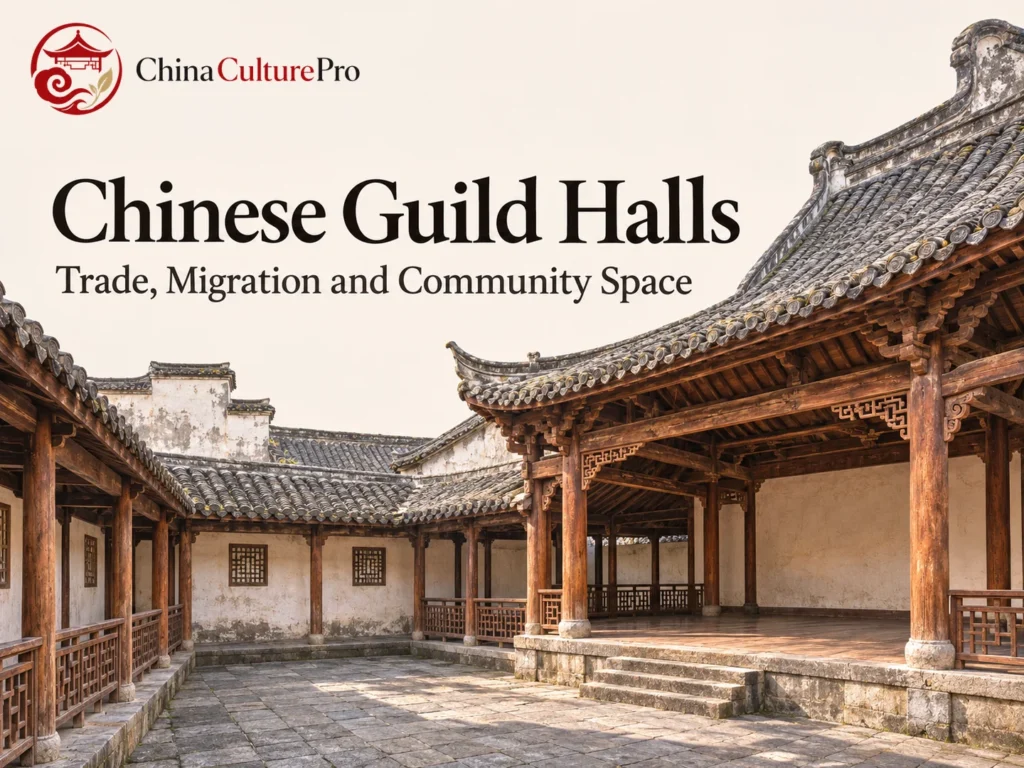

Quick Answer: What Were Chinese Guild Halls?
A Chinese guild hall could be the meeting place of an association based on a shared home region, a shared trade or both. A huiguan (会馆, huìguǎn) often brought together people from the same place. The term gongsuo (公所, gōngsuǒ) was often used by trade or craft associations. The distinction was flexible. [1][2]
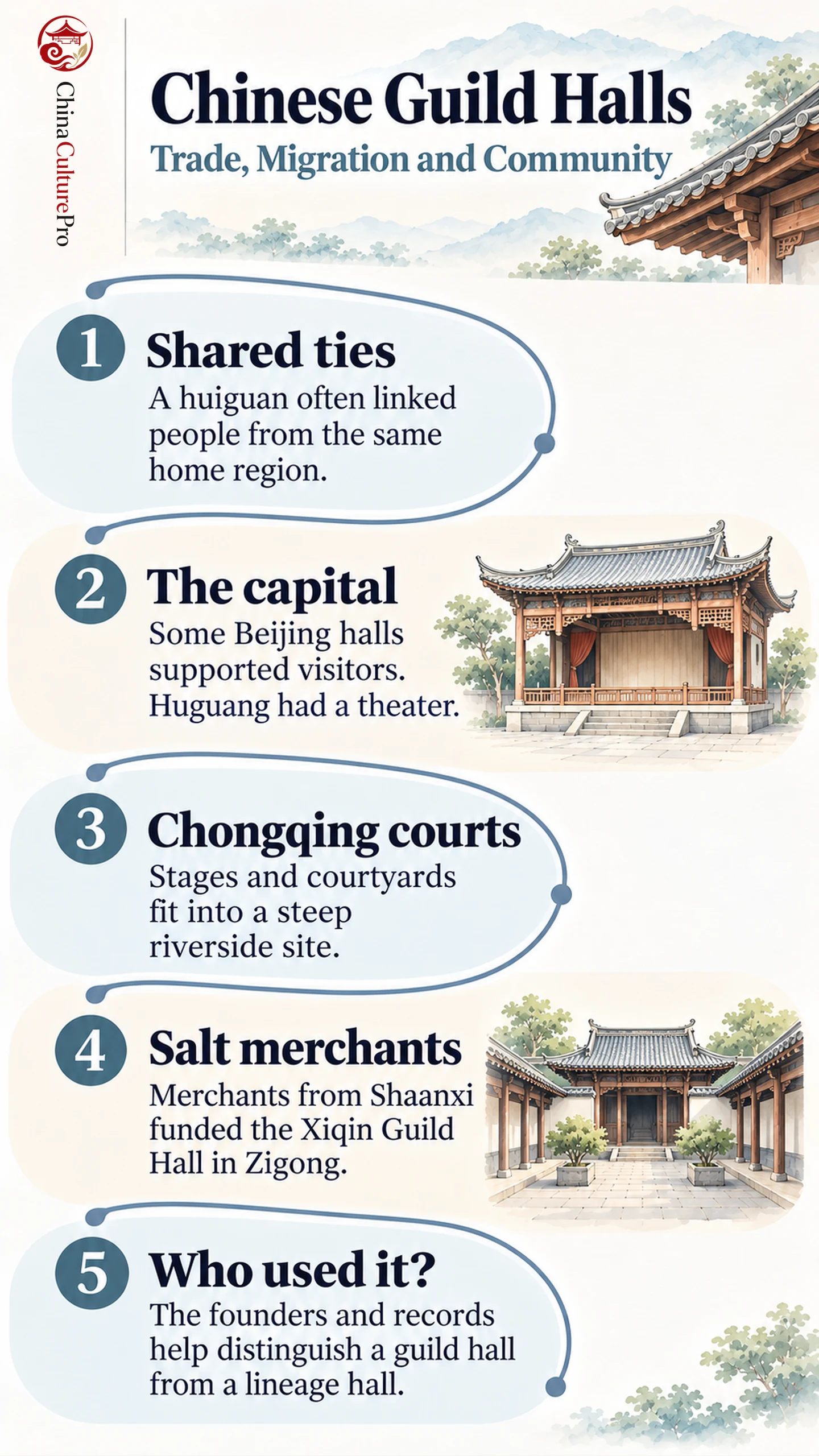
- Shared origins helped people organize away from home. In Beijing, some halls served people coming to the capital for official business or examinations. [1][2][3]
- Trade and migration could overlap. In Zigong, salt merchants from Shaanxi pooled resources to build a hall. [1][4]
- A compound could serve several purposes. Some contained rooms for meeting and lodging, or places for worship and performances. [1][3][5][6]
The name of the building gives one clue. Its founders, records and layout show how the association used it. [1][2][5][4]
A theater in a Beijing association hall, courtyards above the Yangtze in Chongqing and a salt museum in Zigong all preserve parts of a guild hall tradition. Their buildings make more sense once you know who paid for them and who gathered inside.
Huiguan, Gongsuo and the Meaning of Guild
A native-place association brought together people whose home towns or regions were elsewhere. The same origins could give merchants a basis for forming business relationships in a new city. Some huiguan became places to coordinate trade, find accommodation or make contacts. Other associations formed primarily around occupations. [1][2]
English-language histories often use “guild” for both kinds of association. Records from Shanghai show that terms for trade associations and native-place groups overlapped. A gongsuo might have an occupational focus, but the word on a plaque alone cannot tell you who belonged. Read it with the names of donors, the place of origin and the activities recorded for that association. [1][2]
Lodging and Performance in the Capital
In Beijing, native-place associations often supported people temporarily in the capital. Officials and examination candidates could find lodging or meet others from their home region through an association. These uses helped maintain ties with a home community from a distance. [1][2]
Beijing’s Huguang Guild Hall (湖广会馆, Húguǎng Huìguǎn), founded in 1807, served people from Hunan and Hubei. Its compound included a theater at the front, with a separate hall, memorial space and garden. The theater has viewing levels around several sides of the performance space. Here the theater is a distinct part of a larger complex, one way to accommodate performance within traditional Chinese architecture. A 2025 report documents opera performances following the theater’s reopening. [3][7]
Courtyards and Stages in Chongqing
Chongqing’s Huguang Guild Hall refers to a group of buildings. It includes the Yu King Palace (禹王宫, Yǔwáng Gōng), the Qi’an Guild Hall (齐安公所, Qí’ān Gōngsuǒ) and the Guangdong House (广东公所, Guǎngdōng Gōngsuǒ). The complex contains Qing-period buildings and later work. It grew in a city where associations drew on ties to several home regions. [5][6]
The buildings occupy a steep site near the Yangtze. The stages, courtyards and halls fit together at different levels and along axes of approach. Enclosed courtyard compounds provided a plan that could be adapted on the steep site. The buildings use several Chinese roof forms, even where they share that courtyard vocabulary. Researchers describe how the layout made room for stages and audiences where the available ground was constrained. [5][6]
Salt Merchants and the Xiqin Guild Hall
In Zigong, Sichuan, merchants from Shaanxi who were active in the salt trade pooled funds to build the Xiqin Guild Hall (西秦会馆, Xīqín Huìguǎn), a project dating to 1736. The founders shared a home region and a line of business. Their investment created an association compound with a performance stage. [6][4][8]
The building now houses the Zigong Salt History Museum. Its tools and records explain how well salt was made. The building shows what merchants were able to fund together. [4]
How a Guild Hall Differs From a Temple or Ancestral Hall
A hall might include a place of worship, and its court or stage can resemble those in temple complexes. A native-place hall brings together people from the same home region, while ancestral halls are associated with lineage rites. The founders, dedication and surviving records help distinguish the institutions. [1][2][5][9]
People moving elsewhere sometimes sent resources back home as well. The Kaiping diaolou offer a comparison from another region. Guild hall patrons created shared spaces in the places where they gathered, while migrants connected to Kaiping helped fund buildings in their ancestral villages. [1][2][10]
FAQs About Chinese Guild Halls
Was every huiguan a trade guild?
No. A huiguan often served people with the same home region. Some focused on lodging or other support. Others also organized merchant or craft activity. [1][2]
Why did some guild halls have an opera stage?
A stage and viewing court gave members and guests a place to gather for performances. In some compounds, performance spaces sat near places used for worship, giving one complex several roles. [3][5][6][8]
What is the difference between a guild hall and an ancestral hall?
A guild hall served an association that could be organized around shared trade or place of origin. An ancestral hall is linked to honoring the ancestors of a lineage. Both can contain courtyards and ceremonial rooms. [1][2][5][9]
Sources
[1] Christine Moll-Murata. Chinese Guilds From the Seventeenth to the Twentieth Centuries
[2] Bryna Goodman. Native Place, City, and Nation
[3] Beijing Municipal Government. Cultural Venues and Performances
[4] People’s Daily Online. Inside Xiqin Guild Hall: Two Thousand Years of Well Salt
[5] Yuzhong District Government. Chongqing Huguang Guild Hall
[6] Frontiers of Architectural Research. Spatial Composition of Vernacular Opera Stage Courtyards in the Ba–Shu Region
[7] Beijing Municipal Government. Huguang Guild Hall Reopening Anniversary
[8] Encyclopedia of China. Dramatic Stage at Zigong Shaanxi Merchant Guild Hall
[9] Hong Kong Antiquities and Monuments Office. Tang Ancestral Hall
[10] UNESCO World Heritage Centre. Kaiping Diaolou and Villages