
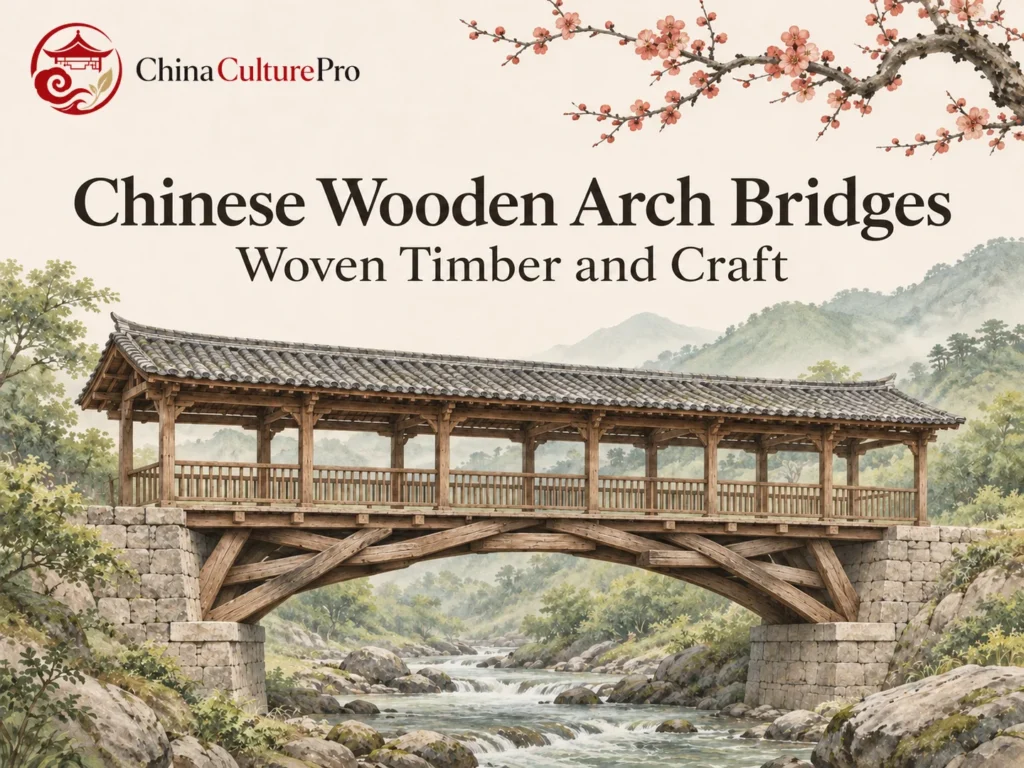

Quick Answer: What Is a Chinese Wooden Arch Bridge?
In parts of Fujian and Zhejiang, bridge builders use overlapping sets of timber beams to make an arch below the deck. A corridor bridge (廊桥, lángqiáo) has a roofed passage. A wooden arch corridor bridge (木拱廊桥, mùgǒng lángqiáo) combines that passage with a timber arch below. The arch carries the deck, and the sheltered passage gives people a place to walk, stop or gather. [1][2][3]
- Beam-weaving creates the span. Straight timber pieces overlap and interlock in a framework that acts as an arch. [1][2]
- The covered passage has its own role. Roofed bridges can have a woven arch, beams or another support beneath the deck. [2][3]
- The craft is living heritage. UNESCO’s inscription concerns knowledge, work and transmission in communities that build and use the bridges. [1][4]
Look below the deck for the arch and above it for the corridor. The two parts explain different things about the crossing. [2][3]
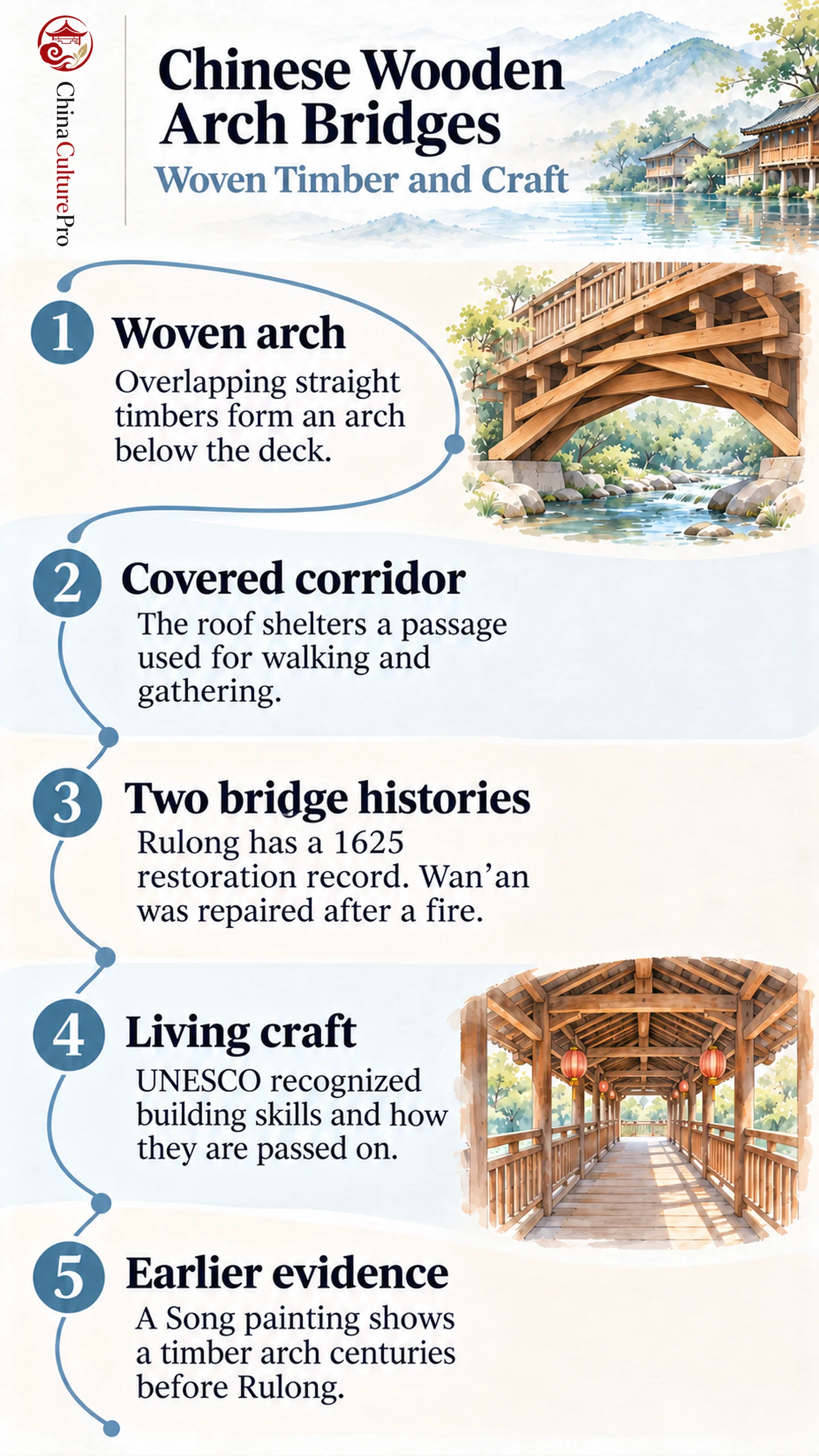
A covered bridge can feel like a long room from the deck. From the bank, the eye follows timber members down toward the supports at each end of the span. The two views show why the roof and the arch tell different stories about one crossing.
How the Timbers Form an Arch
The curve of the arch is built up from straight pieces. Structural studies of surviving bridges describe two sets of straight members that interweave in segmented curves below the deck. Their overlapping positions let them work together as an arch. The arch carries weight toward the supports at the ends of the span. [1][2]
Crosspieces and bracing connect parts of the under-deck structure. Masonry abutments or piers give another role to traditional building materials at some sites. Those supports receive weight from the timberwork and transfer it to the ground. For comparison, other traditional Chinese bridges can carry a span with a stone arch or a sequence of beams resting on piers. [2][3][5]
The craft includes mortise-and-tenon joints (榫卯, sǔnmǎo), where a shaped end fits into an opening. Beam-weaving describes how the framework’s members fit together at the scale of the span. A close view of a joint shows one connection. A view from the bank shows where the joined pieces sit within the arch. [1][2]
What the Covered Corridor Adds
A roof and its posts create a sheltered route over the water. The corridor protects the walking surface from direct weather and provides space to stop or talk. At some bridges it also gives local people a place to take part in communal observances. The tiled roof is part of the structure above the deck. The woven arch supports that deck from below. [1][2][3][4]
The shape of the covered passage can recall Chinese pavilions or other Chinese roof forms. Different crossings can share that covered appearance. Chengyang Bridge in Guangxi has a prominent roofed corridor, but its deck is supported by timber layers that project from the piers and ends. That is a cantilever arrangement, distinct from a woven timber arch. [2][3]
Rulong and Wan’an: Two Bridges With Different Histories
Rulong Bridge (如龙桥, Rúlóng Qiáo) in Qingyuan, Zhejiang, has a documented restoration date of 1625. The record gives a date for work on the surviving bridge. The first construction at that site is harder to date. The corridor’s boarded sides have openings of different shapes, a detail visible above the timber span. [3][6][7]
Wan’an Bridge (万安桥, Wàn’ān Qiáo) in Pingnan, Fujian, crosses its stream in several spans. Piers divide the crossing into sections of different lengths. A fire in 2022 destroyed much of the structure, and conservation work passed inspection in 2024. A 2026 review examined replaced timber and newly installed fire protection. The older crossing and the repaired bridge belong to the same site history, with different dates for the surviving materials. [8][5]
Craft Knowledge and the UNESCO Listing
Families and apprentices learn the craft through work with experienced builders. The knowledge includes how to read the site, choose materials and fit the parts. UNESCO also records the role of local communities in building, maintaining and using the bridges. At some sites, gatherings and observances take place around festivals such as the Dragon Boat Festival. [1][4]
UNESCO first put the practice on its Urgent Safeguarding List in 2009. In 2024 it transferred the element to the Representative List of the Intangible Cultural Heritage of Humanity. This designation applies to the craft and related practices. Individual bridges can be protected separately. The transfer recognizes a living part of traditional Chinese architecture that people continue to teach and use. [1][4][8][5]
What the Song Painting Can Tell Us
The Northern Song handscroll Along the River During the Qingming Festival (清明上河图, Qīngmíng Shànghé Tú) shows a busy timber crossing known as the Rainbow Bridge (虹桥, Hóngqiáo). People and goods move across its open deck above a river. Researchers use the painted structure to compare historical forms of the timber arch. [9][7]
The image is far earlier than the dated surviving bridge fabric at Rulong. The depicted span gives a point of comparison with later arches. Establishing how skills passed between regions or generations requires evidence beyond that similarity. [2][9][7]
FAQs About Chinese Wooden Arch Bridges
Do all Chinese covered bridges use a woven timber arch?
No. A covered bridge has shelter over the deck. The structure below may be a woven arch, straight beams or cantilevers. Chengyang Bridge is an example of a covered crossing with timber cantilevers. [2][3]
What does beam-weaving mean in a wooden arch bridge?
Sets of straight timber members overlap and interlock below the deck to form an arch. The arch transfers weight toward the supports at the ends of the span. [1][2]
What exactly did UNESCO recognize?
UNESCO recognized the traditional design and building practices, including beam-weaving, joinery and transmission of knowledge. It transferred the craft to its Representative List in 2024. [1][4]
Sources
[1] UNESCO Intangible Cultural Heritage. Traditional Design and Practices for Building Chinese Wooden Arch Bridges
[2] Journal of Wood Science. Quantitative Safety Evaluation of Ancient Chinese Timber Arch Lounge Bridges
[3] Ronald G. Knapp, Terry E. Miller and Jie Liu. China’s Corridor Bridges: Heritage Buildings Over Water
[4] UNESCO Intangible Cultural Heritage. Decision 19.COM 7.c.3
[5] Fujian Provincial Department of Culture and Tourism. Review of Corridor Bridge Conservation
[6] Zhejiang Provincial Commission for Discipline Inspection. Covered Bridges in Qingyuan
[7] Frontiers of Architectural Research. Intermedial Reconstruction of Woven Arch Bridge Technology
[8] Fuzhou Municipal Government. Completion of Conservation Work on Wan’an Bridge
[9] The Palace Museum. Zhang Zeduan’s Along the River During the Qingming Festival