

Quick Answer: What Shapes Chinese Culture in Canada?
Chinese culture in Canada develops through the lives of Chinese Canadians (加拿大华人, Jiānádà huárén), whose family histories and routes to Canada differ. Chinese heritage connects with Canadian places, institutions and relationships, producing cultural forms that change across communities and generations.[1]
- Histories: Migration, exclusion and community organizing shape family experiences.
- Everyday life: Languages, schools, gathering places and restaurants connect heritage with local needs.
- Culture: Festivals, sport, literature and popular music offer different ways to participate.
No single home language, birthplace or neighborhood describes everyone. A heritage connection does not require every person to follow the same customs.
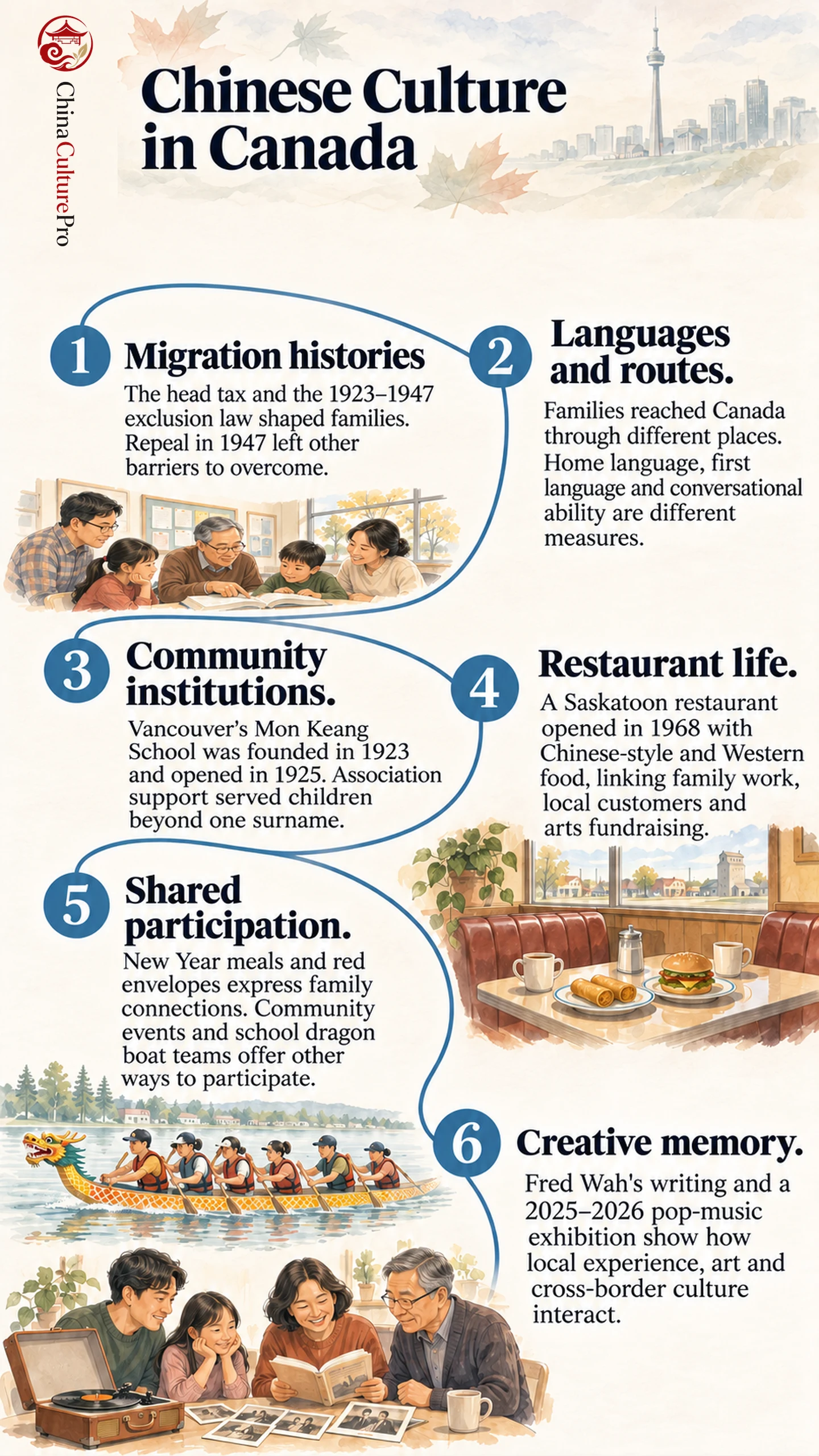
A community school in Vancouver, a neighborhood restaurant in Saskatoon and a family celebration in York Region reveal different Chinese Canadian experiences. Following these local examples within Chinese diaspora histories shows how people carry memories, build institutions and make new cultural forms.
Migration, Exclusion and Changing Community Histories
Chinese migration to Canada includes nineteenth-century workers and merchants as well as later arrivals and Canadian-born generations. Railway construction forms an important chapter within those histories. Communities also developed through work in businesses and through family connections.[2]
Railway construction crossed the territories of many Indigenous nations, connecting Chinese migration history with changes affecting those communities as well.[1]
| Historical period | What changed |
|---|---|
| 1885–1923 | A federal head tax restricted Chinese immigration through a discriminatory fee. |
| 1923–1947 | The Chinese Immigration Act imposed severe exclusion, separating families and restricting entry with limited exemptions. |
| 1947 | The exclusion legislation was repealed; this did not immediately remove every barrier facing Chinese Canadians. |
Limited categories, including teachers and merchants, could still enter under the exclusion law. It nevertheless prevented many spouses and children from joining relatives in Canada.[10] These policies affected whether relatives could reunite and how communities maintained ties across distance. Immigration certificates, family records and community newspapers preserve evidence of those experiences, alongside the histories of work and settlement.[2]
Languages and Different Routes to Canada
Statistics Canada’s 2026 portrait draws on the 2021 Census, rather than a live count of people in 2026. It describes Chinese populations with varied birthplaces, including Canada, China, Hong Kong, Taiwan and Southeast Asia. Its census categories provide an analytical frame, not a personal identity checklist.[3]
Language use varies with those histories and across generations. English, French, Mandarin and Cantonese (粤语, Yuèyǔ) can play different roles, alongside other languages. Home-language use, the first language learned and the ability to converse in a language are different measures; they should not be treated as interchangeable.[3]
Community histories from York Region also describe families whose paths included India, Pakistan, Jamaica or Vietnam before Canada. Experiences in those places can remain part of family life. This helps explain why diaspora language choices cannot be predicted from ancestry alone.[1]
Associations, Schools and Places to Gather
Chinese associations supported education and social life as people built communities. Mon Keang School (文彊學校, Wénqiáng Xuéxiào; Mandarin reading) in Vancouver was founded in 1923 and opened in 1925 through the Wong Kung Har Tong, now the Wongs’ Benevolent Association. It taught Cantonese and Chinese cultural subjects.[4]
Located in the association building, the school welcomed children from families beyond the Wong or Huang surname. This connects association support with a broader educational role. A family-based organization could provide services beyond a narrowly defined membership.[4]
Gathering places also extend beyond historic Chinatown districts. In York Region, shopping centers and plazas have become places for meals, social meetings and celebrations. They show how community life can develop in suburban settings as well as in older urban neighborhoods.[6]
Restaurants as Family Work and Community Spaces
Lorne Avenue Chop Suey, opened in Saskatoon in 1968, offers a concrete restaurant history. It served Chinese-style food alongside dishes such as hamburgers, fish and chips and steak. Homemade egg rolls and fried chicken were part of its local identity; customers included nearby residents, church congregations and exhibition workers.[5]
The restaurant’s role extended beyond serving meals. It also raised funds for the Chinese Folk Art Society through food sales at the local exhibition. Family artifacts later entered the Western Development Museum’s collection, preserving a story that links work, neighborhood life and cultural activity.[5]
This is one local history of Chinese food developing across communities. Its mixed menu connects family work with the tastes and habits of local customers. Other households and restaurants carry different regional and migration histories.
Festivals, Family Traditions and Shared Participation
Chinese New Year (春节, Chūnjié) brings together household traditions and organized events. York Region community accounts describe shared meals, decorations and red envelopes (红包, hóngbāo), gifts expressing good wishes. These practices can connect family members even when relatives live in different countries.[6]
A public program has a different setting from a home celebration. For 2026, the Chinese Cultural Centre of Greater Toronto listed both a community celebration and a separate Spring Festival banquet. The two formats show how New Year traditions can take place through organized community gatherings as well as family custom.[7]
Dragon boat racing (龙舟竞渡, lóngzhōu jìngdù) offers another form of participation. York Region’s community exhibition documents school teams and medals, including a 2016 gold medal won by Pierre Elliott Trudeau High School’s TruDragons team at Toronto’s international festival. The sport can involve people with different backgrounds, joining cultural connections with shared training and competition.[6]
Literature, Popular Music and Cultural Memory
Cultural life also includes writing about local experience. Fred Wah’s Diamond Grill, published in 1996, draws on his work in his father’s café. Described as biofiction in his archive, it explores family and mixed-heritage experience through a literary form; it is not a transcript of historical events.[9]
His earlier experimental poetry drew on jazz and the landscape around Nelson, bringing other local and artistic influences into his writing.
Popular music carries other memories. The Chinese Canadian Museum’s Dream Factory exhibition, which ran from May 2025 to August 2026, explored Cantonese- and Mandarin-language pop through fashion commissions, listening experiences and contemporary art. It traced connections between Canada, Hong Kong, Taiwan and mainland China, including music heard in homes, cars and karaoke spaces.[8]
The relationship with Chinese-language popular music shows that cultural memory includes mass media and fandom as well as older customs. Making art and choosing how to present it are forms of participation, alongside learning inherited practices.
FAQs About Chinese Culture in Canada
Is Chinese Canadian culture the same as culture in China?
No. It develops through local Canadian histories, migration routes, institutions and creative choices while retaining varied connections with Chinese heritage.
Do all Chinese Canadians speak Mandarin?
No. Mandarin, Cantonese, English, French and other languages can have different roles. Ancestry does not establish someone’s language abilities or home language.
Are Chinese Canadian communities found only in historic Chinatowns?
No. Community life also develops in suburbs, smaller cities and other local settings. York Region’s shopping and gathering places provide one example.
Is Chinese Canadian food one fixed style?
No. A Saskatoon restaurant’s mixed menu describes that business and its community, not a standard recipe or cuisine shared by everyone.
Is Chinese Canadian culture expressed only through traditional customs?
No. Literature, popular music, school sport and contemporary art also contribute to cultural life. Heritage can be reinterpreted and newly created.
Sources
[1] York Region District School Board, Museum and Board Archives. Standing in the Doorway: What Does It Mean to Be Chinese Canadian?
[2] Library and Archives Canada. Chinese Canadians
[3] Statistics Canada. Portrait of the Chinese Populations in Canada: Diversity and Socioeconomic Outcomes
[4] Parks Canada. Mon Keang School National Historic Site
[5] Western Development Museum. Chinese History in Saskatchewan: Lorne Avenue Chop Suey and Tom Yee (Kock Hin Tam)
[6] York Region District School Board, Museum and Board Archives. Standing in the Doorway: Home and Building Community
[7] Chinese Cultural Centre of Greater Toronto. 2026 Lunar New Year Celebration Activities
[8] Chinese Canadian Museum. Dream Factory: Cantopop Mandopop 1980s–2000
[9] Fred Wah Digital Archive. Fred Wah
[10] Parks Canada. Exclusion of Chinese Immigrants (1923–1947) National Historic Event