


Quick Answer: How Are Chinese and Korean Culture Connected?
Chinese and Korean culture share histories of exchange, while developing distinct languages, institutions and everyday traditions. Similar-looking clothing, calendars or writing can reflect a connection without performing exactly the same role.
- Shared histories: Ideas, texts, religious practices and artistic techniques traveled across East Asia.
- Clear differences: Writing systems, festival customs, meals and clothing have their own forms and histories.
- Internal variety: Region, generation, family and personal choices matter within both cultural settings.
Many contemporary examples below come from South Korea. They do not represent every Korean community or erase differences across the peninsula and diaspora. Chinese examples likewise belong to particular places and periods.
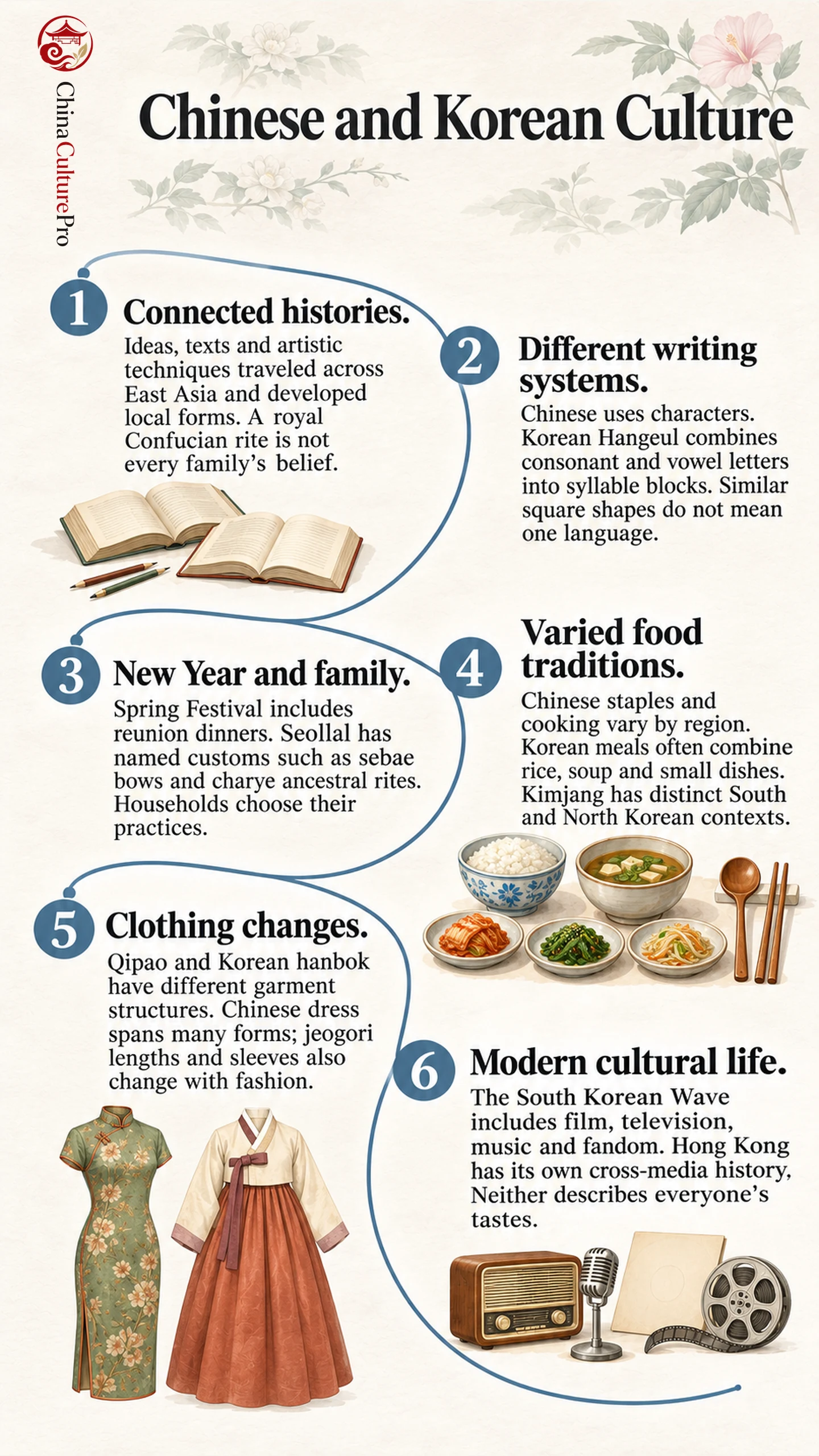
A Korean alphabet block, a New Year family bow and a twentieth-century Chinese dress raise different kinds of comparison. Understanding each object or practice in its own setting gives a clearer picture than treating two cultures as lists of national personality traits or interchangeable customs.
Historical Exchange and Distinct Religious Traditions
Chinese writing, religious ideas and artistic techniques entered Korean settings over many centuries. Korean communities adapted them to local purposes. These exchanges also involved different Chinese regional traditions.[1]
Confucian traditions (儒家, Rújiā) influenced education, government and family ethics. During Korea’s Joseon dynasty (1392–1910), Neo-Confucianism (理学, lǐxué) became central to court and elite institutions. This was a particular historical development, rather than proof that all modern Chinese and Korean people share one philosophy.[1]
At Jongmyo Shrine in Seoul, royal ancestral ritual honors the deceased rulers and consorts of Joseon through prescribed ceremonies and music. Its court setting distinguishes it from an ordinary household observance. The case shows how shared intellectual traditions can take a specific institutional form.[2]
Buddhist traditions also formed part of these exchanges. Buddhism originated in India and developed varied forms as it traveled through China and Korea.[1]
Chinese Characters and the Korean Alphabet
Chinese characters (汉字, hànzì) and Hangeul (한글), the Korean alphabet, are different writing systems. Their visual appearance can be misleading: a square-shaped unit may be a character or a block assembled from alphabet letters. The table compares those structures.[3][4]
| Comparison | Chinese writing | Korean Hangeul |
|---|---|---|
| Basic structure | Uses a large repertoire of characters. | Combines consonant and vowel letters. |
| Appearance on the page | Characters commonly occupy roughly square spaces. | Letters form blocks representing syllables. |
| What writing does not establish | A character’s pronunciation can differ across Chinese spoken varieties. | The visual resemblance of blocks to characters does not make Korean a form of Chinese. |
Simplified and traditional Chinese are character conventions; they are not the same distinction as two spoken languages. Mandarin and Cantonese, for example, can pronounce shared characters differently. The guide to Mandarin and Cantonese develops that separate question.[3]
New Year Customs, Family Rites and Respect
Spring Festival (春节, Chūnjié) includes preparations such as cleaning and gathering food, a reunion dinner on New Year’s Eve, and visits or greetings to relatives and elders. These Chinese New Year traditions connect family life with wider community celebrations, with practices differing by place and household.[5]
Korean Seollal (설날) also emphasizes family connections, but its named customs differ. Sebae (세배) is a formal New Year bow to elders; charye (차례) is an ancestral memorial rite. Tteokguk (떡국), soup with sliced rice cakes, is associated with the holiday. Sharing a New Year occasion does not make these practices identical to Chinese ones.[6]
Families choose how they observe these occasions. When taking part in a celebration, ask which practices the household follows. Learn the names of the greetings and rites, and follow the host’s guidance on etiquette rather than treating a national label as an instruction for every encounter.
Meals, Side Dishes and Regional Food Traditions
Chinese food culture varies considerably by region. Wheat-based foods have a strong northern presence, while rice is especially prominent in the south. These are broad patterns, not exclusive diets: regional ingredients, cooking methods and migration produce many combinations.[7]
A common Korean meal arrangement places rice and soup with a spoon and chopsticks in front of the diner, accompanied by several small dishes. The spoon has an important role in eating rice and soup. This is a meal format, not a rule that every Korean dish is a small side plate.[8]
Kimjang (김장), preparing and sharing kimchi, links food with seasonal cooperation and family knowledge. Recipes and methods vary locally. UNESCO’s records include a Republic of Korea practice inscribed in 2013 and a separate Democratic People’s Republic of Korea tradition inscribed in 2015. The two records make the different modern contexts explicit.[9][10]
A shared utensil or preservation technique does not make two cuisines identical. For a meal, identify the dish and setting before applying general chopstick conventions; for a cultural comparison, name the particular preparation rather than assuming all food in either place has one level of heat.
Clothing Traditions and Changing Silhouettes
Chinese clothing traditions include forms from different eras and communities. The qipao (旗袍, qípáo), also called cheongsam in English, is one example with an important twentieth-century fashion history. The 2026 exhibition Fashioning Chinese Women: Empire to Modernity traced changing Chinese women’s silhouettes from late Qing robes through 1930s qipao and 1960s cheongsam.[11]
Hanbok (한복) refers to Korean dress traditions. Its upper garment, the jeogori (저고리), is worn in forms for both men and women. Sleeve shape and garment length have changed with fashion; one short jacket cannot represent every period or wearer.[12]
A useful comparison identifies construction, date and occasion. A jeogori worn with a lower garment and a fitted qipao or cheongsam are not interchangeable clothing categories. Similar closures or a shared textile motif do not settle the history of an entire outfit.
Popular Culture Beyond a Single National Image
Modern popular culture is another part of the comparison. Hallyu (한류), the Korean Wave, encompasses South Korean film, television, music and fandom, with connections to fashion and other creative industries. The V&A’s Hallyu! exhibition of 2022–2023 presented that wider range rather than treating it as only pop music.[13]
Chinese-language popular culture also has distinct local histories. Hong Kong Pop 60+ brings together music, film, television, radio, comics and toys from the postwar period to the early 2000s. Stage costumes, recordings and household media objects show connections between entertainment and everyday life.[14]
Exploring Chinese-language popular music alongside Hong Kong cinema reveals more than a single national label. Neither a drama genre nor a successful music group describes the beliefs, tastes or lives of everyone associated with a culture.
FAQs About Chinese and Korean Culture
Is Korean a form of Chinese?
No. Korean is a different language. Its Hangeul alphabet arranges sound-based letters in syllable blocks; this visual format should not be confused with Chinese characters.
Do Chinese and Korean people celebrate the same New Year?
Spring Festival and Seollal are corresponding traditional New Year celebrations, but their customs differ. A Chinese reunion dinner and Korean sebae or charye have distinct settings and meanings.
Does a shared Confucian heritage mean identical beliefs?
No. A historical influence on schools, courts or family rites does not determine every individual’s religion, philosophy or conduct today.
Are hanbok and qipao the same kind of clothing?
No. Hanbok covers Korean dress traditions, including upper and lower garments. Qipao refers to a Chinese dress form with its own changing fashion history.
Can one drama or pop group represent an entire culture?
No. Popular media represents particular industries, artists and audiences. It can reveal cultural connections without representing every region, generation or individual.
Sources
[1] The Metropolitan Museum of Art. The Arts of Korea: A Resource for Educators
[2] Korea Heritage Service, Royal Palaces and Tombs Center. Jongmyo Shrine: Intangible Cultural Heritage
[3] World Wide Web Consortium. Chinese Script Resources
[4] National Institute of Korean Language. About Hangeul
[5] UNESCO. Spring Festival: Decision 19.COM 7.b.29
[6] Seoul Metropolitan Government. Korea’s Four Major National Holidays
[7] World Federation of Chinese Catering Industry. Regional Eating Habits in China
[8] Korea Tourism Organization. About Korean Food
[9] UNESCO. Kimjang, Making and Sharing Kimchi in the Republic of Korea
[10] UNESCO. Tradition of Kimchi-Making in the Democratic People’s Republic of Korea
[11] Los Angeles County Museum of Art. Fashioning Chinese Women: Empire to Modernity
[12] The Metropolitan Museum of Art. Jeogori (Top)
[13] Victoria and Albert Museum. Hallyu! The Korean Wave
[14] Hong Kong Heritage Museum. Hong Kong Pop 60+