

Quick Answer: What Shapes Chinese Culture in Australia?
Chinese culture in Australia develops through Chinese Australians (澳大利亚华人, Àodàlìyà huárén), with varied family histories, languages and connections to place. It includes inherited practices and forms created through local work, relationships and public life.
- History: Gold-rush migration, exclusion and later arrivals shaped different generations.
- Community life: Newspapers, institutions and food businesses connect people across locations.
- Cultural expression: Festivals, art and personal objects carry memories and create new connections.
Ancestry, birthplace and home language describe different aspects of a person’s background. None alone defines how someone participates in culture.[3]
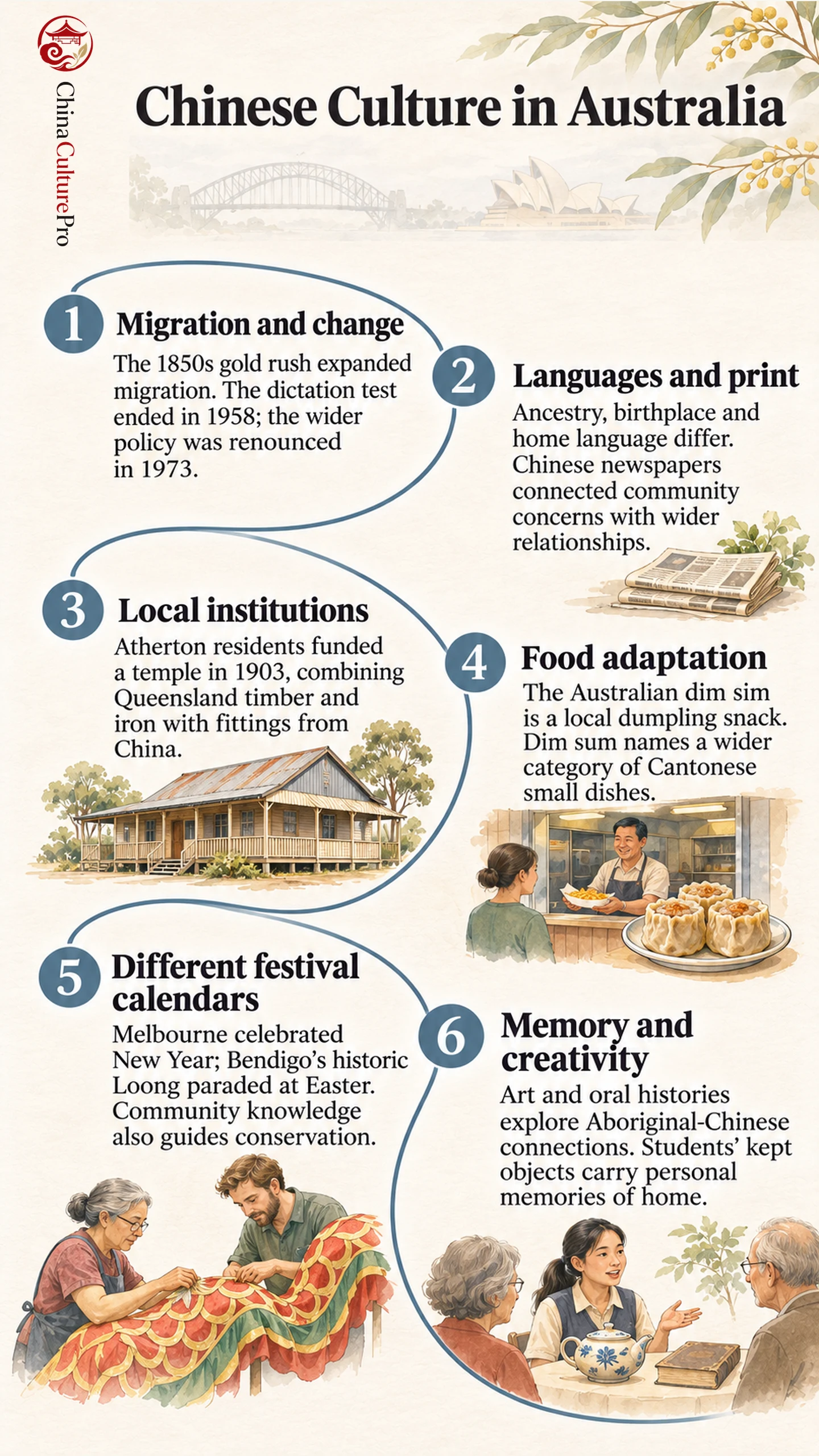
A timber temple in Atherton, a Melbourne takeaway snack and a dragon associated with Bendigo’s Easter fair reveal distinct local histories. Exploring these examples within Chinese diaspora culture shows how heritage develops through Australian places, institutions and everyday encounters.
Migration, Exclusion and Changing Opportunities
The gold rush of the 1850s brought many Chinese people to Australia. Mining communities formed across Victoria and New South Wales, with later gold discoveries drawing people to Queensland.[1] Records also document Chinese settlers in Australia before 1848.[11]
Some miners returned to China; others stayed and moved into work such as market gardening. Their settlement histories belong alongside later migration routes, rather than standing for every Chinese Australian family’s experience.[4]
| Historical change | Meaning for migration |
|---|---|
| 1901 | The Immigration Restriction Act became a key instrument of the White Australia policy, including a discriminatory dictation test. |
| 1958 | The dictation test was abolished; the wider policy did not end in a single step. |
| 1973 | The Australian government definitively renounced the White Australia policy. |
These restrictions affected opportunities to enter Australia and maintain family connections. The sequence matters: ending one exclusionary mechanism and abandoning the wider policy were different developments.[2]
Languages, Newspapers and Different Family Histories
The 2021 Census treats ancestry, country of birth and language used at home as separate measures. Respondents could report up to two ancestries. Someone with Chinese ancestry need not have been born in China, and using English at home does not erase that ancestry.[3]
Mandarin and Cantonese (粤语, Yuèyǔ) appear as distinct home-language categories. Later migration also involved students, skilled migrants and people whose journeys included Southeast Asia. These histories help explain different language choices across generations; the census is a dated snapshot, not a test of cultural belonging.[3]
Chinese-language newspapers became particularly prominent from the 1890s to the 1940s. News, advertisements and shipping timetables connected local concerns with travel and distant relationships. Their language also reflects the Cantonese backgrounds of many earlier migrants, preserving evidence of community life beyond official immigration records.[4]
Community Institutions Beyond the Big Cities
Chinese community history extends beyond metropolitan Chinatown districts. In Atherton, Far North Queensland, residents of Cedar Camp contributed money to build the Hou Wang Temple (侯王庙, Hóuwáng Miào; Mandarin reading) in 1903. Donors’ names were recorded inside, making the building a record of collective support as well as a religious place.[5]
Its timber and corrugated iron were characteristic Queensland building materials. Many interior fittings, including carved work, the bell and metal vessels, were made in China and brought to Australia. The combination shows how a community used local resources while maintaining overseas connections.[5]
The temple was donated to the National Trust in 1979 and became the subject of conservation. It offers one local setting for Chinese religious and community practices, rather than evidence that all Chinese Australians share one faith or institution.[5]
Food Traditions and the Australian Dim Sim
Chinese restaurants became more widespread in suburban and regional Australia during the 1960s and 1970s. Their reach helps explain why food is a familiar point of contact with Chinese Australian life even away from historic community districts.[4]
The Australian dim sim is a useful example of food changing through migration. By the 1940s, Chinese Australian entrepreneurs were adapting Cantonese-style dumplings for local customers. Larger, meatier dumplings became takeaway foods, eventually familiar in fish-and-chip shops as well as other settings.[6]
Three Greek brothers bought a fish-and-chip shop in Shepparton in 1965 and served dim sims. That business history shows a Chinese-derived food entering another migrant family’s working life, rather than remaining within one community.[6]
An Australian dim sim names a particular adapted snack. Dim sum (点心, diǎnxīn; Mandarin reading) is a broader category of small dishes associated with Cantonese dining.[12] The similar English spellings can obscure that difference; neither term defines everything Chinese Australians cook or eat.
New Year Celebrations and Bendigo’s Easter Dragons
Chinese New Year (春节, Chūnjié) appears in public celebrations as well as family life. Melbourne’s Chinese Museum listed a dragon parade, Chinese New Year festivities, lantern making and Chinese calligraphy (书法, shūfǎ) for its February 2026 cultural showcase. The advertised program connected performance with hands-on cultural activities.[7]
Dragon processions also have other local calendars. Loong, a dragon made in Foshan and brought to Victoria by Bendigo’s Chinese community, appeared in Bendigo’s Easter fair until 1970. An Easter procession is not automatically a New Year celebration merely because it includes a Chinese dragon.[8]
Conservation gives this tradition another community role. A project described in 2023 involved cleaning, repair and stabilization of Loong’s fragile structure and surface. Members of the Bendigo Chinese Association worked alongside conservators, connecting specialist material care with community knowledge.[8]
Art, Oral History and Everyday Objects
Our Story: Aboriginal–Chinese People in Australia brought historical records, oral histories and contemporary artists into one exhibition project. Its themes included identity, survival and cultural connection, examining relationships extending from the gold-rush period into later life. The project makes Aboriginal–Chinese histories visible without reducing them to one family story.[9]
Everyday possessions offer another way to explore belonging. The Chinese Museum’s Belongings & Belonging project, listed for 1–15 November 2026, begins with objects international students brought to Australia and kept: books, utensils, teapots and jewelry. The objects connect their owners with hometowns, relatives, friends and remembered encounters.[10]
The project also advertised a story-sharing session for 8 November 2026, inviting the wider Chinese community to contribute an object and its personal history. This participatory approach gives recent arrivals a place in cultural documentation alongside older settlement records.[10]
FAQs About Chinese Culture in Australia
Did Chinese migration to Australia begin with the gold rush?
No. The 1850s gold rush greatly increased migration, but it should not be described as the first Chinese presence or the route taken by every family.
Do all Chinese Australians speak Mandarin?
No. Mandarin, Cantonese, English and other languages have different roles across households and generations. Ancestry does not establish someone’s fluency.
Is an Australian dim sim the same as dim sum?
No. The Australian dim sim is an adapted dumpling snack; dim sum covers a wider range of Cantonese small dishes. Similar names do not make them interchangeable.
Are all Chinese dragon parades New Year events?
No. Bendigo’s historic Loong appeared at its Easter fair. Identify the particular event and local history rather than assuming every dragon procession marks New Year.
Is Chinese Australian culture limited to inherited traditions?
No. Contemporary art, oral-history projects and the interpretation of everyday objects also contribute. Communities create cultural forms while passing on older practices.
Sources
[1] National Museum of Australia. Chinese Gold Miners
[2] National Museum of Australia. Ending the White Australia Policy
[3] Australian Bureau of Statistics. Cultural Diversity of Australia
[4] National Library of Australia. Chinese: Language in Print
[5] National Trust of Australia (Queensland). Hou Wang Chinese Temple and Museum
[6] Museums Victoria. Fusion, Feminism and Food
[7] Museum of Chinese Australian History. Dragon Parade, Chinese New Year Cultural Showcase
[8] Heritage Victoria. Introducing Loong, the Chinese Dragon
[9] National Museum of Australia. Our Story: Aboriginal–Chinese People in Australia
[10] Museum of Chinese Australian History. Belongings & Belonging
[11] National Museum of Australia. Early Chinese Migrants
[12] Hong Kong Tourism Board. A Beginner’s Guide to Dim Sum