


Quick Answer: Who Are the Buyei?
The Buyei people(布依族,Bùyīzú), also written Buyi or Bouyei in English, are an officially recognized ethnic group in China, concentrated in Guizhou. Their communities include speakers of regional Buyei varieties and practitioners of distinctive textile and performance traditions.[1]
Wax-resist cloth is a well-known part of Buyei culture, but it belongs alongside weaving, regional clothing, agricultural life, songs and gatherings. A useful introduction connects a practice with its locality and purpose, rather than treating one blue and white textile as a complete picture of the people.
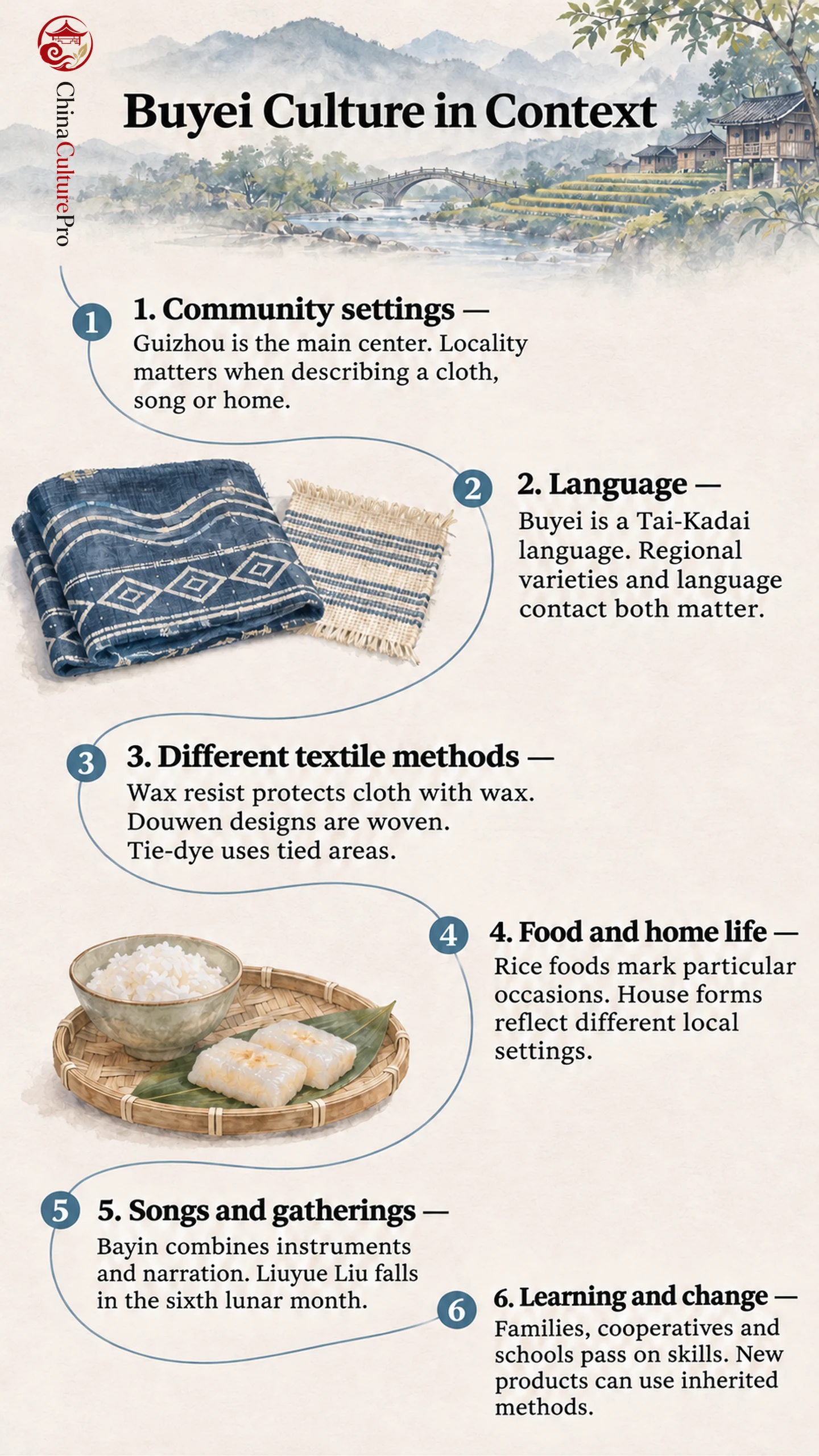
A blue and white cloth does not tell the whole story of the community that made it. Its pattern may come from wax applied before dyeing; another textile may carry designs formed on the loom. Following those differences leads into local speech, household skills and the gatherings where knowledge is shared.
Where Buyei Communities Live
Guizhou is the principal center of Buyei settlement, particularly the Qiannan and Qianxinan Buyei and Miao autonomous prefectures and areas around Anshun, Guiyang and Liupanshui. Buyei communities also live in Yunnan and Sichuan. Within Guizhou, river valleys, agricultural basins and mountain settings provide different local environments.[1]
This geography helps explain why a cloth, song or house needs a more precise location than an ethnic label alone. Anshun wax-resist work, Liuzhi woven cloth and Xingyi seated singing are useful starting points because each identifies a practice and a setting. They offer different ways into Guizhou’s cultural diversity, rather than three examples of an identical village life.
Language and Local Varieties
The Buyei language(布依语,Bùyīyǔ)belongs to the Tai-Kadai language family, also widely called Kra-Dai. It is a language in its own right, rather than a regional dialect of Chinese. A field-based grammar describes influence from Mandarin through language contact while distinguishing Buyei’s underlying linguistic structure.[2]
Chinese-language research commonly describes three regional varieties: Qiannan, Qianzhong and Qianxi, also numbered first, second and third. Language-resource surveys include sites in Longli, Zhenning, Weining and other localities. A description based on one survey point should therefore identify that point instead of claiming to represent every Buyei speaker.[3]
A Latin-based writing scheme was developed in 1956 and subsequently revised. That is a date in the history of modern orthography, not the beginning of the spoken language. Earlier ritual texts also used Chinese characters and adapted character forms to record sounds.[1]
When reading a translated song, look for the original language or variety and the translator’s explanation. English words alone cannot show how a local pronunciation, rhyme or expression worked in performance.
Wax Resist, Weaving and Regional Dress
In wax-resist dyeing(蜡染,làrǎn), a maker draws on cloth with wax before dyeing it. The wax protects selected areas; removing it reveals the contrasting design. The Anshun tradition includes both Miao and Buyei work. Its national heritage record was extended to Anshun in 2008, under project Ⅷ-25, rather than granting exclusive ownership of the method to one group.[4]
Other textile methods produce their designs differently.
| Method or cloth | How its design is formed | What distinguishes it |
|---|---|---|
| Wax-resist dyeing | Wax is drawn onto cloth before dyeing | Contrasting areas appear when the wax is removed.[4] |
| Douwen cloth(斗纹布,dǒuwénbù) | Dyed cotton warp and colored silk weft are worked on a loom | Its repeated square designs belong to woven structure, not a wax-drawn surface.[5] |
| Tie-dye | Selected parts of cloth are tied before immersion in dye | The tied areas resist the dye without a wax-drawing stage.[6] |
Shitouzhai(石头寨,Shítouzhài)near Zhenning is one documented setting for Buyei batik and weaving skills. Regional dress can combine several skills in one garment, with both pleated-skirt and trouser styles and different treatments of cuffs, collars and aprons. Festive outfits may carry more elaborate decoration than everyday clothing.[6]
For Chinese batik, the key distinction is a dye-resist process. For regional traditional dress, the useful questions also include how the cloth was cut, assembled and worn. Color alone cannot answer either question.
Rice Farming, Food and Home Life
Rice cultivation has been important in Buyei agricultural communities, alongside maize and other crops suited to local terrain. River valleys and basins help place that farming history, but they do not define every household’s present occupation.[1]
Glutinous rice connects food with particular occasions. New Year preparations include rice cakes, while seasonal gatherings may involve special rice foods. Accounts of the first-tasting harvest observance describe offering newly gathered grain to ancestors; its date follows local ripening rather than one fixed day everywhere.[7]
Traditional housing also has more than one form. Some descriptions distinguish full and partial raised-floor houses from ground-level homes. In parts of central Guizhou, locally available stone was used for walls and roofing. These are regional building responses, not evidence that every Buyei home must be a stone house.[7]
Guizhou cuisine provides the wider regional food context. Buyei household and ceremonial foods are best understood within that setting, with the occasion identified rather than a single obligatory menu attached to the ethnic name.
Song, Festivals and Community Gatherings
Bayin zuochang(布依族八音坐唱,Bùyīzú Bāyīn Zuòchàng)is a seated musical storytelling tradition associated with the Nanpan River area. Performers combine instruments with singing and narration. The heritage description distinguishes entering a character’s voice from stepping back to tell the story, so the performance is more than instrumental background music.[8]
The Xingyi project entered China’s first national intangible heritage list in 2006, as project Ⅴ-46. The designation concerns a specific performing tradition, not every kind of Buyei song.[8]
Liuyue Liu(六月六,Liùyuè Liù), the sixth day of the sixth lunar month, is another important community setting. In Hefeng, Kaiyang County, a local account describes a song gathering along the Qinglong River and participation from neighboring areas. It connects the occasion with a pause after busy rice-transplanting work and with offerings and hopes for a good harvest. Those hopes describe the meaning of the observance, not a proven agricultural effect.[9]
The festival’s songs and social gathering should not be equated with a single staged bayin performance. A full account identifies whether people are exchanging songs, narrating a story or taking part in a ritual, and whether the description concerns Hefeng or another community.
Craft Transmission in Changing Community Life
Douwen cloth offers a specific example of transmission through both families and new institutions. Wei Houzhen(韦厚珍,Wéi Hòuzhēn)of Niujiao Village in Liuzhi recalled older relatives giving douwen baby carriers as blessings. She established a cooperative in 2014, working with textiles, clothing and skills training; the published account also describes school teaching and contemporary garment and bag designs. Douwen weaving entered Liupanshui’s municipal heritage list in 2021.[5]
The municipal listing is separate from the national Anshun batik project. Together, these examples show why intangible cultural heritage needs both an exact project name and an explanation of how people continue to learn it.
A contemporary bag or classroom demonstration can carry an inherited skill without reproducing the original household object. To assess continuity, ask which materials, techniques and teaching relationships remain, and what the maker has deliberately changed.
FAQs About Buyei Culture
Are Buyei, Buyi and Bouyei the same name?
Yes. These are common English spellings referring to the same officially recognized ethnic group. A spelling difference alone does not identify a separate community.
Is the Buyei language a dialect of Chinese?
No. Buyei is a Tai-Kadai language. Contact with Chinese has influenced it, but borrowing and multilingual life do not make it a Chinese dialect.
Is all Buyei textile work batik?
No. Weaving, wax-resist dyeing, tie-dye and embroidery are different techniques, and a finished garment can combine several of them.
Do all Buyei people wear the same traditional clothing?
No. Regional styles, the occasion and individual choices matter. A festive outfit from one locality cannot stand for everyone’s everyday clothing.
Sources
[1] National Ethnic Affairs Commission. Buyei Overview
[2] Attasith Boonsawasd, Mahidol University. A Grammar of Bouyei
[3] Minzu University National Language Resources Monitoring and Research Center. Buyei Language Use, Development and Protection
[4] China Intangible Cultural Heritage Network. Batik Technique: Anshun Extension
[5] China Intangible Cultural Heritage Network. Buyei Douwen Cloth: Transmission and Innovation
[6] China Today. The Simplicity and Complexity of Bouyei Ethnic Group’s Clothing
[7] National Ethnic Affairs Commission. Buyei Customs
[8] China Intangible Cultural Heritage Network. Buyei Bayin Zuochang
[9] Kaiyang County Culture and Tourism Bureau. Buyei Liuyue Liu