


Quick Answer: What Does Brocade of Spring Show?
Brocade of Spring (锦春图, Jǐn Chūn Tú) shows two golden pheasants among flowering branches and pierced garden rocks. Its interest lies in the contrast between richly colored birds, delicate plants and the rocky setting.
- Artist: Giuseppe Castiglione, known in China as Lang Shining (郎世宁, Láng Shì Níng).
- Collection: National Palace Museum, Taipei.
- Medium: Ink and colors on silk, 169.2 × 95.2 cm.
- Look first: Compare the two birds, then follow the branches around and through the rocks.
The title evokes spring’s richness rather than describing a woven object.
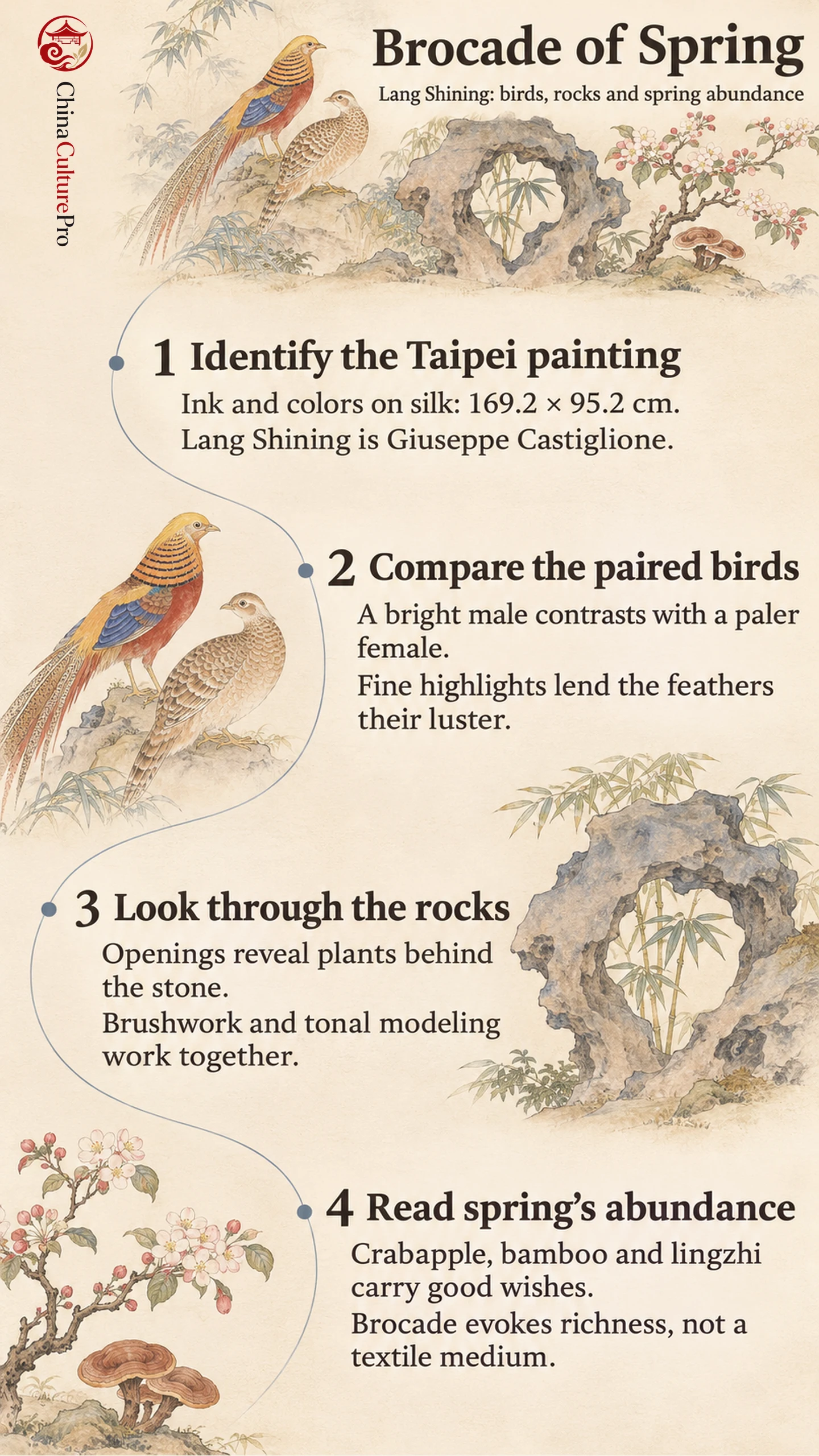
A long tail drops down the left side of the central rock. Above it, the male pheasant’s warm colors stand out against a quieter ground. The smaller, paler female rests farther right, near the rising stems and leaves.
The flowering tree spreads over both birds. Its branches extend into relatively open areas as well as dense clusters of plants, creating a scene that rewards looking beyond the brilliantly colored male.
Identify Brocade of Spring and Its Painter
The museum’s digital catalog calls this work Beautiful Spring; its 2015 English exhibition uses Golden Pheasants in Spring. The collection identifier is 故畫000956. It is a silk hanging scroll measuring 169.2 cm high by 95.2 cm wide. The recorded artist’s signature supplies no execution year. [1]
Lang Shining (郎世宁, Láng Shì Níng) was the Chinese name of the Italian Jesuit painter Giuseppe Castiglione. He reached China in 1715 and served at the Qing court under the Kangxi, Yongzheng and Qianlong emperors. The museum places his career within exchanges between European training and Chinese court painting. [4]
The Qing dynasty guide supplies the broader historical setting. For this painting, the most useful question is how different ways of making forms convincing operate together on one silk surface.
Keep the artist, material and dimensions beside the translated title when comparing reproductions. Different English names can refer to this same object; a familiar phrase alone is less reliable than the collection record.
Compare the Two Golden Pheasants
The male is the immediate color accent. His crest rises above a warm neck, while darker and brighter feather areas alternate across the body. The long tail carries the eye downward from the perch, breaking up the broad face of the rock.
The female has a much quieter presence at the right. Compare her smaller, rounded silhouette with the male’s more extended outline. Compare the pale female against the plants at the right before returning to the male’s brighter outline.
The museum draws attention to white highlight lines that give the male’s feathers their luster. Its Chinese exhibition text specifically notes the absence of his cast shadow on the ground; it also describes light-and-dark modeling in the flowers and fungus. These are distinct observations, not a claim that the whole painting lacks shading. [2]
In an enlarged image, compare a bright feather edge with a darker area beside it. Then step back to the whole bird. Tiny accents can make individual feathers more legible while the larger color divisions keep the body recognizable from farther away.
The bird-and-flower painting guide explains the larger subject tradition. Here, the paired birds work within a constructed garden scene: their perches, nearby foliage and unequal visual emphasis matter as much as their identification.
Look through the Garden Rocks
The large central rock is not simply a solid pedestal. Its irregular openings interrupt the colored surface, while the surrounding ridges and hollows give the eye several routes through the middle of the composition.
The museum notes that crabapple and bamboo behind the rock remain visible through its holes. It contrasts the landscape’s Chinese brush-and-ink handling with the carefully modeled plants and birds. The exhibition introduction also includes this painting among collaborative court works, without naming a particular collaborator for its rocks. [2]
Choose one aperture and compare what appears inside it with what appears just outside. A branch glimpsed through an opening occupies a different position from a stem crossing the rock’s outer edge. Both can remain part of one continuous plant.
Follow a hard rock contour toward an area where foliage interrupts it. The boundary may disappear briefly, then become visible again. Those interruptions help distinguish overlapping layers without filling the entire background with distant scenery.
At the bottom, the slopes and water provide another change of direction. Compare their lower movement with the upright bamboo and the long, descending tail. Compare those directions with the flowering branches spreading across the open upper area.
The painting-techniques guide provides vocabulary for line, color and washes. Use those distinctions to compare neighboring passages here, rather than assigning every individual mark to a named hand.
Read Spring Abundance and Courtly Wishes
Flowering crabapple (海棠, Hǎi Táng) spreads above the birds, while bamboo and lingzhi (灵芝, Líng Zhī), the fungus associated with longevity, join the garden imagery. The museum interprets these elements as auspicious wishes for good fortune and long life, with abundant blossoms evoking spring’s brocade-like splendor. [3]
“Brocade” therefore directs attention to richness and variety: many blossoms, contrasting feathers and a setting filled with different forms of growth. Compare the density of flowers with the sharply differentiated feather colors to test that textile metaphor against the image.
Look from a cluster of pale flowers to the saturated male bird, then to the less conspicuous plants near the rocks. The scene’s abundance depends on different degrees of visibility. Some elements announce themselves immediately; others require a closer view.
These wishes belong to the image’s cultural meaning. They do not by themselves identify an individual recipient, a particular birthday or a documented event in a real garden. A precise commission would require evidence beyond the motifs alone.
The inscriptions-and-seals guide explains how written and collecting evidence can supplement looking. Return afterward to the contrast that makes this scene distinctive: brilliant feathers held within a much larger arrangement of flowering branches, hollow rocks and quieter plants.
FAQs About Brocade of Spring
Is Brocade of Spring a woven textile?
It is an ink-and-color painting on silk. “Brocade” belongs to the title’s comparison of spring abundance with rich patterned fabric.
Is an exact painting date known?
The cited collection entry does not state an exact execution year. Dates attached to other paintings by Castiglione should not be transferred to this scroll.
Are the birds peacocks?
They are golden pheasants, identified by the museum as a male and female pair. The male’s long tail should not be mistaken for a peacock’s display.
Sources
[1] National Palace Museum. Beautiful Spring: digital collection record
[2] National Palace Museum. Golden Pheasants in Spring: Tributes to Realism for Imperial Review, Chinese exhibition text (2015)
[3] National Palace Museum. Digital Exhibition: Auspicious Animals (2023), Brocade of Spring entry
[4] National Palace Museum. Portrayals from a Brush Divine: exhibition introduction (2015)