


Quick Answer: Who Was Bayan of the Yuan?
Bayan (伯颜, Bóyán, c. 1236–1295) of the Mongol Baarin (八邻部, Bālín Bù) was a commander and statesman under Kublai Khan (忽必烈, Hūbìliè). He led the Yuan campaign that took the Southern Song capital of Lin’an (临安, Lín’ān), modern Hangzhou, in 1276.[1][2][3]
- His rise: He came to Kublai’s court as an envoy from the realm of Hülegü (旭烈兀, Xùlièwù) and stayed in Kublai’s service.[1][2]
- The turning point: The Song court at Lin’an surrendered in 1276. Other Song leaders continued resistance until 1279.[3][5]
- The shared name: Another Bayan, from the Merkid, served in a later phase of the Yuan dynasty and was removed from power in 1340.[6][7]
The commander of the 1270s is the subject here. The two men appear in different chapters of the dynastic history.
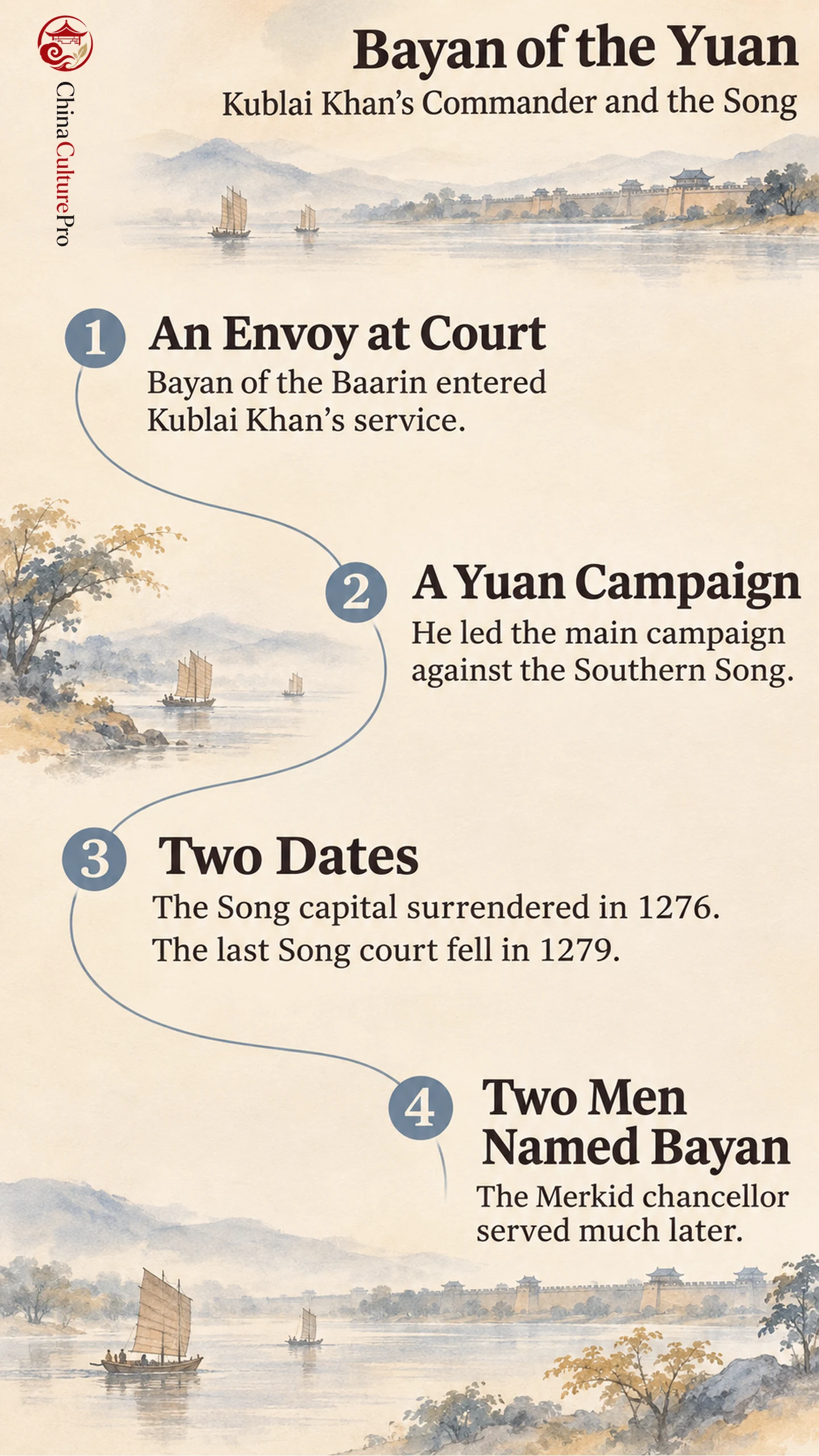
Two dates explain Bayan’s role in the conquest of the Southern Song. The first is 1276, when the Song court at the capital yielded. The second is 1279, when the last Song court was defeated. The gap shows what one commander could achieve by taking the capital and how much still depended on events outside it.
From Hülegü’s Realm to Kublai Khan’s Court
The History of the Yuan (元史, Yuánshǐ) places Bayan’s early life in the western part of the Mongol world. It describes his arrival on an assignment from Hülegü and says Kublai decided to retain him. In the years that followed, Bayan held senior posts at the court and in military administration.[1]
The early record is uneven. Chinese and Persian sources differ on details about his father, and the circumstances behind his dispatch to Kublai are uncertain. The accounts agree sufficiently to trace the broad move from one branch of the Mongol empire to another. From that point, his rise can be followed through his appointments at Kublai’s court.[2]
For the ruler who appointed him, see Kublai Khan. The History of the Yuan presents their first meeting as an early sign of Bayan’s ability. The later offices give firmer evidence of how much authority he came to hold.[1]
What Bayan Did in the Southern Song Campaign
Kublai placed Bayan in overall command of the expedition that set out from Xiangyang (襄阳, Xiāngyáng) in 1274. Aju (阿术, Āshù) commanded another major part of the force. In 1275, Yuan forces defeated the Song commander Jia Sidao (贾似道, Jiǎ Sìdào), a defeat that opened the way for the Yuan advance toward the capital.[3]
The biography’s account of Changzhou (常州, Chángzhōu) adds a different result from the surrender at the capital. The city resisted, Yuan forces captured it, and the chronicle reports a massacre. Its account of the next year reports that Bayan barred his soldiers from entering Lin’an.[1]
Read the two episodes together. They show different outcomes under the same commander. A report of restraint at the capital tells a reader something about the transfer there. It gives little basis for assuming what people experienced in other cities.
Why the Capital’s Surrender Was a Turning Point
In 1276, Grand Empress Dowager Xie (谢太后, Xiè Tàihòu), the young Emperor Gong (宋恭帝, Sòng Gōngdì) and officials at Lin’an yielded to the Yuan. The dynastic history records the transmission of the imperial seal. The surrender changed the political position of officials and districts that had answered to the Song court.[1][4]
Some members of the royal family and their supporters had already escaped to the south. They continued to claim Song authority. The final defeat of the remaining court came in 1279, three years after the surrender at Lin’an.[1][5]
The Song dynasty and Yuan dynasty guides place those events in their separate histories. A dynasty timeline helps explain why the Yuan’s establishment, the capture of the Song capital and the last Song defeat appear under different dates. For a different kind of Song history, the account of Bi Sheng’s movable type follows a technical change recorded long before the conquest.
Bayan remained in Yuan service after the southern campaign. His biography describes later duties on the northern frontier and his role in supporting the accession of Temür (铁穆耳, Tiěmù’ěr) in 1294. Bayan died the following year.[1][2]
How to Tell the Two Bayans Apart
The other Bayan came from the Merkid and rose to power in the court of Toghon Temür (妥懽帖睦尔, Tuǒhuān Tiēmù’ěr). His nephew Toghtō (脱脱, Tuōtuō) removed him from office and sent him into exile in 1340.[6][7]
If a source mentions Kublai, the capture of Lin’an or the Baarin, it is describing the earlier commander. If it mentions the chancellorship under Toghon Temür and the removal in 1340, it is describing the Merkid official. The History of the Yuan treats the two men separately in volumes 127 and 138.[1][6]
That chapter check is a practical way to read dynastic biographies alongside other Chinese historical figures. Romanization can change, and the same Chinese characters can still refer to different people.
FAQs About Bayan of the Yuan
Did Bayan end the Southern Song in 1276?
Bayan secured the surrender of the capital and the court there in 1276. Song loyalists remained active elsewhere until the final defeat in 1279.[3][5]
Is Boyan another name for Bayan of the Baarin?
Yes. Boyan represents the Chinese reading of the characters used for Bayan. Check the clan and dates because the later Merkid official is recorded with the same name.[1][2][6]
Where can you read the historical biography of Bayan?
Read volume 127 of the History of the Yuan for Bayan of the Baarin. Francis Woodman Cleaves published an English translation of the biography in 1956.[1][8]
Sources
[1] History of the Yuan. Volume 127, Bayan of the Baarin
[2] Soyoung Choi, Journal of Asian Historical Studies. Research on the Early Career and Family of Bayan
[3] Cambridge University Press. The Cambridge History of the Mongol Empire, Campaign Excerpt
[4] Journal of Chinese History. Dynastic Transition and Local Experience
[5] Richard von Glahn, Cambridge University Press. The Heyday of the Jiangnan Economy
[6] History of the Yuan. Volume 138, Bayan of the Merkid
[7] John Dardess, The Cambridge History of China. Shun-ti and the End of Yuan Rule
[8] Francis Woodman Cleaves, Harvard Journal of Asiatic Studies. The Biography of Bayan of the Bārin in the Yüan Shih