
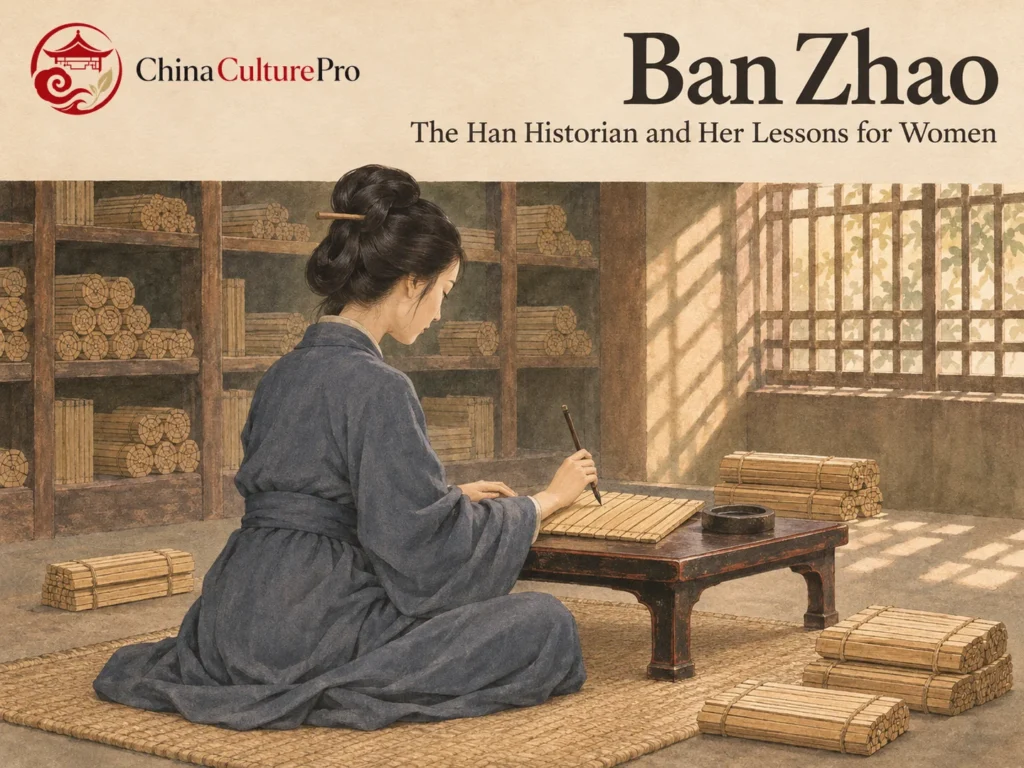

Quick Answer: Who Was Ban Zhao?
Ban Zhao (班昭, Bān Zhāo) was an Eastern Han historian, teacher and writer, born around 45 CE. She continued the unfinished Book of Han (汉书, Hànshū), taught at court and wrote Lessons for Women (女诫, Nǚjiè), a seven-chapter work addressed to young women in her family.[1][2][4]
- Historical work: Emperor He (汉和帝, Hàn Hédì) gave her access to the imperial archives after the death of her brother Ban Gu (班固, Bān Gù).[1]
- Court work: She taught palace women and advised Empress Dowager Deng (邓太后, Dèng Tàihòu).[1][3]
- Education: Her lessons argue that girls should be taught while assigning wives and husbands unequal roles.[4]
Read her biography, her advice and her other writing together. Each comes from a different setting and addresses a different audience.
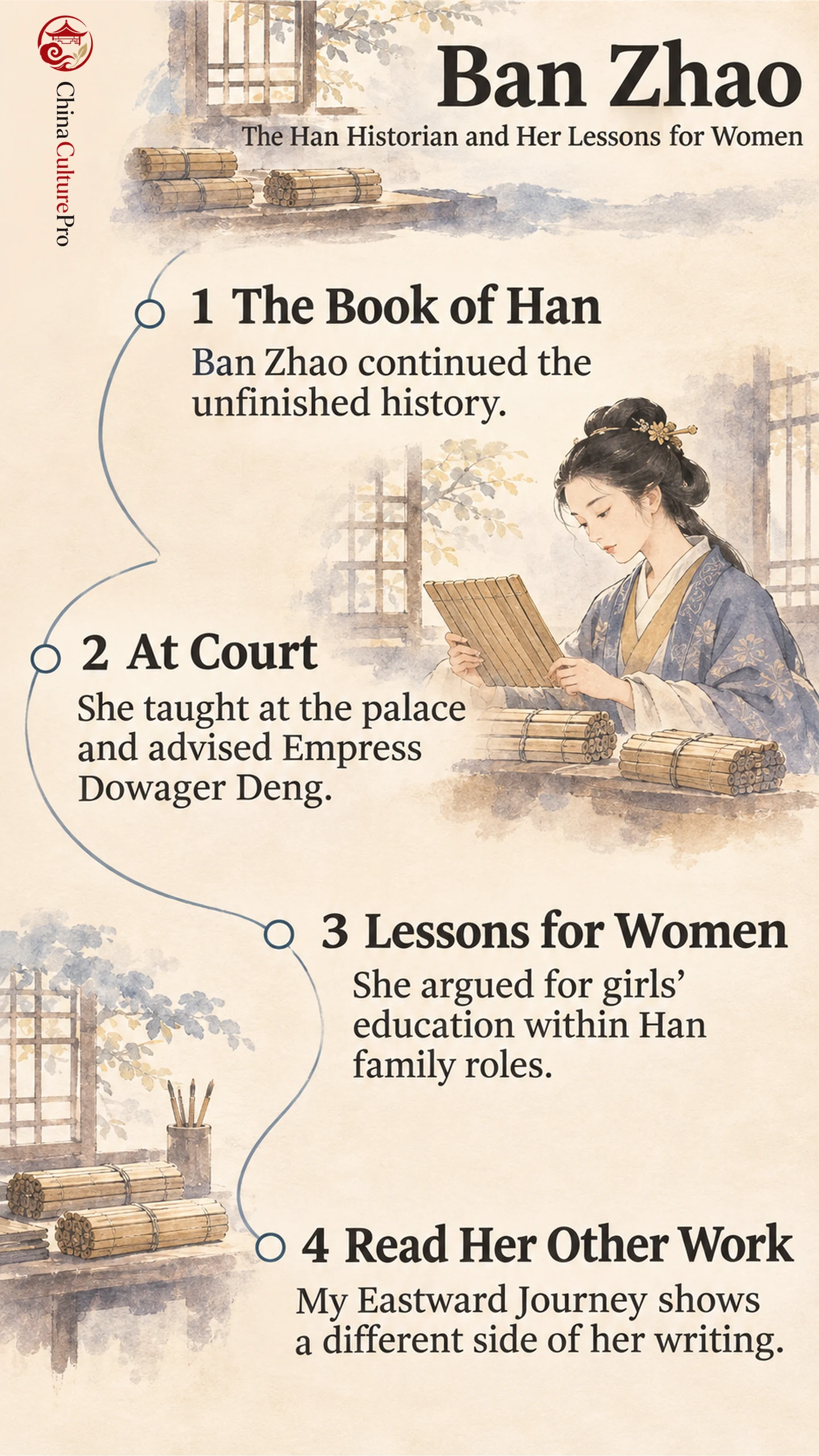
Two kinds of teaching appear in Ban Zhao’s surviving record. One involves readers trying to understand a dynastic history. The other begins with a woman writing for family members about to marry. The audiences help explain why the same scholar could be trusted with imperial documents and make an argument for girls’ learning in a book about domestic life.
How Ban Zhao Continued the Book of Han
Ban Zhao grew up in a family of scholars and received an education in the classics. Her father Ban Biao (班彪, Bān Biāo) had written historical work that helped inspire the larger project taken up by Ban Gu. He died in 92 CE before the received history was complete.[3][8]
The Book of Later Han (后汉书, Hòu Hànshū) identifies the eight tables and the astronomy treatise as unfinished and records Emperor He’s order granting Ban Zhao access to the imperial collection. The tables are an integral division of the book, placing information about rulers, officials and other people into a form that can be compared across time.[1][8]
Ma Xu (马续, Mǎ Xù) also contributed to the work’s completion. The records establish Ban Zhao’s role in continuing the history, while the precise division of labor for every unfinished passage is harder to assign. The Han dynasty guide distinguishes the Western Han that the book covers from the Eastern Han in which its compilers lived.[1][8]
What Her Court Role Involved
The later biography calls her Cao Dagu (曹大家, Cáo Dàgū), a title of respect used for her at court. It records that the palace called her in to instruct the empress and other women, and that the scholar Ma Rong (马融, Mǎ Róng) studied the newly circulating history with her.[1]
Under Empress Dowager Deng, Ban Zhao took part in discussions of affairs at court. This put her in a position to offer advice beyond the work of explaining texts. The court access documented here shows one way a learned woman could exercise authority. Her classical training and relationships at court helped make that unusual position possible.[1][3]
Her different audiences matter. A reader who knows Ban Zhao only as a writer of family advice can miss that she also interpreted a difficult history for other scholars. The biography offers a starting point for considering whose work the official records preserve in the wider history of women in China.
What Lessons for Women Actually Argues
The preface gives the book a specific audience. Ban Zhao says that young women in her household are approaching marriage, and she wants them to have their own copies to read and use. The seven chapters address subjects including conduct, marriage and relations with in-laws.[4]
In the section on husband and wife, Ban Zhao asks why people teach boys but overlook girls. She appeals to a ritual precedent that puts early instruction at eight and further study at fifteen. She uses a familiar rule of instruction to argue that girls deserve teaching too.[4]
In the same passage, her case for teaching girls assumes that wives will serve husbands and that husbands will direct wives. Other chapters counsel deference to in-laws and discuss virtue, speech, appearance and work. To understand the argument in its setting, read what education was expected to make possible within Confucian family relationships.[4][5]
How to Read Her Literary Legacy
Start with the preface and the husband-and-wife chapter. Then compare them with My Eastward Journey (东征赋, Dōngzhēng Fù), a literary composition written in connection with a journey accompanying her son to an official post. The travel piece gives Ban Zhao a different reason to speak about family, memory and public duty.[7]
The later Four Books for Women (女四书, Nǚ Sìshū) included her lessons alongside works from other periods. The collection took shape in the late Ming and circulated in later editions. Its wider instructional audience helps explain why a text addressed to family members acquired a public role.[6]
For a comparison across Chinese literature, Bing Xin also wrote to young readers, in the very different setting of modern print culture. Consider what each writer assumes about the people she addresses and what she hopes her readers will be able to do with what they learn.
FAQs About Ban Zhao
Was Ban Zhao the first female historian in China?
She is often described as China’s first known woman historian. The surviving record documents her work on the Book of Han and her teaching. Her position is unusually well attested for a woman of that era.[1][2][3]
Did she write the entire Book of Han?
Ban Gu was the principal compiler. Ban Zhao continued the unfinished history after his death, and Ma Xu also contributed. Her role belongs to the book’s completion and early transmission.[1][8]
Are Lessons for Women and Admonitions for Women the same text?
Yes. They are English titles for Ban Zhao’s seven-chapter Nüjie. It later appeared within the larger collection called the Four Books for Women.[4][5][6]
Sources
[1] Fan Ye. Book of Later Han, Chapter 84
[2] Ann A. Pang-White, Cambridge University Press. Reappraising Ban Zhao
[3] Stanford Encyclopedia of Philosophy. Gender in Confucian Philosophy
[4] Ban Zhao. Lessons for Women, Chinese Text
[5] UCLA Center for Chinese Studies. Lessons for Women, English Selections
[6] Zhang Mingqi, Kenyon College. Four Books for Women
[7] Xiaofei Tian, Cambridge University Press. Chinese Travel Writing
[8] Michael Loewe, Editor. Early Chinese Texts: A Bibliographical Guide, Han Shu