

Quick Answer: What Happened at the Battle of Yamen?
The Battle of Yamen (崖门海战, Yámén Hǎizhàn), also called the Battle of Yashan, was the naval defeat of the Southern Song (南宋, Nán Sòng) by the Yuan (元, Yuán) in 1279. It took place near present-day Jiangmen in Guangdong. The defeat ended the remaining Song court. [1][2][3][6]
- Before the battle: The Song capital had fallen, but a court continued along the coast.
- At Yamen: Yuan forces defeated the Song fleet that protected the court.
- After the battle: No functioning Southern Song court survived to continue the war. [1][3][4]
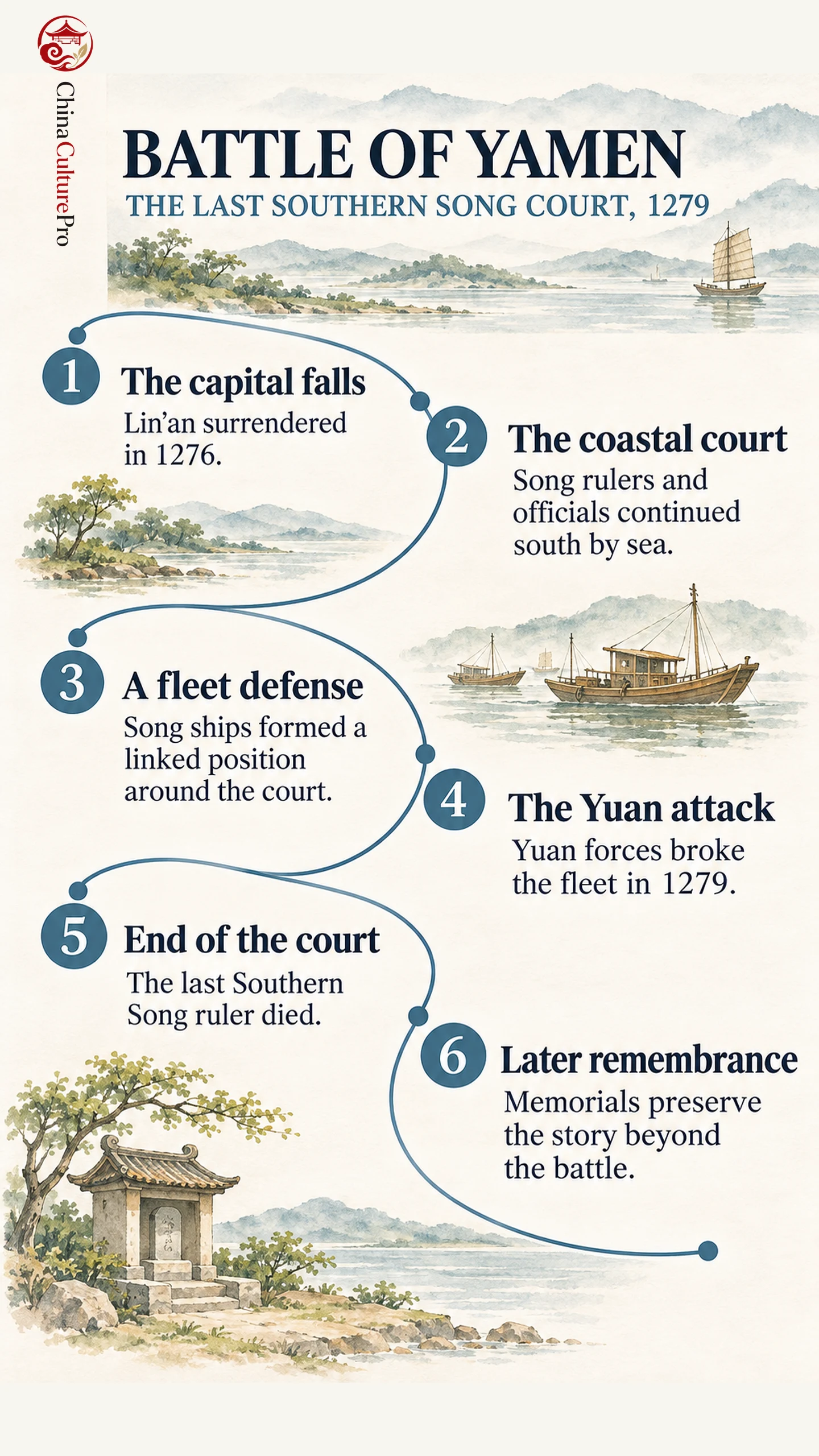
The capital surrendered in 1276. The coastal court remained until 1279. [1][4]
At Yamen, ships carried a government as well as the forces that defended it. The fate of the ruler and officials therefore depended on the same fleet that fought the battle. That is why a victory on the water had an immediate political consequence.
Why the Southern Song Court Was at Sea
The capital Lin’an (临安, Lín’ān), now Hangzhou, surrendered in 1276. The capture of the ruler there did not end resistance. Song officials took two young princes south, first establishing a court in Fujian and then moving along the coast as Yuan forces advanced. This final phase followed the loss of the capital in the wider history of the Song dynasty. [1][4][5]
After the death of Emperor Duanzong (宋端宗, Sòng Duānzōng) in 1278, Zhao Bing (赵昺, Zhào Bǐng) succeeded him. The court’s movement by sea let it remain outside Yuan control for a time. It also made access to protected anchorages, supplies and usable routes increasingly important. At Yamen, defending the fleet meant defending the court itself. [1][4]
How the Yuan Broke the Song Fleet
Song commander Zhang Shijie (张世杰, Zhāng Shìjié) gathered ships into a linked formation around the ruler. The arrangement concentrated defense. It also made dispersal and retreat more difficult once the Yuan pressed the position. The received accounts describe Yuan forces cutting the Song fleet’s access to fresh water and supplies before the final attack. [1][2][7]
The fleet that defeated the Song was led by Zhang Hongfan (张弘范, Zhāng Hóngfàn). Yuan success at sea depended on naval skills and personnel assembled during the conquest, including people with experience from the territories it had taken. The Yuan naval build-up began years before Yamen. Under Kublai, the Mongol government had appointed officers to train others in naval service, drawing on expertise already available in China. Both fleets depended on experienced sailors and officers. [2][3]
The extended account describes an unsuccessful Yuan attempt to use fire against the linked Song ships, followed by pressure from more than one direction. A Yuan force led by Li Heng (李恒, Lǐ Héng) joined the operation. The account describes attacks from the north and south. The failed fire attack and the final assault are separate episodes. The linked formation was able to resist the first. Once the Yuan tightened the blockade and pressed the ships from several directions, the same arrangement left the defenders with fewer options. The attack eventually broke the formation. Once individual ships and crews could no longer act together, the same fleet that had protected the court offered fewer ways to escape. [1][2][7]
What the Sources Say About the Last Emperor
The History of Song (宋史, Sòng Shǐ) relates that the official Lu Xiufu (陆秀夫, Lù Xiùfū) took the child emperor into the water when escape seemed impossible. The History of Yuan (元史, Yuán Shǐ) recounts the victory through the career of the opposing commander. Read the two texts for what each emphasizes: the loss of a court and the defeat of a fleet. [1][2]
The Song annals report a vast death toll after the battle. The number has been repeated in retellings, but an account of bodies found afterward is a different kind of evidence from a count of everyone present. The historical tradition describes a mass loss of life. The precise toll remains uncertain. [1][7]
Why Yamen Marks the End of the Southern Song
The death of the child emperor ended the remaining Southern Song court. The Yuan dynasty already existed by then, and the victory completed the military destruction of its dynastic rival. Some people connected with the defeated court left the region. Studies of refugees in Annam and Champa follow part of that history beyond the battle. They show why the coastal flight belongs to the history of migration as well as the history of conquest. [1][3][4][5]
At modern Yamen, memorials and rites keep the episode present in regional culture. The site includes a shrine, while some families with ties to Guangdong and Fujian visit to commemorate Empress Dowager Yang (杨太后, Yáng Tàihòu). These practices are evidence of how the story has lived on locally. The shrine and rites document later remembrance. It does not settle the position of an individual ship or authenticate every detail of a narrative written after the conquest. [6]
FAQs About the Battle of Yamen
Are Yamen and Yashan the same battle?
Yes. Battle of Yamen and Battle of Yashan are English names for the final Song–Yuan naval battle of 1279. Yaishan is another spelling found in scholarship. [3][6]
Where was the Battle of Yamen fought?
It was fought in the Yamen area of present-day Xinhui, Jiangmen, on the Guangdong coast. This identifies the area, rather than the exact positions of all the ships. [1][6]
Did the Southern Song end in 1276 or 1279?
1276 dates the surrender of Lin’an. The remaining Song court continued along the coast and fell at Yamen in 1279. [1][4][5]
Sources
[1] Toqto’a and others. History of Song, Volume 47: Annals of the Last Song Rulers
[2] Song Lian and others. History of Yuan, Volume 156: Biography of Zhang Hongfan
[3] Bruce A. Elleman. Battle of Yaishan (1279)
[4] Hok-Lam Chan. Chinese Refugees in Annam and Champa at the End of the Sung Dynasty
[5] Journal of the Royal Asiatic Society. The Last Days of the Song Dynasty
[6] Jiangmen Municipal Government. Song–Yuan Naval Battle at Yamen
[7] Hu Cuizhong. Continuation of the History of Yuan, Volume 2